
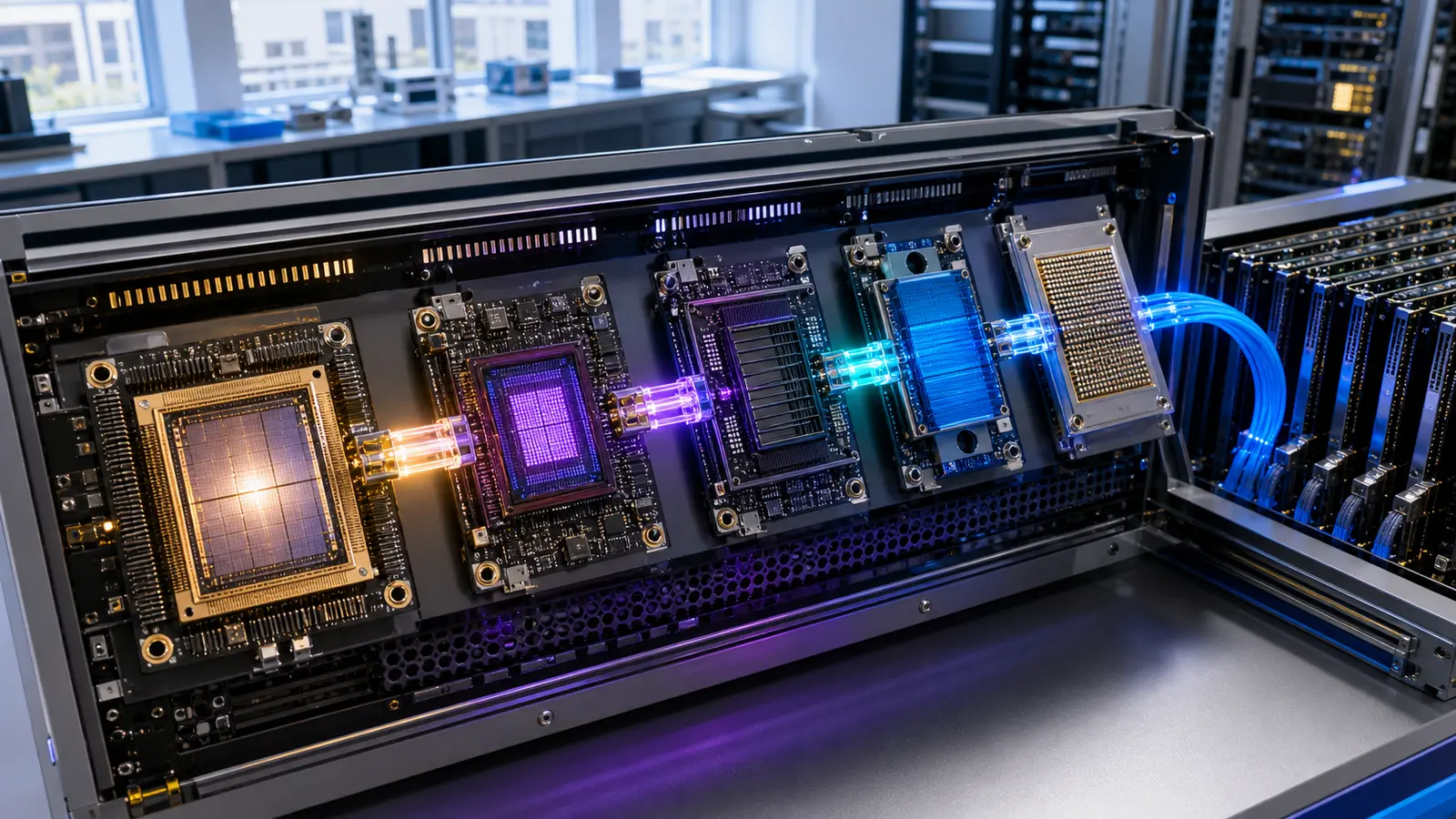
LONDON — August 15, 2026 — OLIX has raised $312 million in Series B financing at a $3.3 billion valuation to develop specialized computing systems for frontier artificial-intelligence inference. The company is building its X-1 platform as a rack-scale production line in which different chips handle distinct stages of generating model output.
The round includes Fundomo, Arm and Hudson River Trading, alongside angel investors including Reed Hastings. Existing investors Hummingbird Ventures, Crane, Plural, Creandum, Phoenix Court and Transition increased their commitments. Professor Nick McKeown has joined the board of directors.
Replacing one general-purpose processor with a production line
OLIX argues that generating an AI token is not a single uniform operation. Different stages place different demands on memory, movement of data and arithmetic. Running every stage on the same type of accelerator can leave expensive hardware waiting or performing work for which it is not optimized.
The X-1 architecture distributes a model across specialized chips while retaining flexible computing fabric for changing model designs. Optical interconnects move data directly between modules using light rather than relying only on copper. The company explains this approach in its official inference-computing manifesto.
What the financing supports
- DX-1 accelerator: complete the first chip focused on the decode stage where a model reasons and produces output.
- X-1 racks: integrate chips, optical links, memory, compilers and scheduling as one system.
- Manufacturing: secure supply-chain and production commitments required for customer-scale hardware.
- Software: develop deterministic compilers and tools that distribute workloads across racks.
- Team growth: expand silicon, photonics and systems engineering in the United Kingdom and North America.
A design aimed at inference cost and responsiveness
OLIX says DX-1 will hold model data in fast on-chip static memory to reduce latency and energy use. The design avoids advanced packaging and high-bandwidth memory, two components facing industry supply constraints. The company targets high output per user together with improved token throughput per watt.
The claims will need validation on production workloads. AI models change quickly, customers use different software stacks and rack-scale systems must deliver reliability as well as benchmark performance. OLIX's task is to prove that specialization creates a durable advantage without sacrificing flexibility.
The financing announcement, board appointment and product schedule are detailed in the company's official Series B statement. Capital is intended to take DX-1 to first customers in the second half of 2027 and fund the broader custom-silicon platform.
Building a supply chain before customer delivery
Semiconductor development requires spending long before product revenue. Design verification, fabrication capacity, optical components, boards, cooling and system assembly must align for a rack to ship. The $312 million round gives OLIX resources to make those commitments while the product remains in development.
Commercial progress will be measured by successful silicon, compiler readiness, system power consumption and customer tests. Delivery dates and manufacturability matter as much as theoretical performance because inference buyers plan facilities and capacity years in advance.
OLIX was founded in London in 2024 by James Dacombe. It is hiring across London, Bristol, Austin, Toronto and San Francisco as it moves from architecture and prototypes toward customer systems.
About OLIX
OLIX is a computing company designing infrastructure for frontier AI inference. Its systems combine specialized chips, lasers, optical networking and rack-level software to produce model output with high throughput and lower energy cost.
Company contact
OLIX Computing Limited
London, United Kingdom
Media: press@olix.com
Website: www.olix.com







ADI News
Leave a comment