
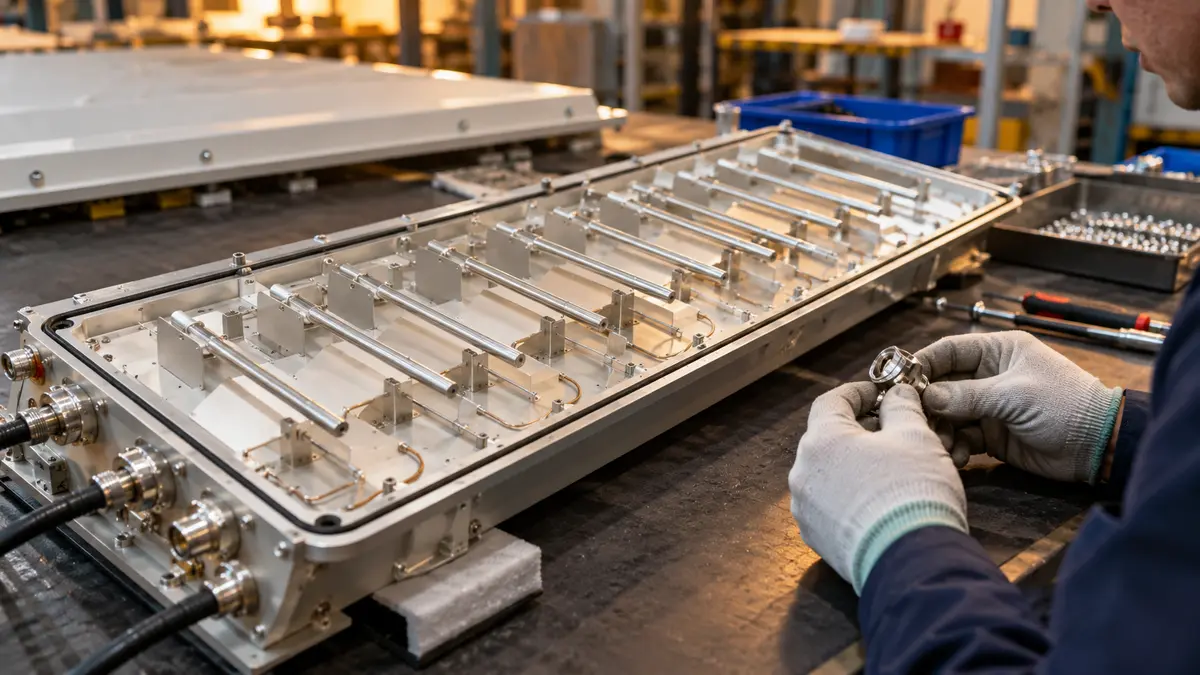
Ericsson reported on 7 October 2026 that antennas manufactured in India are being exported to Europe and other markets. Its production ecosystem had made more than 15,000 antennas and 25 million components since July 2025. The Economic Times carried the announcement in a PTI report from the India Mobile Congress, where company executives discussed manufacturing, network capabilities and the next generation of mobile communications.
How the manufacturing programme developed
The production milestone followed an expansion announced on 22 April 2025. Ericsson then identified VVDN Technologies as its partner for local passive antenna manufacturing. India would join a manufacturing footprint already including Mexico, Romania and China. The company said it intended to localize all passive antenna production for the Indian market by June. It described the investment as an effort to bring development closer to regional customers, collaborate with suppliers and provide equipment for both domestic deployment and international orders.
A second announcement, dated 30 June 2025, introduced the first India-manufactured antenna model intended for global export. The company placed the commercial release in June and the start of international shipments in July. More than half of the antenna content was already produced locally, according to the release. The programme included engineering and sourcing alongside production. Ericsson said its next phase would develop engineering capabilities for regional adaptation and global demand, with the exported equipment subject to the same company standards as products for domestic operators.
The manufacturer's 2025 antenna catalogue describes the range behind these production programmes. It lists 208 products and separates passive antennas, products for special environments, antenna line devices and installation accessories. Its categories cover multiband base stations as well as railways, tunnels, cities and indoor locations. The catalogue also identifies electrical and mechanical development priorities: lower passive intermodulation, improved beam efficiency, lighter structures, wind-load optimization and remotely controlled electrical tilt. These are specifications and design claims from the supplier, describing equipment offered to operators.
Ericsson's 12 February 2025 portfolio announcement placed antennas within a larger equipment renewal. Seven new radios arrived alongside indoor equipment and fronthaul products. Interleaved antennas combined low-band equipment with multiple-input, multiple-output radio systems in one physical footprint. The company presented that configuration as a way to reduce installation and rental requirements. Its new antenna portfolio included the Antenna 4818, with specified electrical and beam efficiencies of up to 85 percent. The release also emphasized lighter equipment, passive cooling and recyclable materials.
Network effects described by the supplier
In a technical news article published on 27 March 2025, Ericsson explained why it was emphasizing passive antenna design. Its portfolio covered frequencies from 600 megahertz to six gigahertz and supported several transmission and beamforming arrangements. The company described signal patterns, interference and power requirements as interconnected parts of antenna performance. It cited joint work with ABI Research on improvements in throughput and energy use. Mikael Eriksson, head of the antenna business, said the company researched and simulated network effects rather than relying solely on product data sheets.
Domestic operators provide the deployment background
An earlier deployment announcement illustrates the scale of the Indian radio market. On 26 February 2024, Ericsson said it had installed 100,000 Massive MIMO radios for Bharti Airtel across 12 telecom circles in more than 500 days. Airtel had over 65 million customers using its 5G network at that point. The equipment programme included radio access products and microwave transport. The two companies also described joint testing with Qualcomm of reduced-capability equipment, intended to extend the types of devices supported by mobile networks.
Airtel extended the relationship on 4 December 2024 through a multiyear agreement covering 4G and 5G radio access products. Ericsson described the contract as worth multiple billions of US dollars. Its announced work included centralized radio access equipment, systems prepared for Open RAN and software upgrades for existing 4G radios. Airtel's chief technology officer, Randeep Sekhon, said the deployment would improve network speed, coverage and reliability. The release placed those objectives within a partnership that had already lasted more than 25 years.
Vodafone Idea provided another domestic procurement channel. Ericsson announced additional 4G and 5G contracts with the operator on 7 October 2024. The supplier would upgrade existing areas and take on Delhi, Kerala, Chhattisgarh and Rajasthan. The planned equipment included lightweight mid-band Massive MIMO radios with integrated antennas. Vodafone Idea chief executive Akshaya Moondra described the investment as modernization of the existing network and preparation for 5G deployment. The contracts therefore covered both established mobile services and the introduction of a newer network generation.
The subsequent launch in Delhi NCR was announced on 14 May 2025. Vodafone Idea deployed Ericsson's AIR 3268 and AIR 3255 radios for the service. The release said modernization had also replaced older 2G and 4G equipment in Delhi without interrupting the network. Vodafone Idea's chief technology officer, Jagbir Singh, presented the launch as part of the company's wider network upgrade. The announcement described completed work in the capital alongside a continuing deployment programme in other parts of the country, rather than a single nationwide completion date.
Indian operators were also testing applications beyond mobile handsets. On 21 February 2024, Airtel and Ericsson reported peak throughput of 4.7 gigabits per second in millimetre-wave testing. The demonstration concerned fixed wireless access, using mobile network technology to connect premises. Sekhon said the result supported Airtel's interest in serving users without accessible fibre connections. Ericsson described the 26-gigahertz demonstration as a step toward integration into a commercial network. The published speed was a test result, tied to the equipment and conditions of that demonstration.
Subscriptions and public manufacturing policy
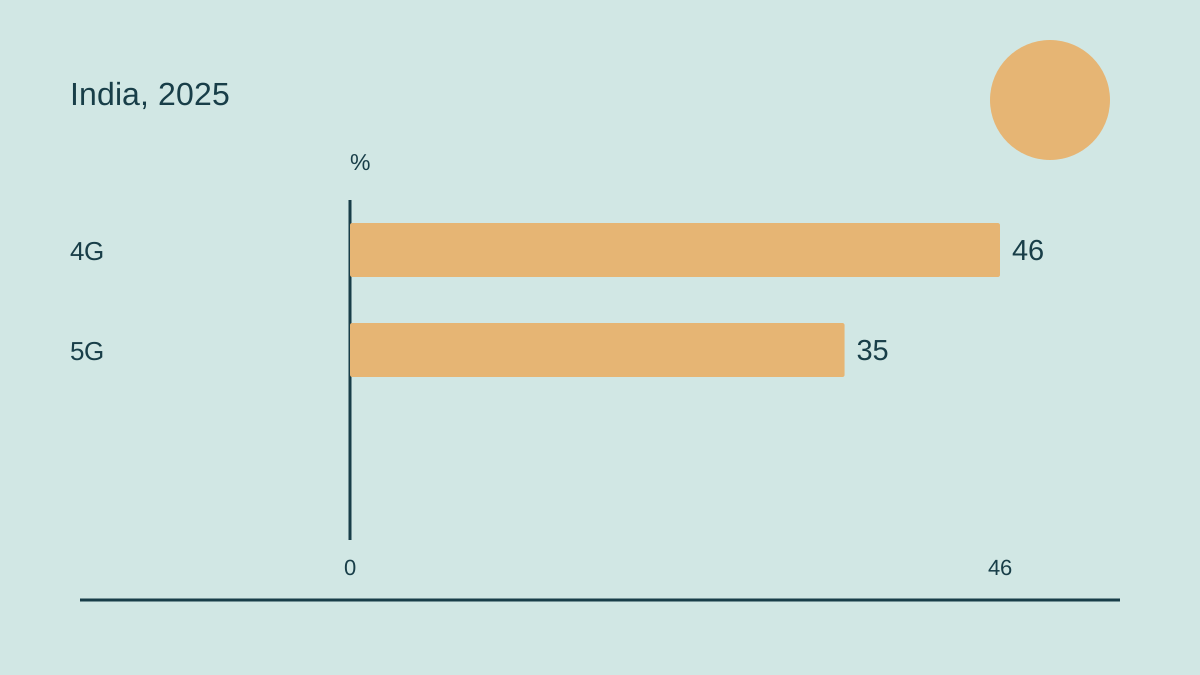
Ericsson's June 2026 Mobility Report measures domestic demand. It estimated 430 million Indian 5G subscriptions at the end of 2025, representing 35 percent of mobile subscriptions. Fourth-generation connections remained the largest group, at 46 percent. The company forecast more than 1.1 billion 5G subscriptions by the end of 2031. It associated adoption with affordable devices, expanding coverage and fixed wireless services. These figures distinguish historical subscriptions from the company's forecast.
Public policy adds another manufacturing context. The Department of Telecommunications' review, published on 19 December 2025, reported cumulative investment exceeding 4,646 crore rupees under the telecom production-linked incentive scheme. Sales exceeded 96,240 crore rupees, including exports of 19,240 crore, as of 30 September 2025. The scheme had operated since April 2021 and incentivized additional investment and turnover. The department reported 29,574 jobs within the programme. These are sector-level administrative figures covering participating production activities, rather than sales or employment attributable to Ericsson's antenna operation.
The workforce programme announced on 21 May 2026 addressed installation and maintenance skills. Ericsson and the Telecom Sector Skill Council planned ten laboratories serving approximately 100 industrial training institutes and 10,000 students. Each participant would receive 60 hours of specialized training. The proposed roles included wireless technician, fibre installer and 5G infrastructure technician. At least one fifth of participants were intended to be women. The partners described the programme as preparation for employment and entrepreneurship, with hands-on exposure to telecom infrastructure and emerging technologies.
Examples of antenna demand outside India
A European example appeared on 12 February 2024, when Vodafone Romania selected Ericsson as a 5G radio access partner under a six-year agreement. The contract combined deployment of new services with improvement of the operator's existing mobile network. Ericsson Antenna System products were part of the announced equipment portfolio. Vodafone's network chief Nicolae Vîlceanu associated the investment with future standalone services, lower latency and more varied uses. The agreement sits within a multiyear Romanian infrastructure programme, separate from the later announcement about exports from Indian production.
Specialized antenna applications were described in Germany on 9 May 2025. Ericsson and Vodafone announced five tunnel-optimized antennas in the 1,400-metre Arlinger Tunnel near Pforzheim. The equipment supported multiple frequency bands and services from 2G through 5G. Its aerodynamic form was designed to handle air pressure changes and vibration. Vodafone's Marc Hoelzer explained that passing vehicles move air masses that can affect antenna structures. The operator intended to extend this approach to additional tunnels as part of its coverage programme.
In Australia, Optus and Ericsson announced an antenna agreement on 13 June 2025. The planned equipment was tailored to the operator's coverage, capacity and energy requirements. Optus network executive Kent Wu said field trials had supported improvements in spectral use and network efficiency. The company also expected stronger indoor and outdoor signals in the areas receiving the equipment. The announcement described an operator-specific deployment programme and its anticipated benefits, giving a commercial example of the antenna business beyond the Indian domestic market.
Telstra's 2 June 2025 announcement concerned a different equipment configuration: the AIR 3284, combining three frequency-division duplex bands with Massive MIMO. Ericsson said early commercial deployments were operating in Brisbane suburbs, with Melbourne expansion planned. The supplier associated the design with additional uplink and downlink capacity and relief of congestion across spectrum layers. Telstra's Ash Hunter placed the radio within a four-year transformation programme. The announcement described a named commercial deployment and equipment-specific performance claims, rather than a general speed achieved by every customer.
Another Telstra project, announced on 23 January 2025 with MediaTek and Ericsson, achieved a peak downlink speed of 9.4 gigabits per second on a live commercial standalone network. A noncommercial laboratory configuration exceeded ten gigabits. The demonstration combined several spectrum layers and radio products at Telstra's Gold Coast innovation centre. The partners explicitly said ordinary customer speeds would not reach the record figure. They described the work as increasing network capacity, with compatible devices and deployed frequencies determining the experience available in particular locations.
Programmable networks and engineering capability
Hardware development ran alongside a software programme announced on 31 October 2024. Ericsson introduced seven 5G Advanced subscriptions covering automation, positioning, mission-critical services, differentiated connectivity, energy management, premium performance and device battery use. The company said the software could operate with Open RAN, cloud-based and purpose-built radio networks. Availability was scheduled from the third quarter of 2024 through the first quarter of 2025. The stated approach used service-level agreements to connect network behaviour with operator objectives, including different performance requirements for different applications.
On 16 October 2024, Ericsson said it was recruiting engineers in India to work on network application programming interfaces. Its research sites in Chennai, Bengaluru and Gurugram covered transport, packet core, operational systems, cloud and artificial intelligence. The company described interfaces that would give developers access to capabilities such as quality on demand and network slicing. Its Indian teams also contributed to an internal language-model platform for telecom tasks. Ericsson presented that work as part of making mobile infrastructure programmable for new services.
A collaboration announced with Telstra on 7 October 2025 focused on how such infrastructure would be operated. The partners proposed work on translating business objectives into network actions, organizing fragmented data and making automated decisions understandable. Their programme combined a technology laboratory with demonstrations intended to validate proposed solutions. It also included a knowledge layer for monitoring and controlling the network. Telstra architect Mark Sanders emphasized experiments in real environments and industry standards. The agreement was a research and validation framework for autonomy, with future industrialization among its objectives.
Ericsson had established its India 6G research team in Chennai on 28 October 2023. The team would collaborate with researchers in Sweden and the United States, including work on channel modelling, hybrid beamforming, lower-energy networks, cloud computing and integrated sensing. Other planned projects covered explainable algorithms and autonomous management. Research head Magnus Frodigh said the programme would incorporate Indian needs into international technology development. The announcement distinguished research on future communications from commercial network equipment already being deployed for fourth- and fifth-generation services.
A related academic partnership preceded that team. On 25 September 2023, Ericsson joined the Indian Institute of Technology Madras' Centre for Responsible AI under a five-year agreement. The company would support and participate in the centre's research. Topics presented at the associated symposium included interpretable algorithms, participatory governance and coordination between automated management loops. Frodigh emphasized trust, fairness and privacy in future networks. The partnership brought university research into the supplier's wider radio, cloud and automation work, with responsible design an explicit subject of the collaboration.
International standards retain their own timetable
The International Telecommunication Union published its 6G framework on 1 December 2023 following approval of Recommendation M.2160. The framework identified 15 capabilities, nine derived from fifth-generation systems. Its proposed uses included immersive communication, highly reliable low-latency services, broader coverage, large numbers of connected devices, artificial intelligence and integrated sensing. The ITU said the subsequent process would define technical requirements and evaluate candidate radio interfaces. It described the prospect of technology standards approved by 2030, providing an international programme beyond any individual company's product announcements.
The next step was reported by the ITU on 17 March 2026. Its Working Party 5D had agreed draft performance requirements in February, including 20 requirements, seven specific to new 6G capabilities. Formal approval by the parent study group was expected in December. The ITU said the requirements would provide a common basis for evaluating candidate technologies. It explicitly distinguished these minimum evaluation levels from guaranteed performance in real deployments. Sustainability, security, resilience and connecting underserved users remained overarching principles of the framework.
Applications demonstrated alongside manufacturing
Ericsson's Innovation Challenge, announced on 2 July 2026, invited Indian startups, researchers and academic institutions to develop applications using 5G, cloud services and connected devices. Partners IAN Mentoring and Incubation Services and TiE Delhi-NCR would provide evaluation and mentoring. The selected areas were:
- Healthcare
- Agricultural productivity
- Environmental sustainability
- Digital inclusion
- Advanced manufacturing
Applications closed on 22 July, with shortlisted teams offered venture-building support. The programme planned to present winning solutions at the India Mobile Congress, connecting the infrastructure supplier with developers working on potential uses for its networks.
At the congress on 7 October, Ericsson presented six selected startups alongside its network demonstrations. Its account described assistive reading, drone logistics, oral-health screening, aerial connectivity, hands-free industrial interfaces and agricultural assistance. Separate exhibits showed mission-critical services and a tethered drone carrying radio equipment to extend coverage. The manufacturing zone highlighted local radio, antenna and semiconductor engineering capabilities. The company presented these demonstrations as applications and development activities within its Indian ecosystem, alongside the cumulative production and export announcement issued the same day.






ADI News
Leave a comment