
IKEA’s planned online buyback test raises a wider business question: how should a retailer connect a marketplace it facilitates with inventory it buys itself? Sarah Butler’s reporting provides the starting point. The distinction matters because facilitating a sale and becoming the buyer produce different responsibilities, cash movements and evidence of commercial success.
This analysis examines the relationship between those channels through five connected questions: who owns the item, what marketplace activity measures, how product information reduces work, where transport creates costs, and how the retailer should judge results. The evidence is available as of 7 October 2026. Company figures below retain their stated periods and definitions; the interpretation of their business implications is our analysis.
A new connection between two kinds of transaction
Ingka Group announced planned buyback integration in Portugal/Spain by December’s end and marketplace expansion into the UK/Ireland. Development and transformation manager Emily Birkin described the next tests.
A hybrid channel gives the owner two economically different routes. A sale to another household requires a match between that household’s requirements and the particular item. A sale to the retailer requires a purchasing decision that takes account of what the retailer can subsequently recover. Neither route eliminates assessment of condition, but the identity of the party doing that assessment changes. For analysis, the important transition is therefore the point where responsibility for the physical product passes from its present owner.
That transition should be separated from the creation of an online listing. A listing describes an intention to sell; an offer describes a proposed bargain. Neither proves that the product has changed hands. Counting all three as the same event would obscure how much of the service is discovery and how much is inventory acquisition. A meaningful commercial model needs records that distinguish listing creation, offer acceptance, inspection, transfer and eventual resale.
Seller convenience becomes an inventory decision
Ingka opportunity leader Malin Cleverdal explained in a July 2025 company interview that marketplace inventory remained with sellers. She contrasted that arrangement with retail inventory control and described the seller journey as a new customer relationship. Her account is a useful operational perspective, rather than independent evidence that the business has solved every resale problem.
For a retailer, taking ownership of a used item creates exposure that does not arise merely from displaying its listing. The retailer must find somewhere to put it, determine what preparation is justified and choose a resale price. If the item remains unsold, space and handling continue to be consumed. This follows from holding physical inventory; it does not establish IKEA’s actual handling costs or margins, which the announcements do not disclose.
The decision can be expressed without inventing a numerical model. Expected proceeds must be considered alongside acquisition, inspection, preparation, storage and selling costs. A purchasing team needs a view of those components before accepting stock. A marketplace team instead needs to understand whether an available item can attract a suitable buyer. Shared software can make the two routes easier to discover while preserving these separate decision criteria.
Seller choice also has a time dimension. An owner may value the ability to complete a transfer within a known period, even if another buyer might eventually offer more. However, certainty has value only when the service can actually deliver it. Until inspection, eligibility and payment conditions are clear, an online indication should not be treated as a guaranteed final settlement. That is a practical distinction between interest in an offer and completion of the transaction.
Traffic, listings and sales answer different questions
Ingka reported 15 million visits and 95,700 listings across six markets through 31 August 2026. January’s separate ambition was 170,000 listings during 2026. Activity and planned output must be distinguished from completed sales.
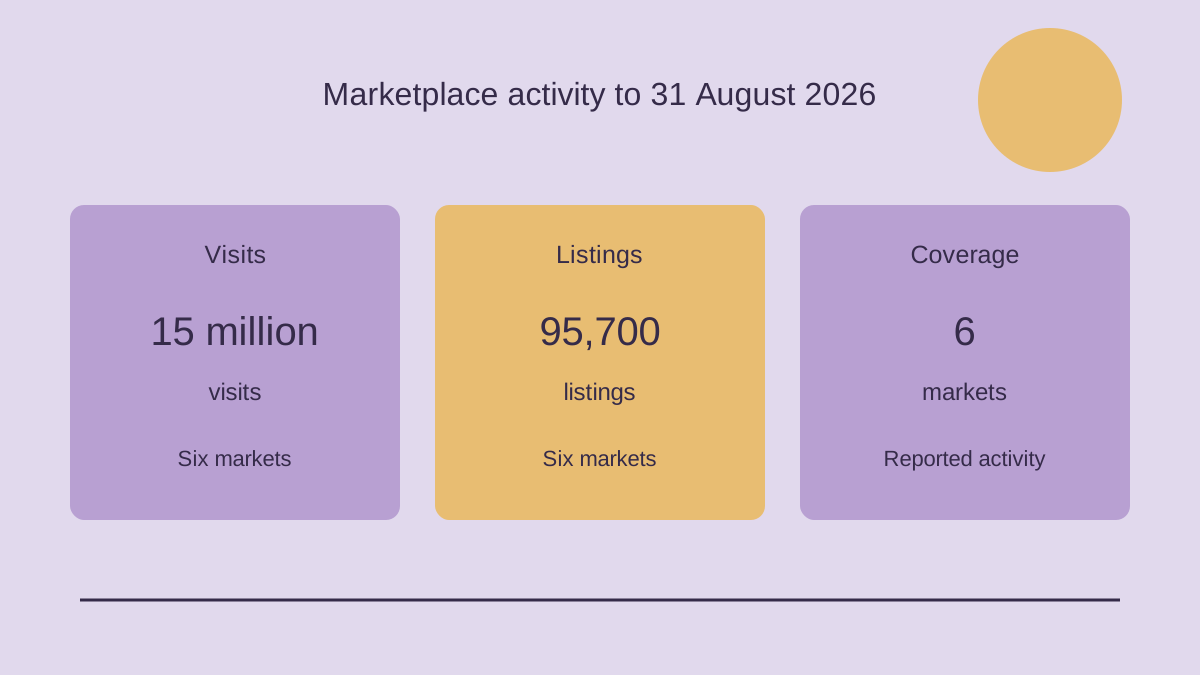
The information supports an assessment of reach and supply creation, but not a conversion rate from visitor to buyer. Visits can include repeat browsing, while a listing can remain active, expire or be withdrawn. Dividing one reported aggregate by another would produce an arithmetic ratio whose commercial meaning depends on definitions absent from the releases. It would not reveal how many people purchased furniture or how quickly owners sold it.
The January ambition and the August cumulative figure also need compatible reporting boundaries before any comparison can establish progress against a target. A year-specific target may differ from a cumulative count; coverage can change when markets open. A useful dashboard would identify the period, markets, counting method and status of each item. This enables a manager to distinguish genuine supply growth from a change in measurement.
For the hybrid model, conversion should be traced separately for household buyers and retailer offers. Strong acceptance of buyback offers could show demand for a convenient exit route even where household-to-household matching remains slow. Conversely, a busy marketplace might need little retailer purchasing. Measuring the channels separately would reveal which service people use, instead of allowing one form of activity to mask weaknesses in another.
Product knowledge can reduce search work
Ingka’s January announcement described product identification, measurements, recommended prices and supporting assembly information. It placed the planned Sweden launch on 28 January. Kirsten Andersson, managing director for platforms and marketplaces, associated the service with easier access to pre-owned products.
Standard product information and individual condition information perform different functions. Dimensions help a buyer decide whether an item fits a room or can pass through an entrance. Instructions can explain how the original design is assembled. Neither establishes that a particular used unit includes every component or remains undamaged. A reliable listing needs both the model description and evidence about the object being offered.
This separation helps explain why a retailer’s catalogue can be commercially useful beyond the initial sale. Reusing established descriptions reduces the work of identifying a model and communicating its basic characteristics. The remaining work concerns the item’s history and present state. Better standard information can focus a buyer’s questions on those remaining uncertainties, rather than forcing every seller to reconstruct the specification from memory.
Suggested prices should likewise be understood as decision support. A recommendation is different from a binding offer and from an achieved selling price. The seller still has to consider condition and the available alternatives. For a purchasing team, a model’s recognition does not remove the need to assess the specific unit. Information quality can improve the decision process without guaranteeing either demand or resale value.
Transport determines whether a match becomes a transfer
Ingka also identified a live TippTapp delivery trial in Portugal and Sweden. Its announcement contains no complete cost schedule.
Furniture exposes the difference between discovering something online and obtaining it physically. Buyers need to know whether collection is possible and whether the item can be moved in its current form. The relevant questions concern access, size, lifting, disassembly and coordination. A successful digital match can still fail if those questions are resolved only after the parties have committed to a purchase.
For a peer-to-peer route, transport connects two households. For a retailer-buyback route, transport may first connect the owner with a retail receiving point, followed by another movement to the next owner. These are different paths, and a service should evaluate them separately. The shorter path is not automatically the cheaper one: accessibility, load combination and the preparation required can alter the work involved. Actual comparisons require operating data.
A useful measure would therefore track the proportion of agreed transactions that reach physical handover, with reasons for cancellation recorded. That would distinguish a pricing problem from a collection problem. It would also show whether delivery assistance expands the set of feasible purchases or simply moves a cost from one participant to another. The commercial question is completed service at an acceptable cost, rather than the mere presence of a delivery button.
Refund cards link disposal with a future purchase
The January marketplace announcement offered a choice of cash or a digital IKEA refund card with a 15% uplift. The nominal difference is clear, but its value to an individual depends on whether that person intends to use the retailer’s products again.
For the seller, unrestricted money and retailer credit have different uses. A person expecting another furniture purchase may find the credit attractive. Someone disposing of furniture without a replacement requirement may prefer money that can be spent elsewhere. Treating these choices as identical would miss the role of future consumption in the decision. The option has to be understood within the seller’s own plans.
For the business, store credit can connect the departure of one item with a later visit or order. That creates an opportunity to observe a longer relationship rather than one isolated transaction. It does not show that every recipient makes an incremental purchase: some could have bought from the retailer anyway. Establishing additional commercial value would require evidence about subsequent behaviour and the costs associated with the incentive.
Evaluation should therefore separate uptake of credit, redemption, incremental buying and total contribution. These are related stages, but each answers a different question. A large nominal card balance is not the same thing as an improvement in profit. A well-defined trial can examine whether the incentive changes participation, whether it attracts suitable resale stock, and whether the resulting customer relationship supports its cost.
Existing buyback activity supplies operational context
In its January 2025 report on FY24, Ingka said it bought back more than 495,000 used products from around 260,400 customers. It also described resale areas in 365 stores and over eight million free assembly parts provided to 2.2 million customers. FY24 covered September 2023 through August 2024.
Those indicators refer to separate services and units. Product counts describe items acquired; customer counts describe participants; store counts describe locations. Assembly parts belong to a repair-support activity. Adding these numbers together would create a total with no consistent operational meaning. Their value lies in showing the different capabilities that can support continued product use, each with its own measurement boundary.
The established retail route matters because a hybrid marketplace does not begin with software alone. Receiving goods, checking them and making them available again involve physical routines. Integrating a digital offer with those routines requires a shared understanding of eligibility and status. The offer displayed to a seller, the assessment at receipt and the subsequent inventory record must refer to the same item.
Repair assistance can also support a different outcome from resale. Retaining a product in its current home may meet the owner’s need without any transfer at all. That gives the retailer several possible responses to a product reaching a new stage in its life. A useful analysis keeps maintenance, ownership transfer and material recovery distinct, rather than describing all activity as one undifferentiated circular transaction.
A comparison with Vinted clarifies the infrastructure question
Vinted’s 9 April 2026 results reported €10.8 billion in 2025 gross merchandise value, €1.1 billion in revenue and €62 million net profit. The company also described investment in shipping and payments. These are group figures, not a measure of furniture-market performance or a forecast for IKEA.
The comparison is useful because it separates value traded between members from money earned by the operator. Gross merchandise value describes the transactions passing through a marketplace; revenue and profit have different accounting meanings. Any assessment of furniture resale should make the same distinction. Listing value, completed sales and retailer income cannot be substituted for one another simply because they all appear in a business dashboard.
Vinted’s disclosed infrastructure investment illustrates a broader operational question: which supporting services should a marketplace provide itself, and which should it coordinate through partners? Furniture presents a different physical problem from easily packaged items, so the answer cannot be transferred unchanged. Nevertheless, payment reliability and handover reliability remain separate requirements that must both be addressed if a transaction is to succeed.
What would demonstrate a working hybrid model?
The next assessment should connect demand, operating work and customer outcomes. No single activity count can do that. A useful trial would maintain separate records for the marketplace route and the retailer-buyback route, with consistent definitions across locations and reporting periods.
- Completed transfers and time from listing to handover, rather than listings alone.
- Offer acceptance followed by successful inspection and settlement.
- Handling, preparation and storage costs for stock the retailer owns.
- Reasons for failed collections, withdrawals and cancelled transactions.
- Repeat use and subsequent purchases, distinguishing observed behaviour from additional commercial value.
Environmental assessment would require its own evidence. Another owner using a product demonstrates a transfer, but the release alone does not quantify avoided production, replacement purchases or transport emissions. Extending useful life is the relevant objective; establishing the environmental effect requires a defined comparison and information about what would otherwise have happened.
The proposed connection is commercially interesting because it combines two approaches to finding the next user of an existing product. Its strongest potential advantage is a more complete seller journey, supported by product knowledge and physical retail capability. Whether that becomes a durable business depends on completed transfers, disciplined inventory decisions and measurable customer value. The October announcement establishes the experiment; those outcomes will establish its performance.






ADI News
Leave a comment