
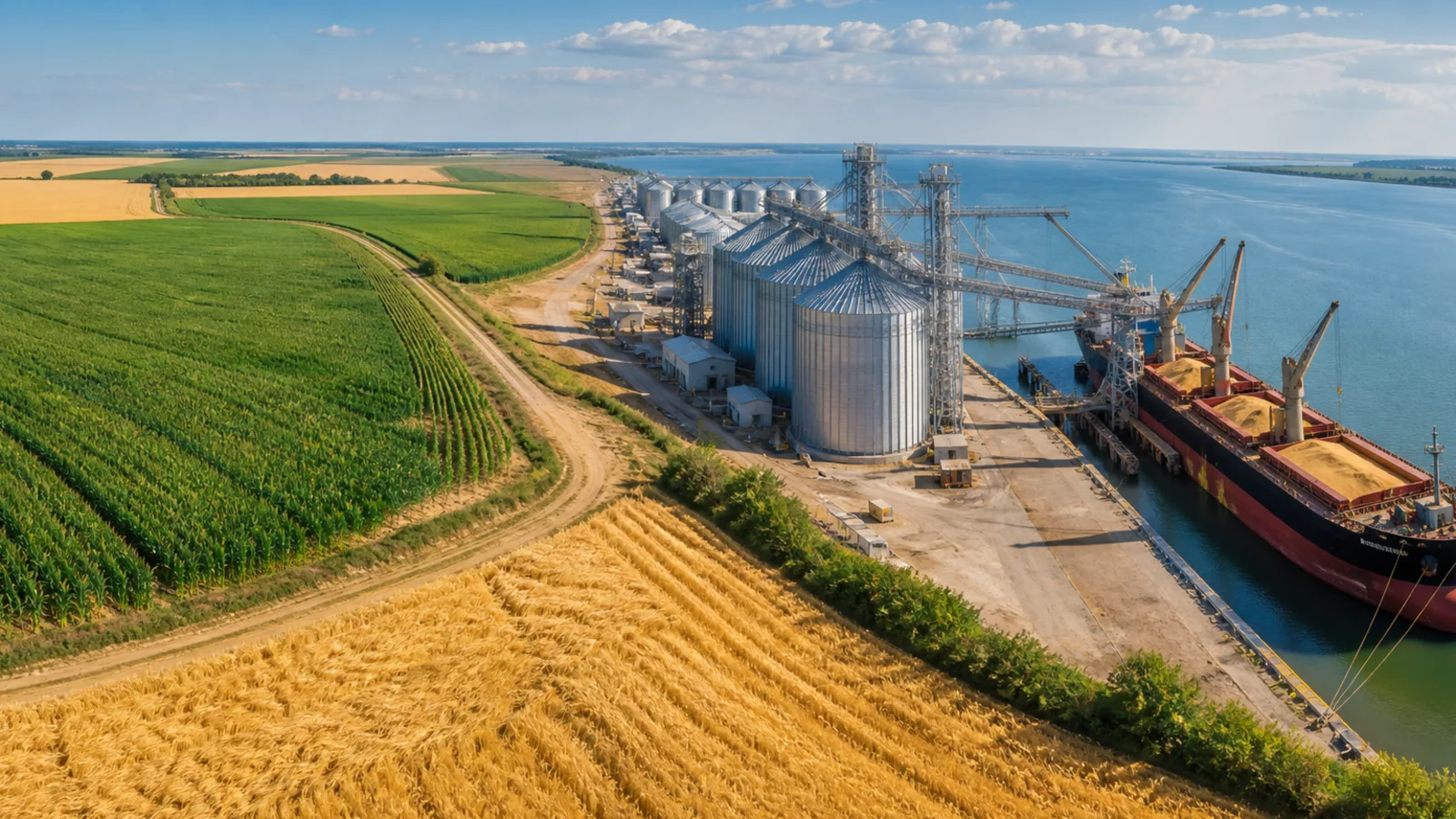
Grain markets can look distant from ordinary business until a price chart moves far enough to change the cost of bread, feed, transport, credit and public subsidies at the same time. In late August 2026, wheat and corn futures delivered that kind of signal. The move was not merely a speculative event on a trading screen. It exposed how weather, Black Sea risk, inventories, freight capacity and import dependence can combine into one operating shock.
Vedomosti reported on August 28, 2026 that December wheat futures in Chicago reached $7.67 a bushel on August 27, the highest level in three years. The previous session had already produced a three-year high of $7.214 after the contract exhausted its daily 45-cent upward limit. December corn reached $5.37 a bushel, also a three-year peak. March and May 2027 wheat contracts traded higher still, at $7.83 and $7.87, indicating that buyers were paying for risk beyond the immediate harvest window.
The central business question is not whether the quotation will rise or fall next week. It is how companies can protect physical supply and cash flow when a staple market reprices faster than annual budgets, customer contracts and government procedures. The answer begins by separating confirmed facts from scenarios, then connecting every scenario to an action.
A futures record is a warning, not a complete forecast
A futures contract is a standardized promise for delivery under defined conditions. Its price reflects expectations about future supply and demand, financing, storage and the value of flexibility. It does not say that every buyer will immediately pay the screen price. Local basis, quality, currency, freight and contract timing can move a physical transaction in a different direction. Management should treat the record as a warning that the distribution of possible costs has widened, not as a single invoice forecast.
The shape of the curve matters as much as the nearest price. When later wheat contracts stand above December, the market is charging more for time. That can reward storage, but only if the holder can finance inventory, preserve quality and access transport later. An importer may read the same curve as evidence that postponing coverage is not automatically cheaper. The decision must compare carrying cost with the cost of being uncovered, rather than rely on hope that prices will normalize.
Why wheat and corn moved together
Wheat and corn serve different food and industrial uses, yet they share acreage, fertilizer, freight assets and parts of the feed market. When corn becomes expensive, some feed buyers can increase wheat use; when wheat supply tightens, that substitution can reverse. A weather problem in one crop therefore changes demand for the other. Traders also rebalance portfolios across agricultural contracts, transmitting risk between markets before physical substitution is visible.
Heat creates several layers of pressure. It can reduce yield during critical growth stages, lower grain quality and increase irrigation or drying costs. Low river levels can restrict barge loads precisely when harvest movements accelerate. Hot weather can raise electricity demand and affect rail or port operations. A procurement model that represents heat only as a farm-yield variable misses the logistics and working-capital consequences downstream.
The Black Sea remains a systemically important corridor
The Black Sea connects major exporters with import-dependent markets around the Mediterranean, Middle East and Africa. A disruption does not have to eliminate all shipments to affect price. Higher insurance, slower inspections, vessel reluctance, damaged infrastructure or uncertainty over future access can increase the option value of grain available elsewhere. Buyers compete for alternative cargoes before a complete shortage develops.
Russia is a major grain exporter, so changes in its harvest, policy and port access matter beyond domestic agriculture. The practical lesson is to model the corridor as several connected capacities: farm output, elevators, rail, river, terminals, vessels and payment execution. A failure at any narrow point can leave ample grain stranded on the wrong side of the bottleneck.
Import dependence turns volatility into a policy problem
Vedomosti highlighted vulnerable Arab economies in Africa and Turkey as buyers of Black Sea grain. Import dependence becomes dangerous when three exposures coincide: a large share of staple consumption comes from abroad, purchases are denominated in hard currency, and retail prices are politically sensitive. A higher commodity quotation then combines with exchange-rate pressure, freight and subsidy costs.
The burden is rarely distributed evenly. Industrial millers may have hedges and credit lines, while small bakeries buy short and cannot absorb a sudden reset. Feed producers pass costs into poultry, dairy and livestock with a delay. Governments may cap retail prices, reduce tariffs, release reserves or subsidize flour, shifting expense from consumers to budgets or suppliers. Every intervention changes incentives, so emergency relief should include a clear duration and replenishment plan.
Price is only one component of landed cost
A procurement team should decompose landed cost into the commodity, basis, inland movement, terminal handling, ocean freight, insurance, financing, currency conversion, duties and quality adjustments. These elements do not move together. A falling futures market can be offset by a rising basis in a deficit region. Cheap grain can become expensive when a port queue or shallow river limits transport. A stronger seller currency can erase a dollar-price decline for a local buyer.
This decomposition prevents false confidence. If a company hedges only Chicago futures, it may still carry basis, freight and foreign-exchange risk. That does not make the hedge useless; it shows what the instrument covers. Management should assign an owner to every residual exposure and define which can be accepted, transferred, diversified or passed through to customers.
A practical grain-risk dashboard
- Market: nearby and deferred futures, volatility and local basis.
- Physical: contracted tonnage, quality, origin, storage and days of coverage.
- Logistics: rail and truck availability, river conditions, port queues and vessel bookings.
- Financial: margin requirements, supplier credit, currency exposure and insurance limits.
- Customer: pass-through clauses, renewal dates, demand elasticity and critical accounts.
- Policy: tariffs, reserves, export rules, subsidies and food-price restrictions.
Inventory is an option with a visible carrying cost
Extra grain on hand buys time. It allows a mill, feed producer or distributor to continue operating when arrivals slip or prices jump. That flexibility has a cost: interest, storage rent, shrinkage, quality loss, fumigation, insurance and the possibility that the market falls. Inventory policy should be linked to the cost of interruption, not chosen by habit or a generic days-of-supply target.
Segmentation improves the decision. Critical grades with few substitutes may justify more coverage. Commodities available from several nearby origins may need less. A company can define base stock for ordinary variability, a strategic buffer for severe disruption and a commercially traded layer released when price signals are strong. Mixing those purposes makes it easy to sell the emergency reserve for short-term profit and discover the shortage later.
Storage capacity can become the next bottleneck
A high forward price can encourage producers and merchants to hold grain. If elevators fill, farmers face pressure to sell, leave crops in less suitable storage or delay harvest movement. Importers rushing to build buffers can also overwhelm destination silos. The rational action for one company becomes a congestion problem when many firms act simultaneously.
Capacity should be reserved before the crisis phase. Contracts need intake rates, quality responsibility, power backup and rules for exceptional dwell time. Managers should inspect whether nominal capacity is actually available for their grain, at their delivery window, with compatible handling equipment. A silo full of another crop or waiting for maintenance does not provide resilience.
Hedging needs governance before sophistication
Futures and options can stabilize part of the purchase price, but they introduce margin calls, accounting questions and execution risk. A hedge can be economically sensible and still create a cash crisis if the company has not funded collateral. The board should approve objectives, permitted instruments, limits, counterparties, reporting and the treatment of exceptions before volatility rises.
The objective is not to beat the market. It is to narrow the range of outcomes around an operating plan. A layered program may cover portions of expected demand at different dates, leaving some volume open for flexibility. Options preserve participation in lower prices while limiting an extreme increase, although the premium is real. The right structure depends on demand certainty, credit capacity and the basis relationship between the instrument and physical purchases.
Supplier diversification must be operational
A spreadsheet with five supplier names is not diversification if all cargoes use the same port, bank, inspection company or shipping lane. True alternatives must be qualified in advance. Product specifications, food-safety documents, credit, restrictions screening, payment routes and trial deliveries all take time. A supplier contacted for the first time during a shortage will prioritize established customers.
Diversification also has a cost. Smaller allocations can reduce volume discounts and complicate quality control. The premium should be compared with the value of continuity. Companies can maintain a core relationship for efficiency while assigning a meaningful share to secondary origins so those channels remain commercially alive. A dormant contingency contract without periodic execution may fail when called.
Contract design determines who carries the shock
Long fixed-price contracts protect buyers when costs rise but can bankrupt an undercapitalized supplier. Fully floating prices preserve supplier viability but transfer volatility to the customer. A workable agreement can use index-based adjustments, caps, collars, review windows and transparent treatment of freight or currency. The mechanism should be understandable enough to calculate without a dispute.
Force-majeure language is not a procurement strategy. It allocates legal consequences after an event but does not deliver substitute grain. Contracts should require early notification, disclosure of affected routes, mitigation steps and rights to source elsewhere. Customer agreements need corresponding pass-through provisions, or the company may hedge supply while leaving the sales margin exposed.
Working capital can fail before physical supply
When commodity prices rise, the same tonnage consumes more cash. Suppliers shorten payment terms, exchanges demand margin and insurers review limits. A profitable processor can encounter a liquidity squeeze even while warehouses remain stocked. Treasury must participate in commodity planning, using common volume and price scenarios rather than receiving a funding request after procurement has committed.
Stress tests should combine price, currency, margin and delayed customer payment. The severe case is rarely one variable. A buyer may pay more for grain, post collateral on a hedge and wait longer for a retailer to settle. Committed credit facilities, collateral eligibility and covenant headroom should be verified against that combined peak. Cash buffers assigned to another project are not available twice.
Food manufacturers need a recipe and portfolio response
Manufacturers can reduce exposure through recipe optimization, pack sizes, waste reduction and product mix, provided safety and consumer expectations are protected. Feed users may adjust formulations within nutritional limits. Millers can improve extraction and blend grades. These actions require technical validation; a rushed substitution can damage quality, equipment or brand trust.
Commercial teams need a price architecture rather than an indiscriminate increase. Essential products may be protected while premium or convenience lines absorb more margin recovery. Smaller packs reduce the cash price but can raise cost per kilogram, so communication must be honest. Data on customer switching, promotions and regional income helps decide where demand is most fragile.

Logistics visibility extends beyond the booked vessel
A confirmed vessel booking does not guarantee that grain reaches the loading window. Managers need the status of farm collection, elevator intake, railcars, documentation, berth readiness and inspection. Milestones should include confidence levels and latest safe dates. An alert after a ship arrives is too late to avoid demurrage or replace missing cargo.
Digital tracking helps only when events correspond to physical evidence. A status entered manually as dispatched may mean the truck has not left. Scans, weights, seal numbers and terminal receipts improve confidence, but exceptions still need an owner. The best control tower is not the screen with the most dots; it is the operating process that converts an uncertain event into a timely decision.
Smaller importers can build collective resilience
Large companies can hedge, charter vessels and hold strategic stocks. Smaller mills or distributors often cannot reach efficient lot sizes or obtain exchange access. Purchasing cooperatives, shared storage and pooled freight can improve bargaining power, provided governance prevents one member from consuming the buffer unfairly. Transparent allocation rules are essential during scarcity.
Banks and development institutions can support warehouse-receipt finance, trade credit and guarantees. The design should reward verified inventory and sound risk management rather than encourage speculative hoarding. Public platforms can publish tenders, arrivals and reserve releases, reducing rumor-driven bidding. Better information does not remove scarcity, but it can reduce the premium created by uncertainty.
The United States price signal has global reach
Chicago contracts are widely watched because they provide liquid benchmarks, not because every cargo originates in America. A sharp move changes valuations, collateral and negotiation anchors around the world. Exporters compare alternative destinations; importers reassess replacement cost; lenders recalculate borrowing bases. The signal can affect a physical deal even where the local balance sheet differs.
Businesses should avoid treating the benchmark as universal truth. The useful approach is to map how a one-dollar futures change historically affects their specific origin, quality and delivery point, including timing. That relationship can weaken during disruption. Regular basis analysis reveals when the local market has detached and a familiar hedge ratio needs adjustment.
Scenario planning should produce decisions
A useful scenario has thresholds, owners and reversible actions. The base case may assume ordinary harvest movement and stable corridor access. A stressed case can combine lower yields, expensive freight and delayed arrivals. A severe case can assume temporary route loss and currency depreciation. Each case specifies minimum inventory, coverage percentage, credit need, customer communication and authority to activate alternatives.
- Measure exposure by month, grade, origin, currency and customer contract.
- Define early indicators such as weather, basis, freight, port delays and margin calls.
- Set thresholds that trigger coverage, storage reservations or supplier activation.
- Fund the cash peak before committing the physical or financial hedge.
- Review outcomes and update assumptions after every significant market move.
The exercise should include operations, procurement, finance, sales, legal and quality teams. Commodity risk crosses their boundaries. If each department optimizes alone, procurement may secure expensive grain that sales cannot reprice, or treasury may close a hedge that leaves operations short of the required grade.
What executives should ask after the August shock
Executives do not need to predict the exact harvest or settlement price. They need to know whether the company can continue serving customers across a plausible range. How many days of verified stock exist? Which cargo depends on one corridor? What cash is required if prices and margin calls rise together? Which customers permit pass-through? Which substitute has already passed quality testing? Who can approve an emergency origin?
The August records offer a disciplined moment to answer those questions. A price spike can fade while the weaknesses it exposed remain. Companies that use the warning to qualify supply, reserve capacity, finance coverage and rewrite contracts will keep value even if quotations retreat. Those that respond only by buying at any price may exchange market risk for inventory, liquidity and customer risk.
Resilience is a portfolio of imperfect protections
No single hedge, warehouse or supplier can neutralize a global grain shock. Resilience comes from protections that fail differently: physical inventory, diversified origins, financial coverage, flexible recipes, customer clauses, committed liquidity and timely data. Each has a cost, but the portfolio can be cheaper than trying to eliminate uncertainty through one oversized bet.
The three-year highs in wheat and corn show how quickly a familiar market can enter a different regime. The durable response is not panic and not complacency. It is an operating system that converts a market signal into measured exposure, funded choices and accountable action. For food businesses and import-dependent economies, that capability is becoming as important as the crop forecast itself.



ADI News
Leave a comment