

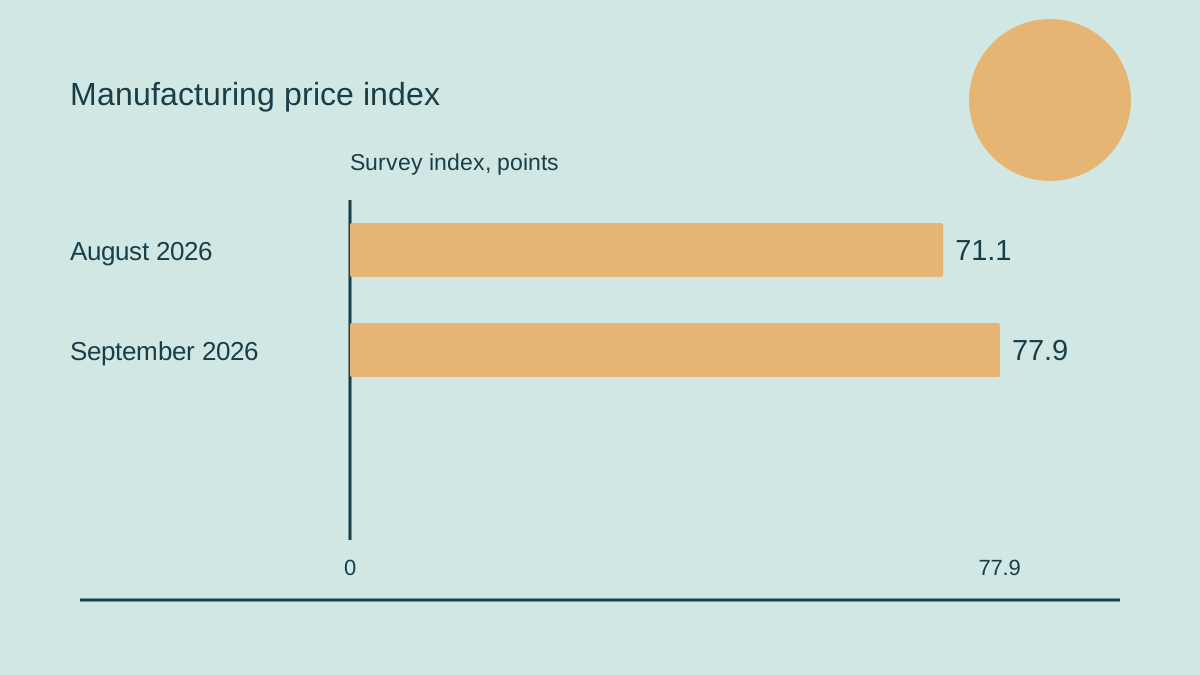
Manufacturing managers in the United States enter October with a difficult combination: activity is expanding, but the cost and reliability of fulfilling orders remain unsettled. Reporting published by Manufacturing Dive on October 1 puts the September Institute for Supply Management manufacturing index at 54.5, against 54.6 in August. The price index moved from 71.1 to 77.9. These are survey readings, rather than percentage changes in physical output or purchase prices.
The practical question is how a company can respond to growing demand without treating every encouraging indicator as permission to expand fixed costs. The answer depends on separating demand, capacity, costs and cash. A factory may have work waiting and still struggle to convert it into deliveries. Equally, a healthy order book does not tell a manager whether the next order earns an acceptable margin. The September signals are useful because they prompt those distinctions, rather than settle them.
Expansion describes direction, rather than the size of the opportunity
A purchasing managers' index summarizes responses from a panel of businesses. Its threshold helps distinguish a broad tendency toward improving conditions from a tendency toward deterioration. It is not a direct measurement of units assembled, sales revenue collected or profits distributed. Reading a survey value as a growth rate would therefore create a misleading picture of the operating environment. Managers should use the direction as a starting point, then compare it with the evidence in their own businesses.
That comparison needs consistent definitions. A commercial team may call an enquiry an order, while production planning recognizes only a signed contract with a confirmed specification. Finance may count revenue when goods are shipped, although the sales team celebrates the booking weeks earlier. A single headline cannot resolve these differences. Before adjusting a plan, a company should identify which internal measure actually corresponds to the question being asked: interest, committed demand, completed work or cash received.
The same discipline applies to the reporting period. Comparing this month's order intake with a cumulative annual number tells a different story from comparing it with last month. A change in product mix can also make monetary sales rise while the number of units falls. None of these outcomes is inherently contradictory. They show why an aggregate survey is most valuable when management uses it to ask precise questions rather than to produce an automatic forecast.
Why rising costs can accompany a growing order book
Demand and profitability move through different channels. Customers can increase orders just as suppliers revise quotations, transport becomes less predictable or replacement parts become harder to secure. A manufacturer then faces two separate tasks: accepting work that makes commercial sense and finding a reliable way to complete it. Revenue growth can obscure the second task when attention remains fixed on the value of bookings. The contract matters, but so does the cost of honoring it.
Consider the decisions involved in pricing a new order. The company needs a material quotation, an estimate of processing time, an allowance for scrap and rework, a delivery schedule and payment terms. If one input is uncertain, a precise final price may imply more confidence than the underlying calculation deserves. This does not require refusing every difficult order. It requires making the uncertainty visible and deciding who bears it before the company commits resources.
A broad price survey cannot substitute for that calculation. Some purchased items might become more expensive while others remain stable. An individual supplier could have stock at an earlier cost or a contract that delays a revision. Conversely, a factory might face a sharp increase in one essential component even when its average purchasing cost changes little. The useful managerial response is to examine exposure by input and contract, rather than apply a uniform surcharge without evidence.
The difference between a backlog and executable work
A backlog can signal future production, but its quality matters as much as its size. Some orders are complete and ready to schedule. Others depend on customer approval, engineering changes, a missing component or a financing decision. Combining them in one total makes the sales picture simpler while making the production picture less useful. A company that knows the reasons behind each delay can distinguish a commercially valuable queue from a collection of unresolved dependencies.
This distinction changes the capacity discussion. Adding another machine will not accelerate an order waiting for a final drawing. Hiring more assemblers will not solve a shortage of a specialized purchased component. A manager first needs to identify the constraint and test whether removing it increases completed deliveries. That can lead to a smaller and more effective intervention: engineering time, better supplier coordination, a revised inspection sequence or a realistic agreement with the customer.
Production plans should therefore include readiness as well as promised dates. A schedule built from confirmed materials and specifications gives the shop floor a more dependable sequence of work. It also makes exceptions easier to recognize. When an order is moved forward, the planner can explain which other job changes and why. The objective is not a perfectly static schedule. It is a controlled process in which changes have an identifiable operational and financial consequence.
Procurement decisions need more than a cheaper quotation
When costs are volatile, searching for a lower unit price is understandable. Yet the quotation is only one part of the purchasing decision. A replacement supplier may require new tooling, testing, documentation or a different minimum order quantity. Delivery arrangements can alter working capital and insurance obligations. A cheaper component that arrives too late can create costs elsewhere in the operation. The comparison should therefore use the full conditions required to put an acceptable part into production.
Qualification deserves particular attention. For a critical item, a supplier's ability to make an initial sample does not automatically establish an ability to deliver consistent production quantities. Buyers need to understand how quality is checked, how deviations are handled and how engineering changes are communicated. These questions are useful even when demand is expanding rapidly. Indeed, pressure to fill orders can make them easier to overlook precisely when the consequences of a failure become greater.
A sensible purchasing review separates immediate continuity from longer term diversification. Existing stock and agreed deliveries may support the next production cycle, while a second supplier is qualified for later use. Trying to complete both tasks through an emergency switch can create avoidable uncertainty. There is no universal timetable for this process. Its pace should reflect the importance of the item, the cost of a disruption and the evidence available about the alternative source.
Cash can become the hidden constraint during growth
An expanding order book often requires spending before the corresponding payment arrives. Materials must be purchased, employees paid and finished goods held or transported. A business can therefore report stronger sales prospects while its cash position becomes tighter. This is a timing problem as well as a profitability problem. Forecasting it requires the company to connect purchasing commitments, production milestones, invoicing and collection, rather than treat each department's plan as a separate document.
Payment terms can change that exposure. A deposit, a staged invoice or an agreement on customer supplied materials may distribute funding requirements differently. Such arrangements have commercial consequences and need a clear agreement, but they illustrate why accepting more work should involve finance before the contract is signed. The relevant question is whether the company can fund a realistic delivery sequence under the agreed terms. A positive margin calculated at completion is insufficient if funding fails earlier.
Inventory also needs a purpose. Holding more of a scarce input may protect production, while accumulating a slow moving finished product can tie up cash without improving service. The two decisions should not be grouped under a simple instruction to increase stock. Management should record what risk each buffer addresses, how it will be used and what would justify reducing it. That makes the stock decision reviewable when conditions change instead of allowing a temporary response to become permanent habit.
Employment choices should follow the work that needs doing
Recruitment is another area where an improving sector indicator can encourage an overly broad response. A factory needs skills attached to particular tasks, shifts and equipment. Adding headcount without identifying those requirements can leave the actual constraint untouched. It can also place additional demands on experienced workers who must train new colleagues. Before making a hiring decision, management should understand which capability is missing and when that capability is needed in the delivery plan.
Training and work organization can be alternatives or complements to recruitment. A maintenance task that repeatedly interrupts output may benefit from a planned routine. A complicated changeover may need documented instructions and supervised practice. A quality bottleneck may require better measurement methods. These interventions should be evaluated on their own merits, rather than presented as guaranteed substitutes for hiring. Their value lies in linking a specific operational problem to a testable improvement.
Flexibility also has limits. Overtime might absorb a short peak, but it does not automatically provide a durable answer to sustained demand. Outsourcing can add capacity while introducing coordination and inspection requirements. Cross training broadens coverage but takes time before it becomes dependable. A company should compare these options against the duration and certainty of the work, paying attention to fatigue, safety and the quality of the finished product as well as nominal capacity.
A planning process that separates signals from commitments
The most useful response to the September reading is a structured review with a small number of decisions. Commercial, purchasing, production and finance teams should work from the same list of committed orders. Each team can then contribute its evidence: customer requirements, material availability, available processing time and expected cash movements. Differences should be resolved explicitly. A shared document is valuable only when the definitions and assumptions behind it are also shared.
- Separate confirmed orders from enquiries and conditional commitments.
- Identify the component, process or approval that limits each delivery.
- Refresh cost estimates where supplier terms or specifications have changed.
- Match proposed stock buffers to a stated continuity risk.
- Compare cash requirements with the timing of customer payments.
- Approve capacity additions against a clear operational constraint.
This review can produce several possible outcomes. A company may accept an order unchanged, revise the delivery date, request different payment terms or invest in a clearly identified constraint. It may also decline work that cannot be completed economically. These are managerial choices informed by evidence, not conclusions contained in the survey itself. Writing down the reasoning helps distinguish a measured response from a reaction to a reassuring or alarming headline.
How to evaluate the next delivery cycle
After a decision, management should compare the agreed plan with the next completed delivery cycle. The comparison needs to include the promised date, the actual date, the cost estimate and the costs recorded. If a difference appears, the company should identify its cause before changing the entire approach. A missing drawing, an optimistic processing estimate and an unexpected supplier delay require different remedies. Treating all three as evidence of the same general uncertainty would lose the information needed to improve the following cycle. Repeated reviews can then reveal which assumptions remain dependable and which need a different basis.
What would justify changing the operating plan
A plan needs conditions for revision. Managers can specify which developments would trigger another review: a material delivery failing to arrive, a customer changing its specification, a persistent increase in quoted costs or a confirmed order falling outside available capacity. The trigger should be linked to an actual decision. Collecting more indicators without deciding how they will be used adds reporting activity while leaving the organization no better prepared to respond.
Historical comparisons should also remain open to correction. Survey publications and company records can be revised, and initial estimates may differ from later measurements. A dashboard should preserve the period and version used in a decision so that management can explain what it knew at the time. This is especially useful when evaluating a capacity investment. Hindsight can clarify the result, but it should not be confused with the evidence that was available before the commitment.
The September manufacturing picture consequently supports neither complacency nor a universal retreat from investment. It suggests a more demanding test for growth: whether a company can turn credible demand into reliable deliveries, preserve an acceptable margin and finance the journey between the two. An expanding sector provides opportunities. Capturing them still depends on the quality of individual contracts, purchasing decisions and production plans. That is where the headline becomes a usable business analysis.




















ADI News
Leave a comment