
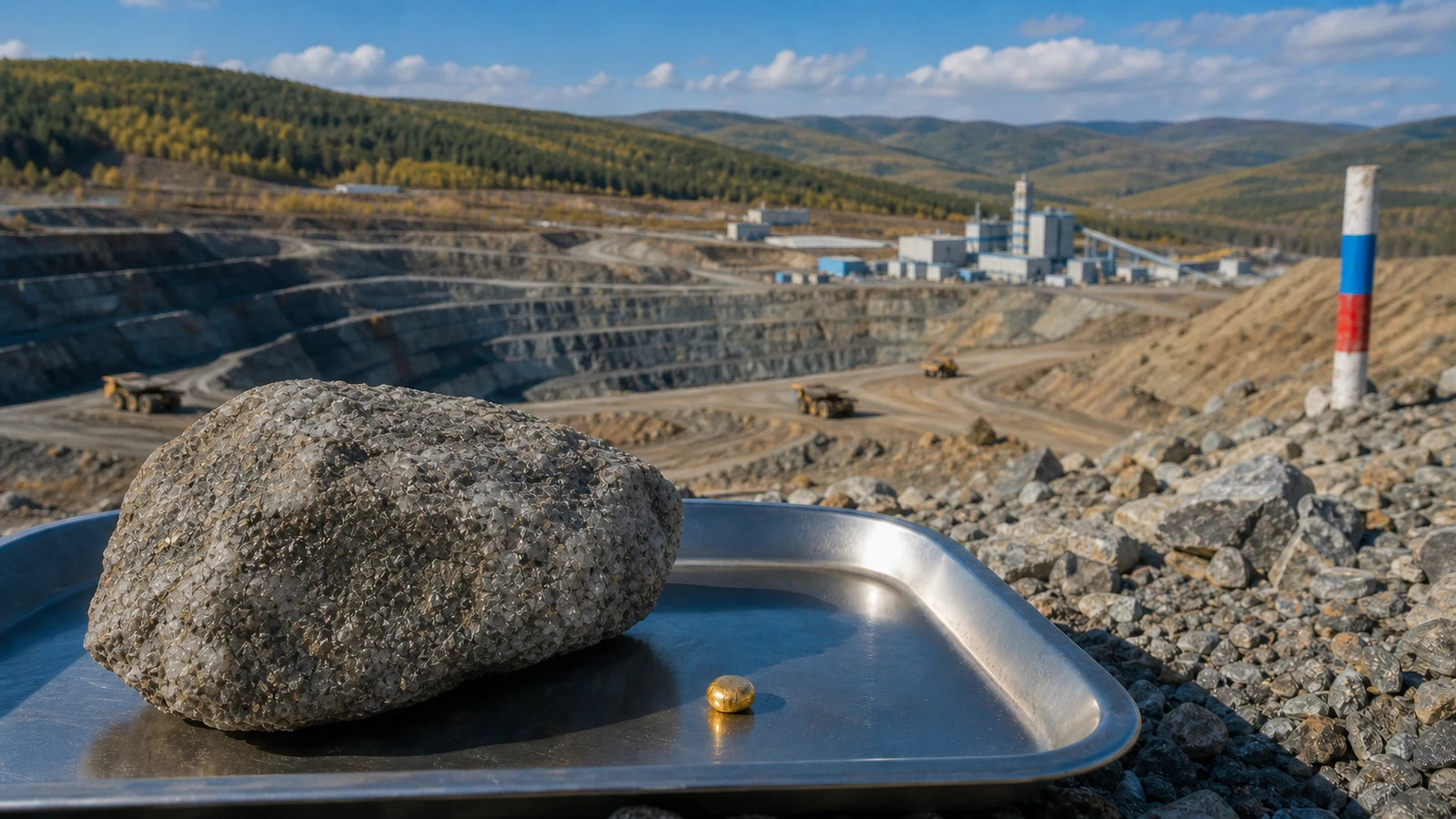
Polyus received the first gold from ore mined at the Sukhoi Log deposit on September 25, 2024. The material was processed during pilot tests at the nearby Verninskaya gold recovery plant rather than at a new dedicated facility. According to Interfax, the trial campaign had begun in the second half of the year. The result confirmed that ore from one of the world's largest undeveloped gold deposits could pass through an operating processing circuit and produce a saleable metal output.
The milestone mattered to mining in Russia, but it was not the start of full commercial production. Polyus was still building site infrastructure at Sukhoi Log, re-engineering the project and preparing updated information for the fourth quarter of 2024. Construction of the deposit's own recovery plant was expected to begin in 2025. The first gold therefore reduced one kind of technical uncertainty while leaving the largest construction, financing and operating tasks ahead.
Pilot processing answered a narrow but important question
A resource estimate describes how much metal geological work indicates in the ground. It does not alone prove how ore will behave after blasting, crushing, grinding and recovery. Pilot batches allow engineers to compare predicted hardness, mineralogy and recovery with physical results. They can observe which settings consume excessive energy, where valuable material is lost and how the circuit responds to different ore zones.
Using the existing Verninskaya plant offered a practical bridge between laboratory work and a future dedicated complex. Operators could test real tonnes with industrial equipment and established controls. Yet the neighbouring plant could not reproduce every condition of the future operation. Different scale, transport distance, equipment design and blend composition mean that pilot success supports engineering decisions without replacing commissioning of the new plant.
What the first gold demonstratedand what it did not
- Demonstrated: Sukhoi Log ore could be mined, transported and treated in an operating recovery circuit.
- Demonstrated: the trial produced physical gold rather than only a laboratory model.
- Not demonstrated: the final plant's design throughput, recovery rate or operating cost.
- Not demonstrated: the schedule and capital discipline of the main construction programme.
- Not demonstrated: stable performance across all ore types and seasons.
Additional reserves increased both opportunity and responsibility
Polyus chief executive Alexey Vostokov said further exploration had added 3.5 million ounces of Sukhoi Log reserves to the company's balance in the previous year. More reserve ounces can extend mine life or support a larger production plan, but they also require an updated sequence for pits, waste movement and processing capacity. An ounce in the reserve becomes economically meaningful only when it can be reached, processed and sold within a viable schedule.
The company described substantial preparatory infrastructure work as already completed while stressing that the main construction remained ahead. A remote large mine depends on roads, power, worker accommodation, water management, repair capacity and a dependable supply chain. These supporting systems may receive less attention than the recovery plant, yet delays in any one of them can constrain the entire operation.
Energy and environmental design affect long-term economics
Polyus identified energy-efficient technologies, high environmental standards and renewable electricity as priorities for design and infrastructure. For a long-life mine, energy use is not only a public commitment. Crushing and grinding are power-intensive, so efficiency directly affects operating cost and exposure to future price changes. Reliable renewable supply can improve predictability if generation, transmission and backup are designed for industrial continuity.
Environmental performance also has operational consequences. Water balance, waste-rock placement, tailings management and land disturbance require controls throughout construction and production. A large reserve can support decades of output, which makes early design choices cumulative. Avoiding a problem in the layout is generally less disruptive than correcting it after equipment and waste facilities are fixed in place.
Evidence to watch as the project advances
- Updated capital estimate and construction sequence after re-engineering.
- Recovery and energy results from representative pilot ore batches.
- Progress on power, roads, water and other enabling infrastructure.
- The start and pace of construction for the dedicated recovery plant.
- Commissioning results that connect nameplate capacity with stable output.
The first gold was a tangible transition from geological promise to metallurgical evidence. It showed that Sukhoi Log ore could enter an industrial process and yield metal, but it did not compress the remaining project into a finished mine. Investors and industrial partners still needed to evaluate the re-engineered design, infrastructure, capital requirement and ramp-up. The significance of September 25 lay in sequencing: Polyus gained an early operating signal before the main plant was built, giving the company evidence it could use to improve the much larger decisions still to come.


ADI News
Leave a comment