
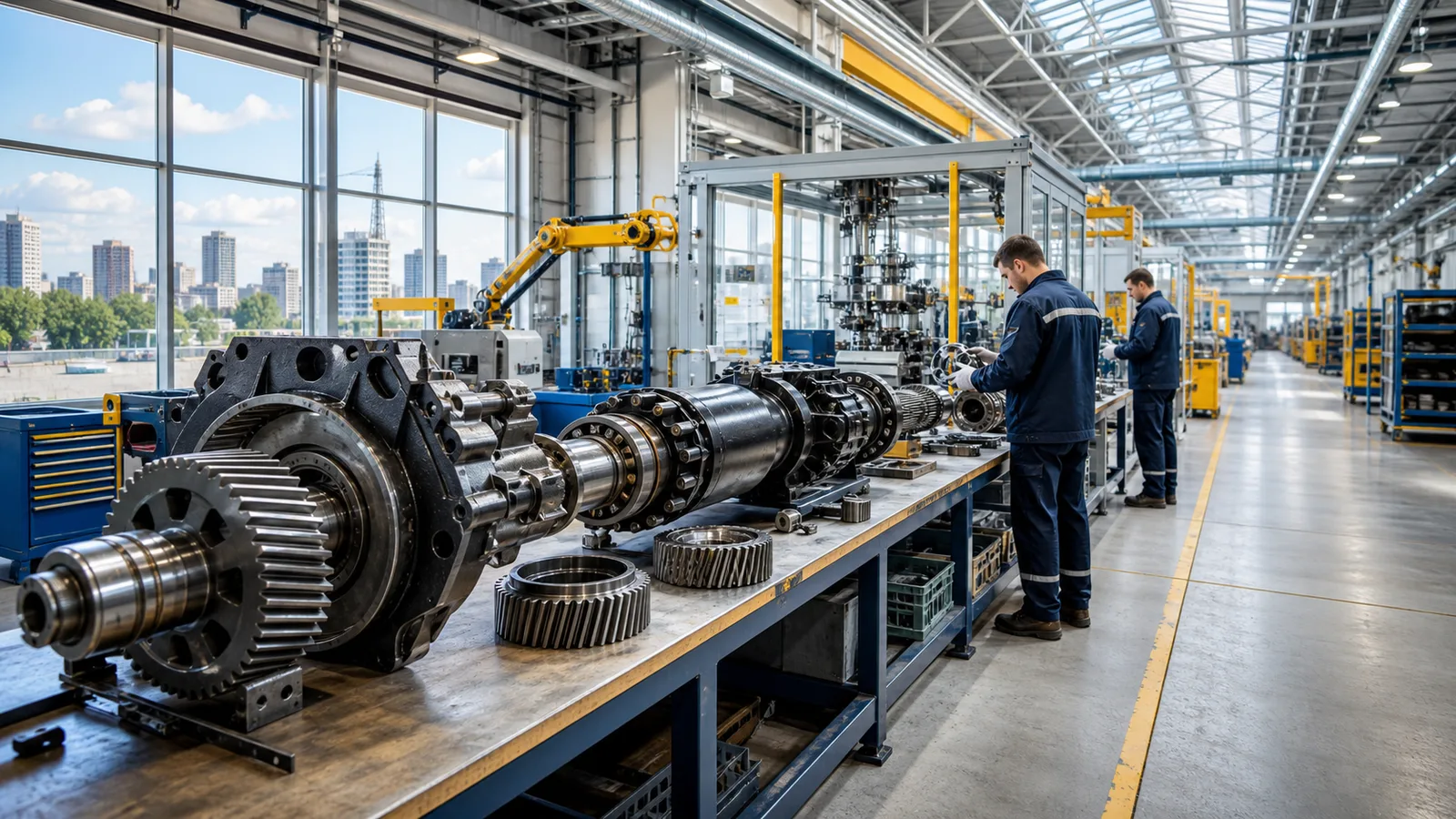
Rostselmash officially opened a new transmission factory in Rostov-on-Don on February 21, 2024. The plant was designed to manufacture automatic and mechanical transmissions, axles and reduction gears for tractors, combine harvesters and road-building machinery. According to Interfax's report from the opening ceremony, total investment in the project exceeded RUB 10 billion.
The new legal entity New Dynamics operates the project on a 70,000-square-metre site within Rostselmash's industrial territory. More than RUB 4.7 billion was directed to the first stage, which organized production of shafts and gears. The federal Industrial Development Fund provided a RUB 5 billion preferential loan for equipment. The financing structure therefore joined corporate capital with long-term industrial support for a technically demanding component base in Russia.
A component factory changes control of the whole machine
A tractor manufacturer can assemble a finished vehicle while still depending on imported gear sets, axles or transmissions. These components determine how engine power reaches the wheels and how reliably a machine works under changing field loads. Bringing them into a dedicated production system gives the manufacturer more direct control over tolerances, engineering changes, delivery schedules and after-sales parts.
The first stage covered 13-tonne and 18-tonne axle sets for combine harvesters, the corresponding geared parts, and geared components for mechanical transmissions used by the 2000-series tractors. Rostselmash said the initial facilities could supply enough components for about 3,700 tractors of all series annually. That figure describes the practical link between component capacity and final-machine output: a missing axle can stop an otherwise complete tractor line.
What the first production stage must prove
- Dimensional accuracy. Shafts and gears must remain within tight tolerances across repeat batches.
- Material discipline. Heat treatment and surface quality must support heavy agricultural loads.
- Assembly reliability. Bearings, housings and gear pairs must operate as one tested unit.
- Production rhythm. Component output must match tractor and combine schedules without excess inventory.
- Service support. Spare parts and technical feedback must remain available throughout a machine's working life.
From 150,000 gears toward a broader product family
Management described the opening as the start of a longer programme. Initial capacity was about 150,000 gears, with plans to increase output to 700,000. Scale matters because expensive machining, measurement and heat-treatment equipment must be loaded consistently. Yet volume alone is not enough. A gear that needs rework, creates noise or fails early transfers cost into final assembly, warranty service and a customer's harvest window.
The second stage, planned through the end of 2026, was intended to add automatic transmissions for the 2000- and 3000-series tractors, automatic transmissions and axles for a new 1000-series tractor, and systems for road-building machinery. It also included 25-tonne, 28-tonne and 35-tonne axle sets for combines. This expansion would move the factory from a narrow replacement programme toward a reusable engineering platform serving several vehicle families.
The investment sits inside a three-factory programme
The transmission project was part of a larger Rostselmash investment programme. The group was also creating a new tractor plant in Rostov-on-Don and a facility for agricultural and municipal machinery in Taganrog. The Taganrog site, located at the former Taganrog automobile plant, entered operation earlier in February 2024 after investment of about RUB 2.5 billion by the beginning of the year.
Several sites create coordination risk as well as scale. Product design, component specifications, factory planning and service data must use compatible versions. If a tractor design changes but the gear programme receives the revision late, local production does not prevent disruption. The industrial advantage appears when engineering and manufacturing information travel faster than physical parts and each plant can trace which revision entered each machine.
Milestones beyond the opening ceremony
- Stable serial output of shafts, gears and first-stage axle sets.
- Measured field reliability in tractors and combine harvesters.
- Growth from 150,000 gears without deterioration in quality or delivery.
- Qualification of automatic transmissions and heavier axle families.
- Dependable spare-parts supply and repair knowledge for customers.
The February opening established physical capacity and a new production organization. Its larger business result will be measured over years: fewer critical supply interruptions, faster engineering changes, reliable machines during seasonal work and enough repeat orders to support specialized equipment and skills. If those outcomes follow, the RUB 10 billion project will have done more than replace imported components. It will have made the transmission a controlled industrial capability connected to Rostselmash's tractors, combines and future road-building equipment.



ADI News
Leave a comment