
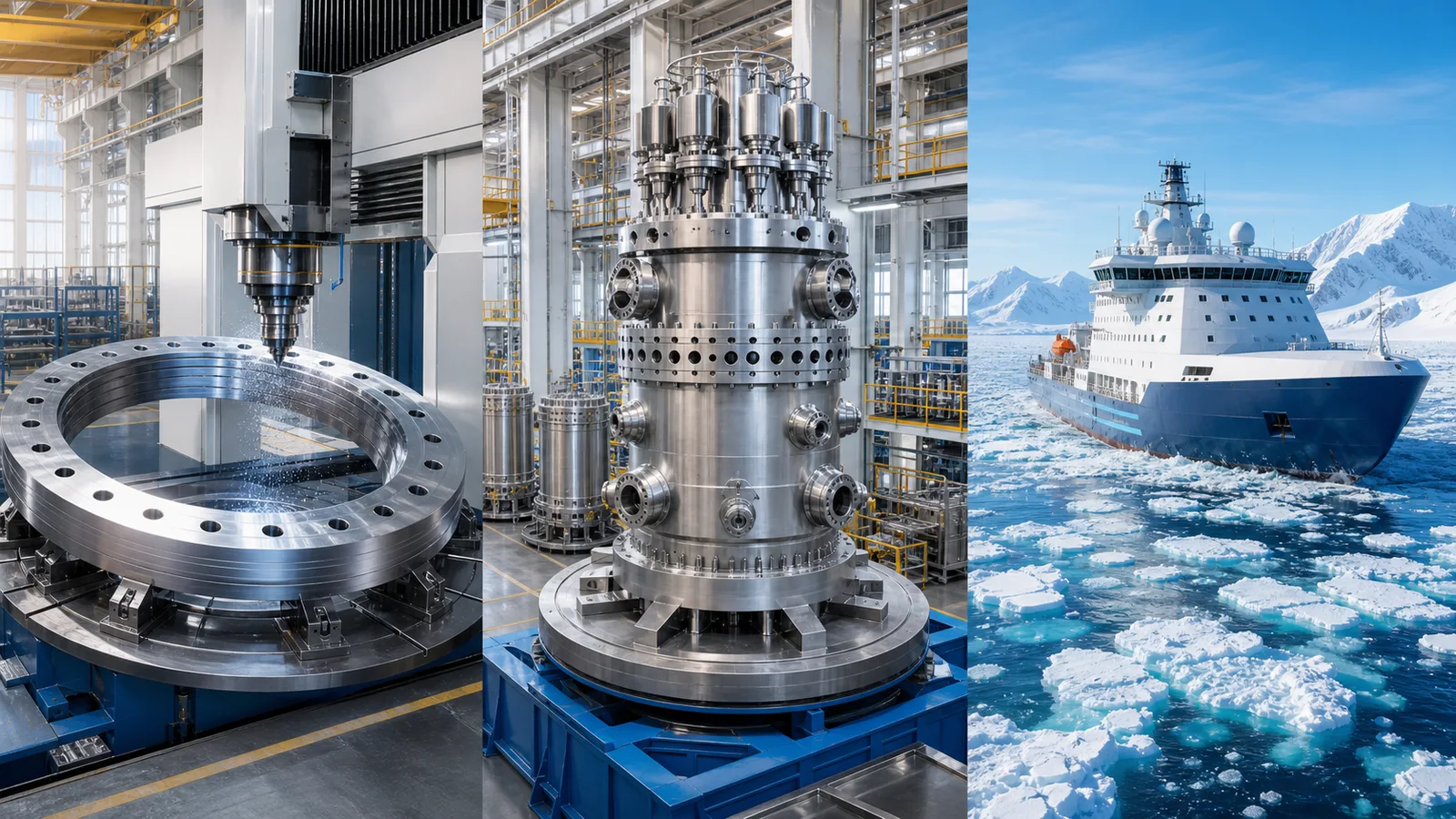
ZiO-Podolsk began assembling a RITM-200 reactor unit for the new nuclear icebreaker Leningrad on March 11, 2025. Work started with precision machining of a large flange, an early operation that turns a major forged component into part of the pressure boundary. Vzglyad reported the manufacturing milestone that day, citing Atom Media and representatives of Rosatom's mechanical-engineering division.
The event is a production story rather than a ceremonial shipbuilding update. The Leningrad was laid down in January 2024, but its propulsion programme depends on long-cycle equipment made far from the shipyard. A reactor unit requires specialised metalworking, welding, inspection and documentation before it can be integrated into a vessel. Starting the flange therefore moves a critical industrial schedule from planning into physical execution in Russia.
Serial production becomes visible
Rosatom's engineering managers described RITM production as serial and flow-based. That distinction matters. A single prototype can rely on exceptional work, custom fixes and long pauses between stages. A recurring programme needs repeatable tooling, trained teams, stable suppliers and inspection records that can be transferred from one unit to the next without weakening safety requirements.
Eight RITM-series reactor units were simultaneously at different stages of production at the Podolsk plant, according to the report. They were intended for icebreakers and floating power units. Such a queue can improve learning because workers and engineers encounter the same families of operations repeatedly. It also raises scheduling pressure: delays in one machining or testing station can affect several units rather than one isolated project.
What serial manufacturing must coordinate
- Long-lead forgings and specialised materials from qualified suppliers.
- Machining capacity for large components with tight tolerances.
- Welding, non-destructive examination and documented quality gates.
- Delivery dates aligned with construction progress at the shipyard.
The RITM design is presented as more compact and powerful than earlier Soviet marine reactor systems. Compactness can free useful space aboard a vessel and simplify layout decisions, but it does not make manufacturing simple. Higher performance in a smaller envelope places more value on dimensional accuracy, heat-management engineering and dependable auxiliary systems. Every gain at the design level has to survive the realities of factory production.
From factory order book to Arctic capacity
A universal nuclear icebreaker uses two RITM reactor units. That creates a paired-delivery obligation: ship commissioning depends on both units and their supporting equipment reaching the required readiness. Production managers therefore need to control not only the completion date of each vessel, but also the synchronisation of sister units, acceptance tests, transport and installation windows.
The business relevance extends beyond one ship. New-generation universal icebreakers equipped with RITM-200 units had already supported operation of the Northern Sea Route, whose cargo flow reached a record 37.9 million tonnes in 2024, the source said. Reactor production is several steps removed from a cargo booking, yet it contributes to the availability of ships that escort traffic and extend navigation in difficult ice conditions.
Indicators after the flange milestone
- Completion of the main vessel and other long-cycle components.
- Progress of the paired reactor unit required for the icebreaker.
- Factory acceptance, delivery and installation against the shipbuilding schedule.
- Stable throughput across the eight-unit production queue.
Serial work also changes supplier economics. Predictable demand allows contractors to retain specialised staff and justify investment in fixtures, inspection equipment and process control. In return, the programme becomes more exposed to common bottlenecks. A shortage or quality problem affecting a shared component can propagate across several reactor units, making supplier diversification and traceability commercially important.
The start of machining is therefore a small visible step inside a much larger programme. It does not mean the reactor or the Leningrad is close to operation. It does show that a named ship has entered the manufacturing flow at a plant already carrying multiple RITM orders. The next meaningful evidence will be steady progression through assembly, testing and delivery without disrupting the wider serial queue.
















ADI News
Leave a comment