
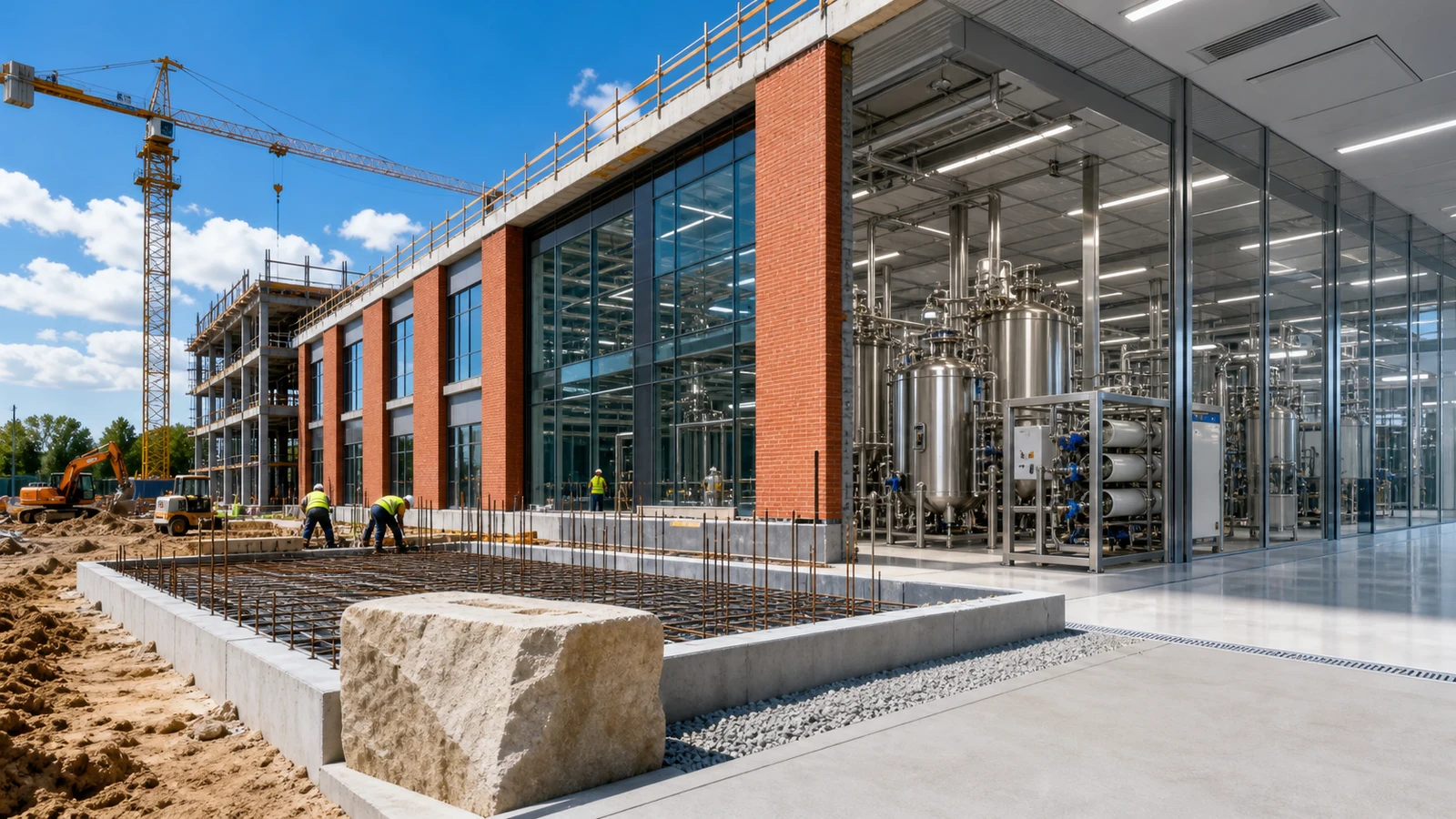
Construction of a new active pharmaceutical ingredient complex began in Pushkin, Saint Petersburg, on July 30, 2024. A foundation stone marked the start of the project for Active Component, which planned to complete the facility by the end of 2026. According to a Kommersant report by Alexandra Ten, the investment agreement was valued at RUB 3.8 billion and covered both the new complex and reconstruction of the company's existing capacity.
The project was designed to produce strategic active substances for medicines corresponding to 35 international non-proprietary names on the essential-drugs list. Planned applications included oncology, organ transplantation, cardiovascular disease and type 2 diabetes. The investment therefore joined industrial expansion with supply security in Russia: a medicine cannot be manufactured continuously if its active ingredient is unavailable, even when formulation and packaging lines are ready.
The active ingredient is a small component with a large constraint
An active pharmaceutical ingredient provides the intended therapeutic effect. It may represent a small share of a tablet or injectable product by mass, but its quality and availability determine whether finished medicine can be released. Production requires controlled chemistry, purified utilities, contamination prevention, analytical testing and records that connect each batch to raw materials and process conditions.
That requirement makes capacity more than a number of tonnes. A reactor can be physically installed yet remain commercially unavailable until equipment, methods, personnel and cleaning procedures are qualified. Different substances may need separate containment or campaigns to prevent cross-contamination. The project schedule therefore includes an invisible layer of validation after the visible building is substantially complete.
Capabilities the new complex must combine
- Process control. Stable temperature, pressure and reaction conditions across each batch.
- Containment. Protection of workers and products when highly active substances are handled.
- Purity. Removal and measurement of impurities to approved limits.
- Traceability. Complete documentation from incoming material to released ingredient.
- Changeover. Verified cleaning and scheduling when equipment serves multiple products.
RUB 3.8 billion covered more than a new shell
The reported investment included reconstruction of existing production assets as well as the new site. That broader perimeter can be useful. Upgraded laboratories, utilities or legacy lines may support the new building and prevent an imbalance in which reactors are available but quality control, warehousing or waste treatment becomes the bottleneck.
Active Component already operated two sites: a Metallostroy facility with annual capacity of 80 tonnes and a Pushkin facility capable of up to 250 tonnes. The new complex would therefore extend an operating network rather than create a manufacturer from zero. Existing experience can shorten learning, although a larger and more diverse product range increases the burden on planning, technical transfer and quality systems.
Thirty-five names described breadth, not automatic output
The target of 35 international non-proprietary names indicated a broad strategic portfolio. It did not imply that all substances would begin at equal volume on the same date. Demand, regulatory readiness, production complexity and customer qualification differ by molecule. A phased launch can prioritize ingredients with the clearest shortage risk and validated buyer demand while later products complete transfer.
Saint Petersburg's government reported that the city already produced about 430 international non-proprietary names, including 200 essential medicines. The new project adds depth inside that ecosystem. Local formulation companies can benefit from shorter supply lines and closer technical cooperation, but they still need competitive quality, price and delivery performance rather than location alone.
Milestones that turn construction into supply
- Completion of the building envelope and clean utility systems.
- Installation and qualification of reactors, filtration and analytical equipment.
- Validation batches for each prioritized substance.
- Regulatory documentation and customer approval of the manufacturing source.
- Reliable commercial batches delivered on schedule and within specification.
The foundation stone represented the beginning of an industrial sequence, not its result. By committing RUB 3.8 billion to a new complex and reconstruction, Active Component aimed to expand both physical capacity and the supporting production system. The project's business value will emerge when qualified substances for the promised medicine categories reach customers consistently. Completion by the end of 2026 would be a construction milestone; dependable batches across a carefully phased portfolio would be the stronger proof that the investment improved pharmaceutical supply resilience.

ADI News
Leave a comment