
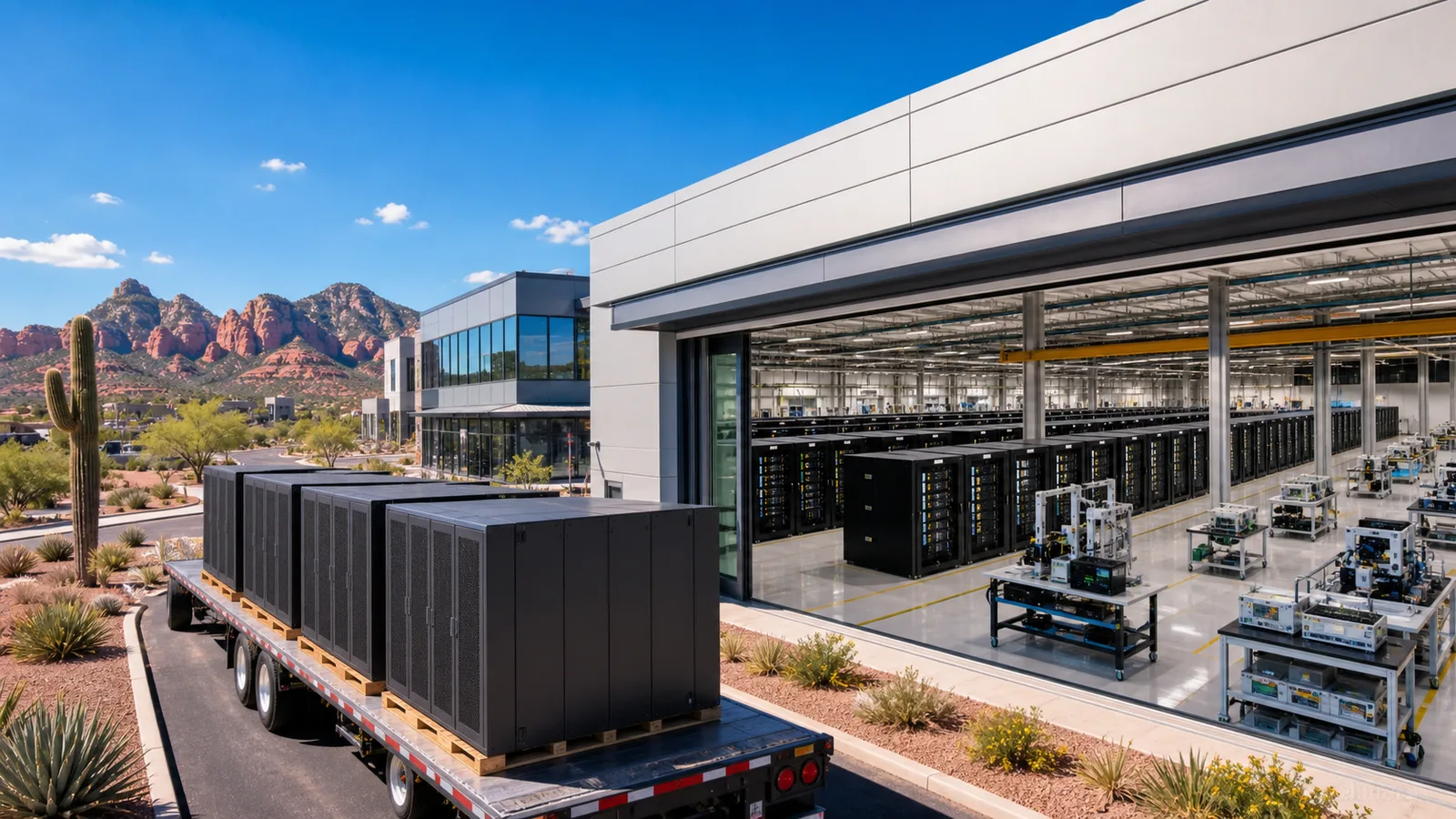
Nvidia announced a plan to build artificial-intelligence infrastructure worth as much as $500 billion in the United States over four years, working with manufacturing partners including Taiwan Semiconductor Manufacturing Company. Interfax reported the programme on April 14, 2025, citing the chip designer's statement.
The programme connects several stages that are usually spread across countries. Taiwan Semiconductor Manufacturing Company had already started producing Nvidia's Blackwell artificial-intelligence chips in Phoenix, Arizona. Foxconn and Wistron were expected to manufacture supercomputers at American plants, with capacity expansion planned over the following twelve to eighteen months.
From imported processors to a domestic production chain
Nvidia designs the processors and computing platforms at the centre of the current artificial-intelligence investment cycle, but it relies on specialist manufacturers for physical production. Most of its processors were still made in Taiwan when the announcement was published. Adding American fabrication and system assembly does not eliminate the international network; it gives that network a second major production base closer to customers building data centres in North America.
The distinction between a chip and an artificial-intelligence system is important. A fabricated processor must be packaged, tested, connected to memory and networking components, installed in a server, cooled and integrated with many similar units. The partnership structure therefore addresses more than semiconductor output. It attempts to build a sequence from wafers to complete supercomputers that data-centre operators can deploy.
Partners and announced roles
- Taiwan Semiconductor Manufacturing Company had begun making Blackwell chips at its Phoenix site.
- Foxconn and Wistron were assigned supercomputer production at plants in the United States.
- Nvidia would coordinate the computing architecture, demand planning and the broader supplier network.
- Additional manufacturing capacity was expected within twelve to eighteen months.
A ceiling, not a single factory budget
The figure of up to $500 billion describes the scale of infrastructure Nvidia expected to build with partners over four years. It should not be read as the price of one campus or as a cash commitment made by Nvidia alone on the announcement date. The total can include chips, servers, manufacturing equipment, facilities and purchases across a wide partner ecosystem. Actual spending will depend on customer orders, construction schedules and the pace at which new plants qualify their production.
This qualification process is a central execution risk. Advanced chips must meet exacting yield, performance and reliability standards. A newly installed line cannot immediately be assumed to match a mature plant. Supercomputer assembly brings separate constraints: high-power electrical systems, liquid cooling, precision networking and reliable access to thousands of components. Capacity only becomes commercially useful when the whole system can be delivered and supported at scale.
Measures that will show whether the plan is working
- The volume and yield of Blackwell processors fabricated in Arizona.
- The dates when Foxconn and Wistron lines begin serial supercomputer output.
- Lead times between customer orders and operational data-centre capacity.
- The share of system value manufactured or assembled inside the country.
- Power, cooling and grid connections available for the resulting computing clusters.
Supply resilience becomes a commercial asset
Chief executive Jensen Huang said additional American capacity would help meet rapidly growing demand while strengthening the supply chain. That resilience has commercial value. Customers committing billions of dollars to artificial-intelligence facilities need confidence that processor deliveries, replacement parts and complete systems will arrive on schedule. A broader manufacturing footprint can reduce exposure to disruption at any one location, although it also creates the challenge of maintaining consistent quality across plants.
Nvidia said domestic production could support hundreds of thousands of jobs over coming decades. The immediate employment effect is likely to extend beyond assembly workers to construction, equipment maintenance, power engineering, logistics and specialised suppliers. The longer-term effect depends on whether the facilities remain competitive after the first investment wave and whether local suppliers win recurring orders rather than temporary installation contracts.
For the United States, the announcement represented an attempt to capture more of the physical value chain behind the artificial-intelligence boom. For Nvidia, it was a way to turn exceptional demand into a more diversified production system. The plan's significance will ultimately be measured not by its headline ceiling, but by qualified chip output, delivered supercomputers and dependable operating capacity.
















ADI News
Leave a comment