
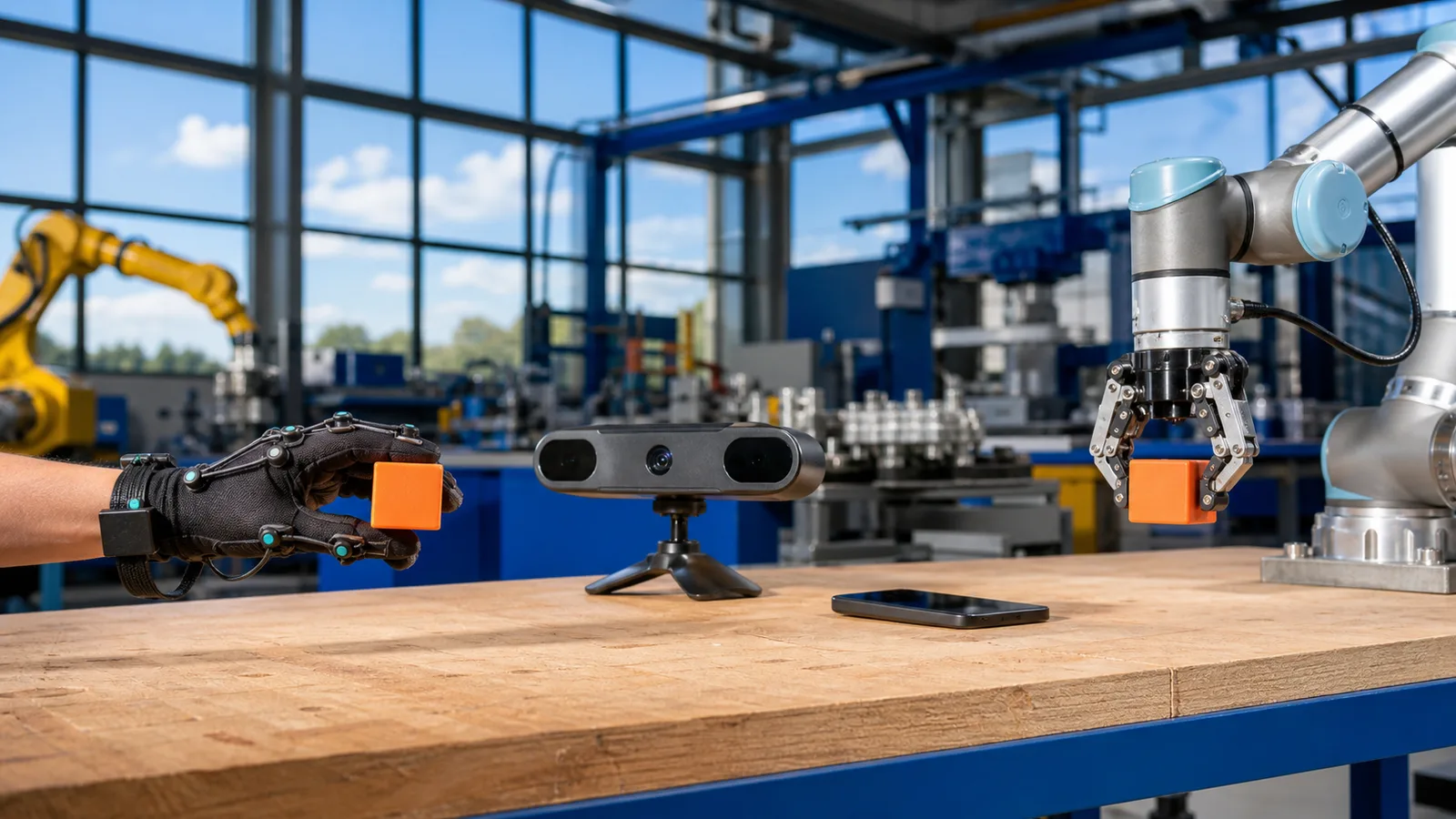
Mecka AI has disclosed $60 million in financing for a business that collects human-motion data and uses it to train robots. Fortune reported the funding on June 1, 2026. The total consists of a previously unannounced $25 million Series A round completed in November and a subsequent $35 million investment. Framework Ventures led the financing, while Mecka AI did not disclose its valuation.
The New York City startup records physical actions with custom body sensors and smartphones. Its premise is that robots can learn useful movements from large collections of human behaviour instead of relying only on teleoperation, in which a person manually controls a robot to create training examples. The company says it has collected thousands of gigabytes of data and expects a $100 million annual revenue run rate from signed contracts, although it has not identified its customers.
Human movement is becoming a commercial data product
Language models benefited from enormous quantities of text, but robots need information about the physical world. A machine has to understand how force, balance, timing and object shape interact during an action. Video can reveal what happened, while wearable sensors can add information about orientation and motion that a conventional camera may miss. Combining several capture methods can produce richer examples for a model that must control a mechanical body.
Mecka AI argues that demonstrations performed naturally by people can scale more efficiently than collecting every example through a robot operator. The distinction is important because teleoperation requires compatible hardware, trained operators and time on the target machine. Human-motion capture can take place with lighter equipment and may cover a wider variety of environments. The resulting data still has to be cleaned, labelled and translated into representations that different robot designs can use.
What the financing is intended to support
- Production of custom sensors and other equipment for capturing physical actions.
- Collection of larger and more diverse datasets across hands, bodies, objects and environments.
- Quality control that removes unreliable demonstrations and protects customer training pipelines.
- Technical teams that help customers integrate datasets into robotics models.
- Commercial expansion beyond the startup's current group of undisclosed contract clients.
The company is selling more than raw files
Co-founder and chief executive Josh Gao does not want Mecka AI to operate only as a data broker. He says the company plans to work directly with customers as they integrate information and train robotics models. That service layer may be important because motion data is not automatically useful. Sensor coordinate systems, task definitions, robot geometry and safety constraints have to be aligned before a model can convert an observed movement into a reliable action.
The startup has 40 employees and was formally launched in 2025 after its four founders spent time studying robotics research, visiting laboratories and testing their thesis with partners. Gao and Mogen Cheng previously sold a restaurant-payments technology company. Jason Chong sold another startup to a cryptocurrency exchange, while Duy Nguyen built a business trading collectible footwear. Their backgrounds differ from the conventional path through major artificial-intelligence laboratories, which gives the company a commercial perspective but also increases the importance of specialist robotics hiring.
Framework Ventures co-founder Vance Spencer described Mecka AI as the fastest-growing revenue company his firm had backed. That assessment is an investor's view rather than independently audited evidence. The projected $100 million annual run rate is also a forward-looking figure based on signed contracts, not a reported full-year result. Investors and customers will need to distinguish contractual potential from recognised revenue and cash collection.
Evidence that should be monitored
- The proportion of signed contract value that becomes recognised and collected revenue.
- Whether models trained on human demonstrations perform reliably on different robot bodies.
- The cost of collecting, cleaning and labelling each useful hour of physical data.
- Customer concentration and the duration of contracts in a young robotics market.
- Privacy, consent and security controls for recordings of people and physical environments.
Data quality and rights may determine the long-term advantage
More data is valuable only if it represents the actions customers need and contains enough context to teach them safely. A sensor may capture a hand trajectory without recording the object's weight, surface friction or the force applied. A smartphone video may show the scene but lose depth or precise joint position. Mecka AI therefore has to combine signals, document collection conditions and measure whether additional examples improve a model rather than simply enlarging storage.
Rights management is equally important. People who generate demonstrations should understand how recordings will be used, retained and shared. Customers need assurance that datasets do not expose private locations or confidential processes. Clear consent, access controls and traceable data lineage can become commercial advantages when robotics moves from laboratory pilots into homes, hospitals and factories.
For the technology market of the United States, Mecka AI's financing shows that investors are beginning to value the less visible inputs behind physical artificial intelligence. The decisive question is not whether human motion can be recorded. It is whether the startup can repeatedly turn those recordings into measurable improvements on customers' machines. If its integration service, datasets and capture hardware reinforce one another, the company could build a defensible position between robotics developers and the real-world experience their models require.






ADI News
Leave a comment