
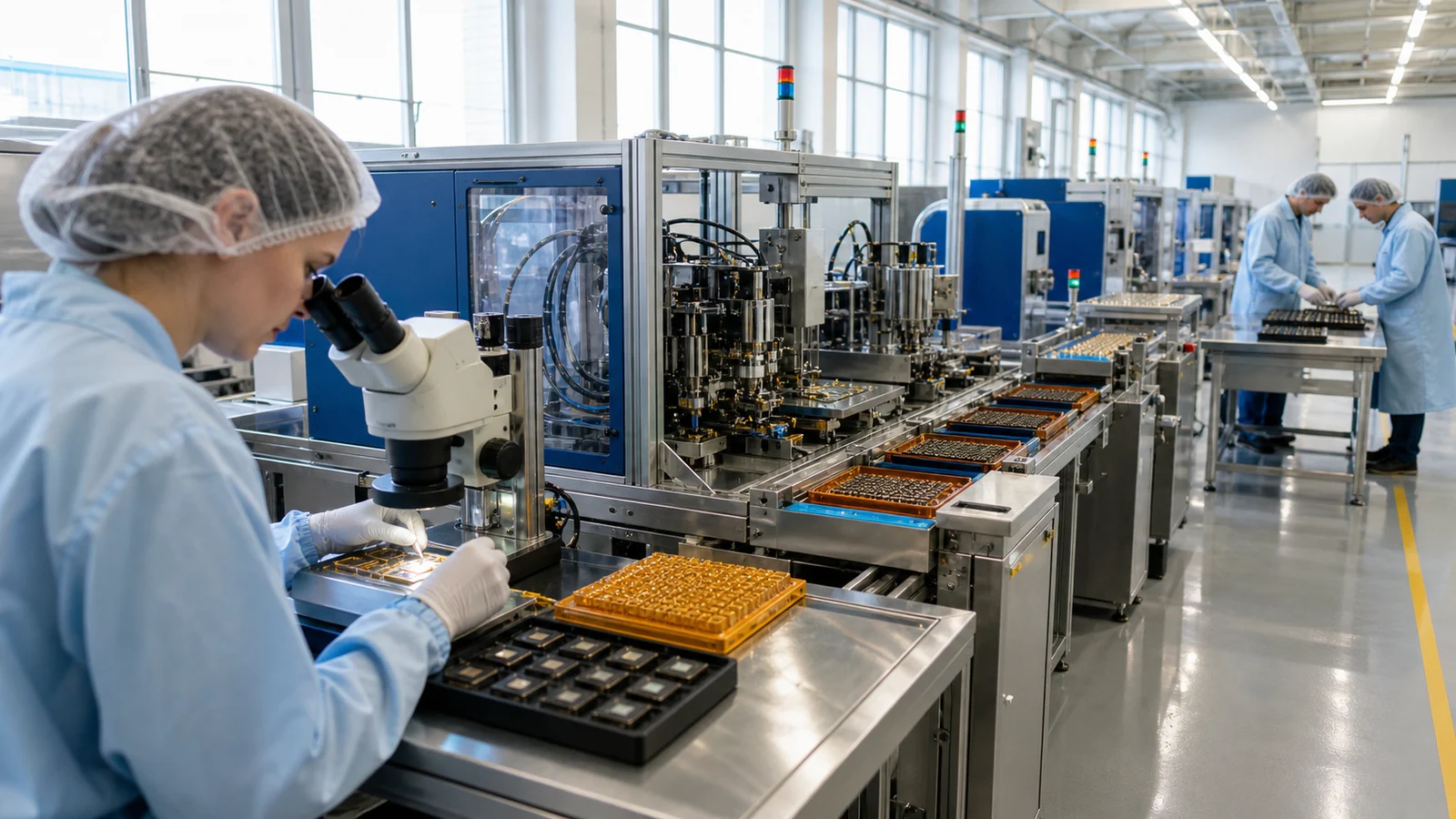
On 26 June 2024, the Beshtau group (Бештау) announced that it had started producing microprocessors at its site in Rostov-on-Don. According to Oleg Kuznetsov at RBC Rostov, the facility was already packaging about 20,000 to 30,000 chips a month. The company planned to invest roughly RUB 2 billion and raise annual output to 2 to 2.5 million units.
The announcement mattered to the electronics industry in Russia, but required precise interpretation. Beshtau performed its own design and packaging, while buying substrates and using imported intellectual-property blocks and processor cores. This was not a complete wafer-to-chip cycle, but the localization of specific engineering and manufacturing stages.
Where localization begins and ends
A microprocessor passes through distinct stages: architecture design, logic development, wafer fabrication, die separation, substrate mounting, electrical connection, sealing and testing. Performing later operations in Rostov creates skills, jobs and quality control, but does not remove dependence on a foreign core or substrate supply.
That distinction does not make the project unimportant. The package determines heat transfer, mechanical protection and contact reliability. A defect at this stage can destroy a good die. Customers still need to understand the origin of critical components and whether future batches will remain available, particularly when equipment must be supported for years.
The project in five measures
- 20,000 to 30,000 chips a month. This was the actual packaging volume at the publication date.
- About RUB2 billion. This was the planned investment in project expansion.
- 2 to 2.5 million units annually. Management identified this as the longer-term production level.
- Roughly half of output. The group expected to consume this share in its own computer equipment.
- Three years of training. ComNews reported that building the workforce took this long.
Demand must come before scale
Moving from tens of thousands of chips a month to millions a year requires more than machinery. The business needs stable orders, a proven yield, material inventories and disciplined testing. An underused line raises unit cost, while rapid expansion without quality evidence creates expensive returns for computer manufacturers.
The plan to use about half of the processors within the group created anchor demand. Beshtau's computers, all-in-one systems and other equipment could align chip specifications with the final device and expose defects quickly. The remaining output needed external buyers, which meant independent qualification and competition on price, documentation and delivery.
What will determine the economic result
The investment figure alone does not prove sustainability. The manufacturer needs to measure packaging yield, testing cost, return rates, changeover time and repeat orders. Customers care about compatibility, guaranteed lead times and the ability to obtain the same specification several years later.
Imported cores and substrates create a separate risk. They accelerate product launch and reduce initial development cost, but retain external constraints. A credible strategy should identify alternative suppliers, usage rights, minimum inventories and the thresholds at which deeper localization becomes economically justified.
The main business conclusion
Beshtau's project demonstrated a practical staged approach to microelectronics: learn design, packaging and deployment in the company's own equipment, then expand as demand is verified. That is more credible than claiming complete technology independence before every link in the chain exists.
Success will be determined not by the number of packages produced, but by yield, reliability in devices and the ability to turn an internal order into a competitive product for outside customers. If those measures hold, the Rostov facility can become a durable part of the national electronics supply chain.

















ADI News
Leave a comment