
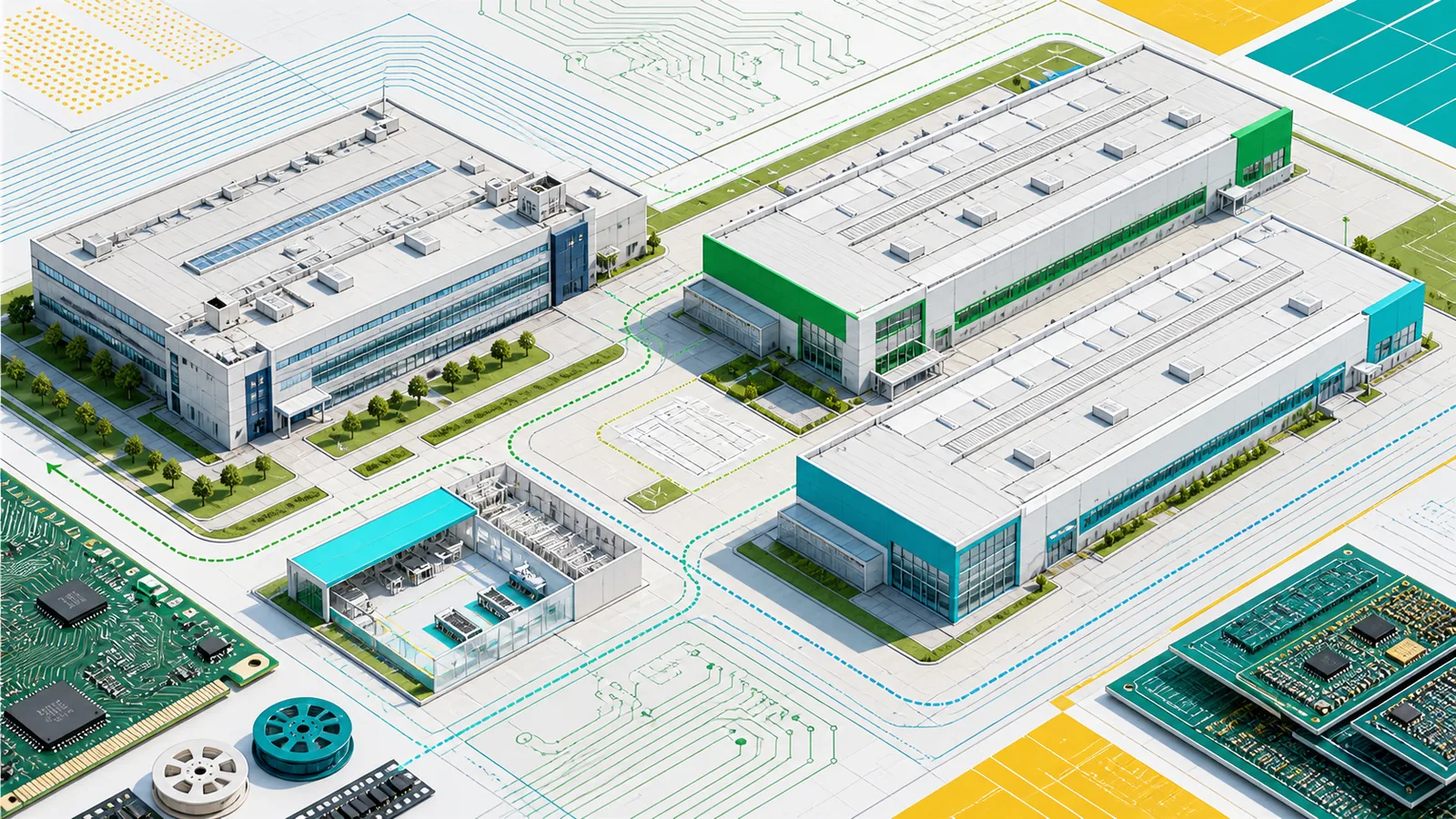
Russian electronics maker ICL plans to more than double the footprint of its manufacturing site in Tatarstan. The project would add two production buildings and an incoming-inspection workshop with a combined area of 13,000 square metres to the existing 8,000-square-metre plant. Kommersant reported the expansion on June 2, 2025, after chief executive Evgeny Stepanov presented it at the company's partner conference.
The plan is important because it combines a large physical expansion with an unsettled demand outlook. ICL did not disclose the timetable, budget or precise production targets. Market participants nevertheless estimated that the new buildings, equipment and related costs could require at least RUB 10 billion. The investment case therefore depends less on floor area alone than on the amount and variety of work that the additional lines can attract in Russia.
A larger platform for electronics production
ICL opened the current motherboard factory in 2023 using Chinese equipment. Its stated capacity is as many as one million boards a year. The new proposal includes buildings for computing equipment and electronics as well as a dedicated incoming-control shop in the Innopolis special economic zone. That configuration suggests attention to both output and the verification of components before they enter production.
Incoming inspection matters in electronics because one weak batch can interrupt an entire assembly schedule or create failures that are expensive to diagnose after delivery. More space for testing can support a wider supplier base, more product configurations and clearer traceability. It can also help a contract manufacturer separate customer specifications and document whether components met the agreed standard.
What the expansion must prove
- That new lines can win enough orders to operate beyond short production campaigns.
- That component inspection reduces defects and costly rework rather than becoming a bottleneck.
- That the plant can switch between products without excessive setup time and idle inventory.
- That contract customers receive clear protection for designs, forecasts and technical data.
The financial starting point provides some scale. ICL Tech recorded 2024 revenue of RUB 13.7 billion and net profit of RUB 792 million, according to corporate data cited by the source. An expansion estimated at RUB 10 billion would therefore be a major commitment relative to one year's earnings. Phased commissioning, binding customer orders and careful working-capital control would reduce the risk of placing expensive equipment into lightly used halls.
The utilisation question
Industry participants did not agree that Russia needs more general-purpose electronics capacity. One manufacturer told the newspaper that existing plants already had long periods of downtime and suggested ICL might use the new lines to make products for other brands. The report also cited estimates that domestic capacity for tablets and mobile phones was heavily underused. Those warnings do not automatically invalidate ICL's project, but they change the test of success from construction to sustained utilisation.
Contract manufacturing could answer that problem if the plant serves several brands instead of depending on ICL's own devices. Shared production can spread depreciation, engineering staff and quality systems over a wider order book. It also introduces complexity: different customers may require distinct components, software images, testing protocols, packaging and confidentiality rules. The operating advantage will come from disciplined changeovers and procurement, not simply from owning more surface-mount machines.
Demand signals to watch
- Signed multi-year manufacturing agreements with third-party electronics brands.
- Capacity utilisation and output per line after each new building opens.
- The share of revenue from contract production rather than internal products.
- Defect rates, delivery reliability and inventory turnover across a broader product mix.
The consumer market offers both opportunity and caution. Russian laptop brands collectively held 12.9% of unit sales in the period cited by the report, while sales of domestic notebooks reached 180,000 units and grew 53% year on year. The wider Russian laptop market totalled 3.9 million units in 2024. Growth from a small base can support local assembly, but it does not guarantee that every new line will be filled.
ICL's proposal is therefore best read as a move to build a flexible industrial platform. If two new buildings combine component control, board assembly and final-device production for multiple customers, the company may convert unused market capacity into a service advantage. If demand remains fragmented and orders arrive only in bursts, the same fixed assets could depress returns. The decisive news will come when ICL discloses a schedule, customers and measurable production commitments.







ADI News
Leave a comment