
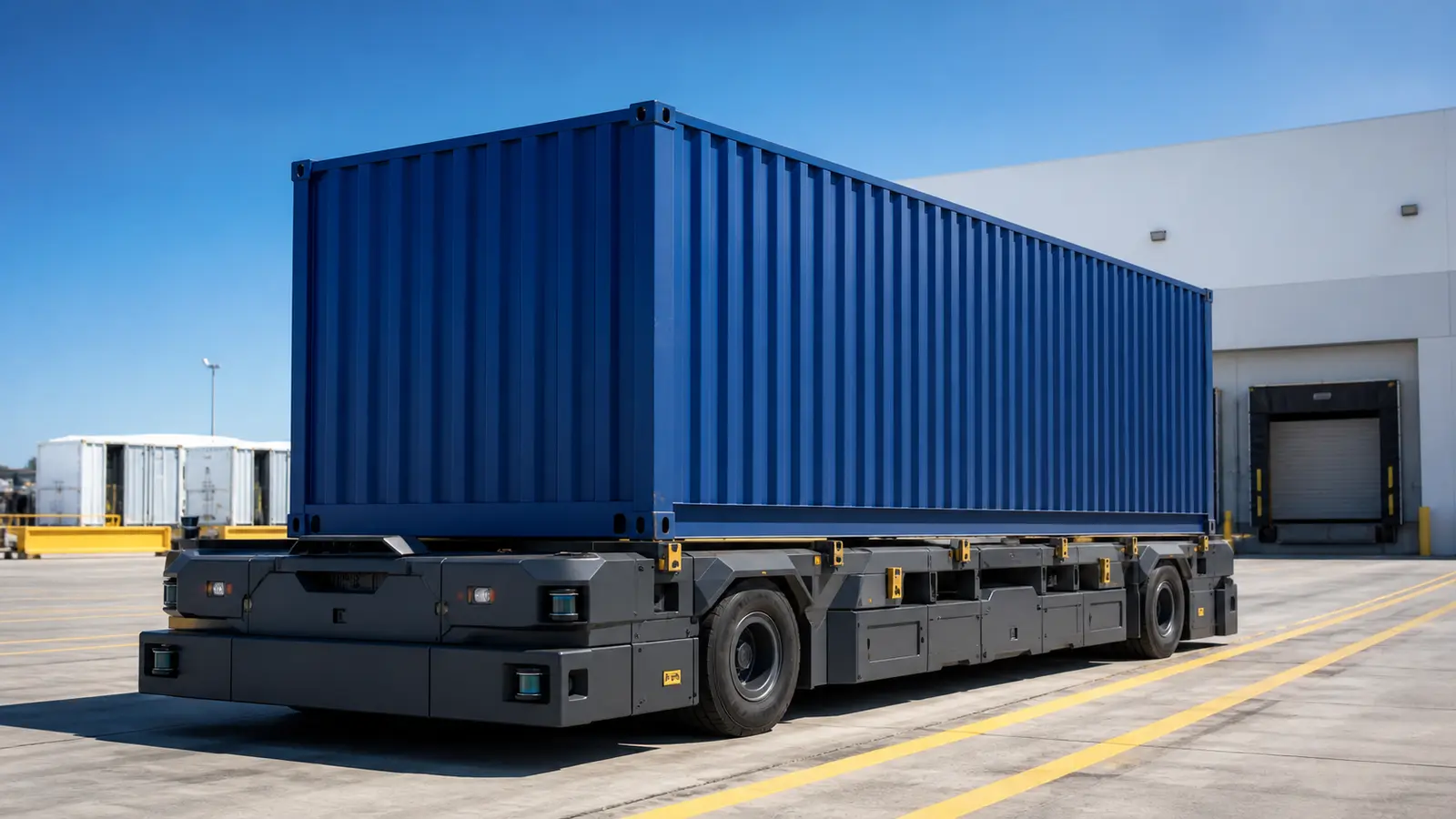
Humble, a San Francisco freight-technology startup, has emerged from stealth with a $24 million seed round and a fully electric autonomous vehicle called the Humble Hauler. Fortune reported the launch on April 21, 2026. Eclipse led the financing with participation from Energy Impact Partners. The company is entering a large but capital-intensive market with a design that removes the conventional truck cab rather than adapting a vehicle built for a human driver.
The Hauler is a low platform intended to carry standard 40-foot and 53-foot shipping containers between loading docks. Humble says it can unload at the destination instead of leaving a trailer at a transfer yard. That dock-to-dock model differs from autonomous trucking systems that operate only between fixed highway hubs and then hand freight to a locally driven vehicle. It also makes the startup responsible for a wider range of roads, manoeuvres and loading environments.
A purpose-built vehicle changes the engineering trade-offs
Traditional autonomous-truck projects normally retain the cab, steering controls and seating of a road tractor. Humble argues that a machine designed without a driver can use the space and weight differently. Cameras, lidar and radar can be distributed around the chassis for 360-degree coverage without the cab blocking sightlines. The vehicle may also devote more of its permitted mass and length to batteries, sensors or payload.
Removing the cab does not remove complexity. The platform still has to detect vulnerable road users, read an imperfect loading yard, reverse accurately under a container and respond safely when another vehicle behaves unexpectedly. It also needs redundant braking, steering, communication and power systems because there is no onboard driver to take control. A lower profile may improve visibility around the machine while making it less familiar to pedestrians and other motorists.
What distinguishes the Humble Hauler concept
- A fully electric chassis designed from the beginning for autonomous freight.
- No driver cab, creating an unobstructed perimeter for cameras, lidar and radar.
- Compatibility with both 40-foot and 53-foot shipping containers.
- A dock-to-dock operating model rather than a highway-only transfer between hubs.
- Vision-language-action models intended to interpret scenes and select vehicle actions.
The prototype is fast; commercial validation will take longer
Founder and chief executive Eyal Cohen says the first prototype was built in roughly six months. His earlier work includes helping to develop Otto, which demonstrated an autonomous freight delivery in 2016, selling SparkAI to John Deere in 2023 and leading hardware at Waabi. That experience supports the team's ability to assemble a working vehicle, but a prototype programme is different from a reliable freight service operating every day.
Commercial vehicles accumulate long hours, heavy loads and repeated vibration. Sensors become dirty, connectors loosen and batteries perform differently in heat and cold. Warehouses also vary in lane markings, dock geometry, traffic rules and wireless coverage. Humble will have to show that its system can handle those variations without creating more supervision work than it removes. Maintenance staff and recovery procedures are therefore as important as the driving model.
Eclipse partner and Humble board member Jiten Behl told Fortune that logistics operators could see 30% to 50% greater efficiency. This is an investor's proposition, not an independently verified operating result. Savings might come from higher vehicle utilisation, lower energy use and removal of driver waiting time, but they can be offset by remote supervision, charging infrastructure, insurance, maintenance and periods when a human recovery crew is required.
Evidence a freight customer should require
- Safe kilometres completed in representative weather, traffic and loading-yard conditions.
- The frequency and duration of remote interventions or physical recovery visits.
- Payload, range and charging time with both supported container sizes.
- Total cost per completed load, including infrastructure, maintenance and insurance.
- Performance when sensors are obstructed or a communications service is unavailable.
Regulation and operating design will shape the addressable market
The source describes truck freight in the United States as a $906 billion industry. It also cites an estimate that autonomous freight could grow from $575.7 million in 2026 to $3.25 billion by 2035. Those figures describe an opportunity rather than guaranteed demand for Humble. Customers will adopt the platform only where route economics, safety approvals and freight volumes justify dedicated equipment.
A proposed federal autonomous-driving framework was introduced in February 2026, while Cohen met with the National Highway Traffic Safety Administration shortly before the launch. National rules could reduce the need to satisfy a different technical regime in every state, but local road access, vehicle registration, liability and warehouse safety would still matter. A cabless design may also require regulators to reconsider assumptions built around human controls and emergency access.
Humble plans a pilot programme before broader deployment. Behl suggested that product development and initial scaling would require an order of magnitude less than $1 billion, implying a figure below $100 million, but the company has not published a complete capital plan. Manufacturing vehicles, stocking service parts and supporting customers across several regions can consume cash quickly. The seed round should therefore be viewed as financing for validation rather than proof that mass production is funded.
The Hauler is a useful test of purpose-built autonomy. Its design may eliminate compromises inherited from human-driven tractors and make container movement more efficient. At the same time, dock-to-dock service exposes the system to more varied conditions than a protected hub route. The decisive milestones will be independently measured safety, repeatable loading performance and a total cost advantage after every support expense is included.





ADI News
Leave a comment