
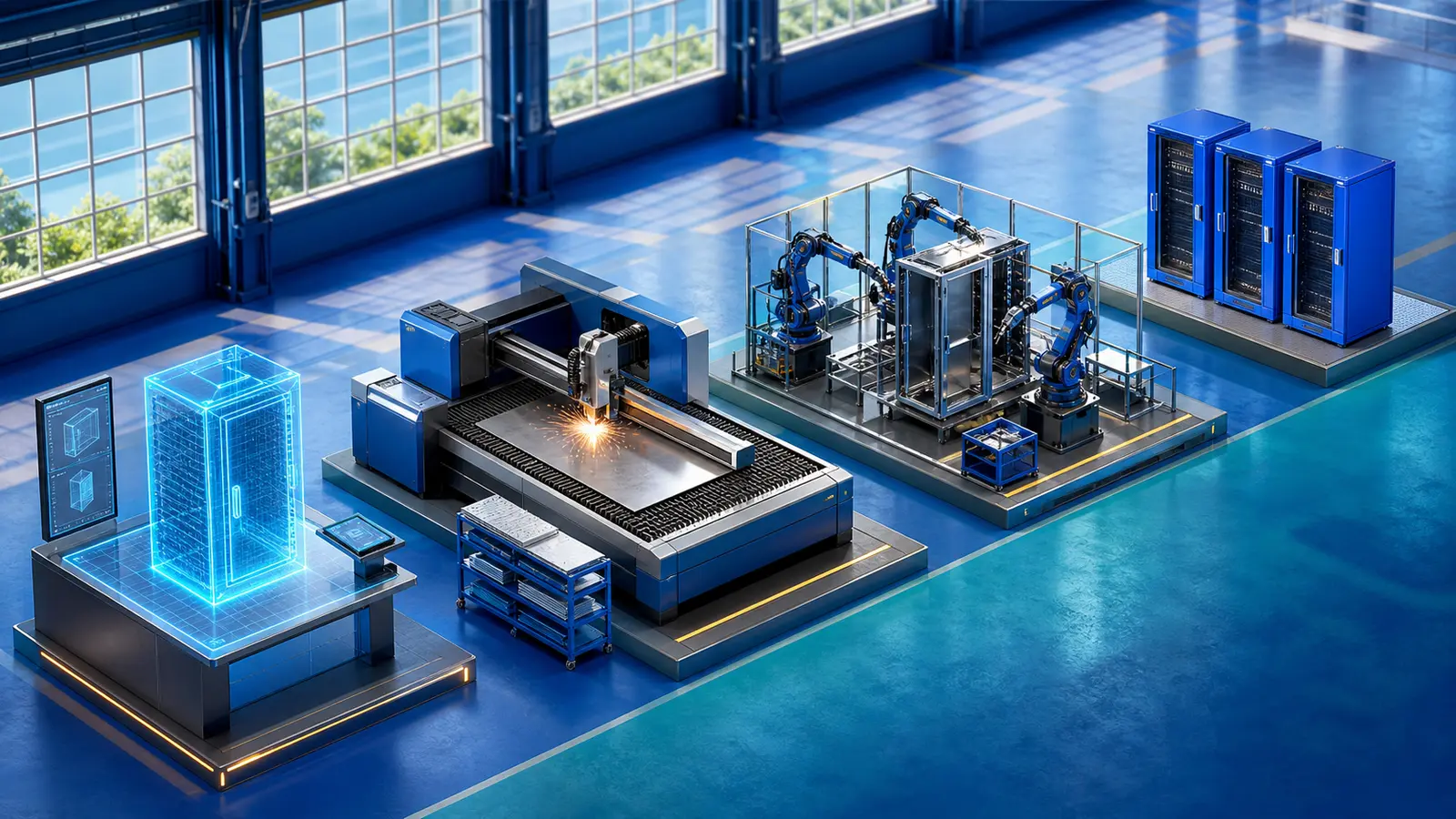
Foundational Industries has raised a $25 million seed round to develop factories designed around artificial intelligence from the beginning, rather than adding isolated automation to an existing production line. Fortune reported the financing on July 30, 2026. BoxGroup and Zigg Ventures led the round, with several other venture firms participating.
The company plans to start with custom rack enclosures for data centres. That choice gives the project a defined industrial product and a customer group facing unusually rapid technical change. New AI chips can require different power, cooling and physical configurations, so data-centre developers, specialised cloud operators and chipmakers may need hardware that cannot be supplied efficiently through a slow, standardised catalogue.
A factory built in software before it is built in steel
Chief executive Jonathan Winer told Fortune that the seed capital is not intended to finance a giant plant immediately. The near-term objective is a minimum viable product. Foundational Industries says it has already modelled the complete factory in software with emulators, allowing the team to test how product specifications should become bills of materials, manufacturing instructions and machine activity before committing to a large physical footprint.
This sequence reverses a familiar automation programme. A conventional manufacturer usually begins with an operating plant, identifies repetitive tasks and installs a robot arm, inspection camera or planning application around equipment that is already in place. An AI-native factory starts with the desired product and treats software as the coordinating layer for the complete production system. Machines, workflows and quality controls are then selected to serve that model.
What the seed round must prove
- Product intent can be translated into an accurate bill of materials and a workable manufacturing process.
- Software emulation can identify bottlenecks before expensive machinery and floor space are committed.
- A flexible line can make customised rack enclosures without losing cost control or delivery reliability.
- Quality data can move back into the design model so that each production cycle improves the next one.
The proposition is attractive because design and manufacturing changes are often separated by organisational boundaries. Engineers revise a product, procurement teams find components, production planners allocate equipment and operators discover practical constraints on the floor. Every transfer creates delay and the risk of lost information. A common software model could shorten that chain, but only if its instructions remain compatible with material availability, machine tolerances and real quality requirements.
Data-centre hardware is a demanding first market
The first product category creates both opportunity and risk. Investment in AI computing is increasing demand for racks, cooling systems, power equipment and the metal structures that hold them. At the same time, hardware configurations can change as chip density and thermal requirements evolve. A factory able to move quickly from specification to production could serve smaller or more specialised orders that are inconvenient for high-volume plants.
Yet rack enclosures are physical products, not software demonstrations. They must arrive on time, fit the intended equipment, support the required loads and integrate with power and cooling systems. Raw material prices, component lead times, fabrication yield and transport costs still determine the economics. Foundational Industries therefore has to show that an intelligent planning layer improves the complete operating result, not merely the speed of producing a digital design.
Winer previously spent six years at Alphabet's Sidewalk Infrastructure Partners, where Fortune says he helped deploy more than $1 billion. That background links the new venture to infrastructure finance as well as software. Building a repeatable factory model requires decisions about capital intensity, capacity utilisation and customer commitments. The seed round can fund development and validation, but later expansion will depend on evidence that each additional production cell creates predictable throughput and margins.
Metrics that will separate a factory from a prototype
- Time from a customer's approved specification to the first conforming unit.
- First-pass yield and the cost of scrap, rework and late engineering changes.
- Machine utilisation across orders with different sizes and configurations.
- On-time delivery, warranty claims and the stability of supplier lead times.
- Capital required for each unit of repeatable annual production capacity.
The larger wager is flexibility rather than labour cost
The company presents its approach as a response to the dense manufacturing ecosystem of China. Fortune reported Winer's view that competing only through cheaper labour or by copying existing automated plants would not create a durable advantage. His alternative is to use strong AI models and abundant computing capacity to compress the work between a customer's product request and a manufacturable process.
For the United States, the strategic claim is that flexible, software-defined production could make smaller runs and frequent design changes more economical. That would not replace the scale advantages of established industrial clusters. It would target a different problem: products whose technical requirements change too quickly for a rigid, continuously loaded line.
The distinction is important for customers. A data-centre operator does not buy an abstract national manufacturing strategy; it buys equipment at an agreed specification, price and delivery date. Foundational Industries will be judged by those commercial outcomes. If the software can reduce engineering cycles while maintaining quality, the model may expand beyond rack enclosures. If physical execution remains slow or expensive, a sophisticated digital factory will not by itself create a competitive business.
The $25 million round therefore finances a test of industrial architecture, not proof that the architecture has already won. The next milestones are concrete: turn the simulated factory into operating equipment, deliver conforming products, learn from production data and demonstrate that flexibility pays for the added software and engineering. Success would show that AI can coordinate manufacturing as a whole. Failure would underline how much of factory economics still depends on disciplined physical execution.
















ADI News
Leave a comment