

Crusoe is committing $200 million over the next year to expand a modular data-centre business built around transportable computing units. Forbes reported the expansion on March 12, 2026. The plan includes a new 350,000-square-foot factory in Brighton, Colorado, where five production lines and about 200 employees are expected to manufacture the Crusoe Spark systems.
Each Spark unit is roughly the size of a shipping container and provides about one megawatt of computing capacity. Crusoe intends to produce as many as 100 units a year, with the first factory output due during the summer of 2026. The product is aimed at artificial-intelligence inference: the continuous, commercial work of running trained models for customers rather than the exceptionally large computing campaigns used to train them.
Modular capacity shortens the path from order to revenue
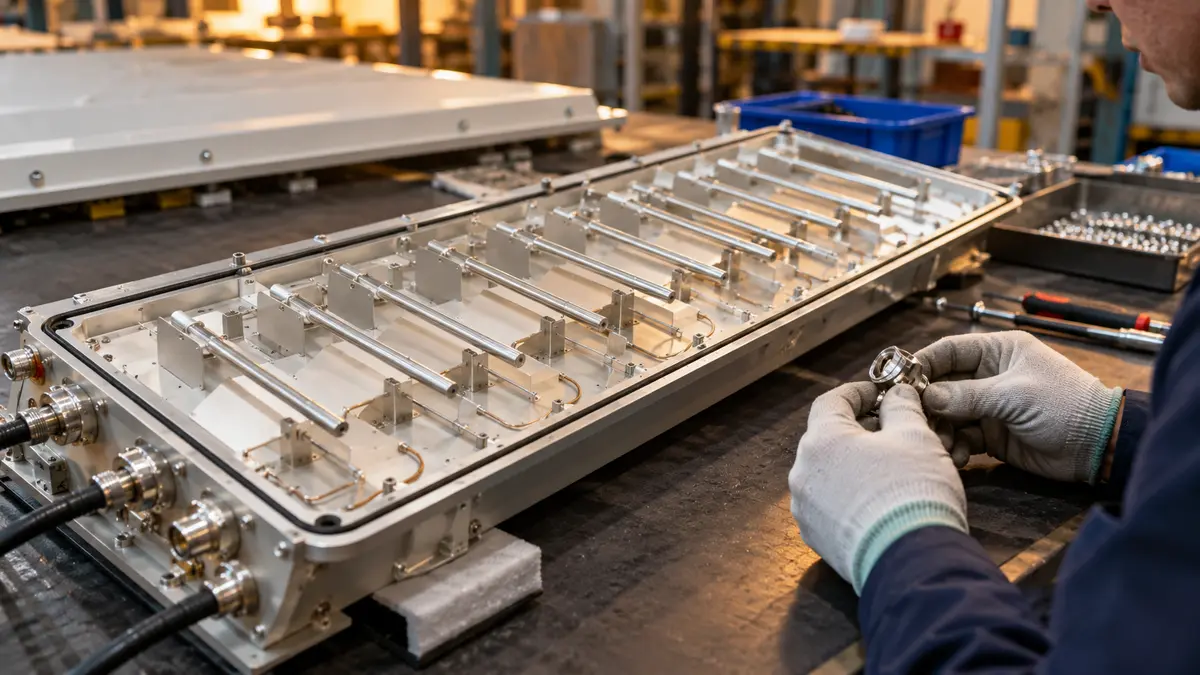
A conventional hyperscale campus requires land, grid connections, major buildings and a long sequence of engineering approvals. A prefabricated module shifts more of that work into a controlled factory. Server racks, cooling systems, power distribution and monitoring equipment can be installed and tested before delivery. Customers still need a prepared site and an adequate electricity supply, but they receive a repeatable block of capacity instead of coordinating every component as a separate construction project.
That distinction matters when demand changes faster than utility infrastructure can be expanded. A company can add one module, measure utilisation and install another when demand becomes visible. The approach does not eliminate capital risk, yet it divides one large commitment into smaller decisions. It can also bring computing closer to users whose workloads need rapid responses or whose data should remain on their premises.
What the Colorado factory is designed to provide
- Five production lines for repeatable assembly rather than one-off site construction.
- About 200 manufacturing jobs across a 350,000-square-foot facility.
- Annual capacity for as many as 100 modules of approximately one megawatt each.
- Pre-installed computing, cooling and electrical equipment that can be tested before shipment.
- A faster route to deploy inference capacity near customers or within private facilities.
Crusoe is balancing modular systems with hyperscale projects
The factory does not represent a retreat from very large data centres. Crusoe is also involved in the 1.2-gigawatt Stargate campus in Abilene, Texas, where individual buildings are designed to draw more than 100 megawatts. Co-founder Cully Cavness described the combination as a barbell strategy: the company wants exposure both to enormous training campuses and to smaller units that can be manufactured, transported and installed in increments.
The two formats solve different commercial problems. Hyperscale construction concentrates huge quantities of processors and power in one location, which suits demanding training workloads and customers able to make long commitments. Modular infrastructure emphasises speed, flexibility and proximity. Hospitals, industrial groups and other organisations may prefer private on-site capacity for security or latency reasons, while cloud customers can use units located closer to their applications.
Crusoe currently sells the computing capacity of its Spark units through its own cloud service. AI video company Decart is among the customers cited by the source. Crusoe is also considering an Edge Zones offering that would place modules at customer locations and sell the available computing capacity there. That service had not yet been deployed when the plan was reported, so the factory investment should not be read as proof that every proposed distribution model is already operating.
Commercial indicators to follow
- Whether the first units leave the Brighton factory on the announced summer schedule.
- Factory throughput, order backlog and utilisation across the five production lines.
- The time required to connect delivered modules to power, fibre and customer workloads.
- Demand from customers that need inference capacity rather than model-training clusters.
- Margins after equipment purchases, transport, installation and continuing cloud support.
A growing market still carries execution risk
Modular data centres are not a new category. Established infrastructure suppliers already sell packaged systems, and new entrants are pursuing the same promise of faster deployment. Crusoe therefore has to compete on more than the shape of the enclosure. It must demonstrate efficient cooling, dependable power management, useful software, predictable delivery and enough access to processors for customers to treat Spark as a complete service rather than a metal box.
The market outlook provides room for several competitors. JLL projected that global annual sales of prefabricated data centres could rise from $11 billion in 2025 to $48 billion by 2030. Such forecasts are not guaranteed demand. Orders can slow if artificial-intelligence investment weakens, if processors remain scarce or if customers discover that grid access is still the dominant constraint. Factory capacity may improve construction speed without solving the local permitting and electricity challenges at every destination.
For the technology industry of the United States, the Brighton project illustrates a shift from treating data centres only as immovable property toward manufacturing them as repeatable industrial products. The investment will be validated by delivery performance rather than by factory size alone. If Crusoe can turn standardised one-megawatt modules into dependable, occupied computing capacity, Spark could give the company a second growth path alongside giant campuses. If installation remains constrained by power, chips or customer economics, the new lines may simply move the bottleneck from construction sites to the factory floor.



















ADI News
Leave a comment