
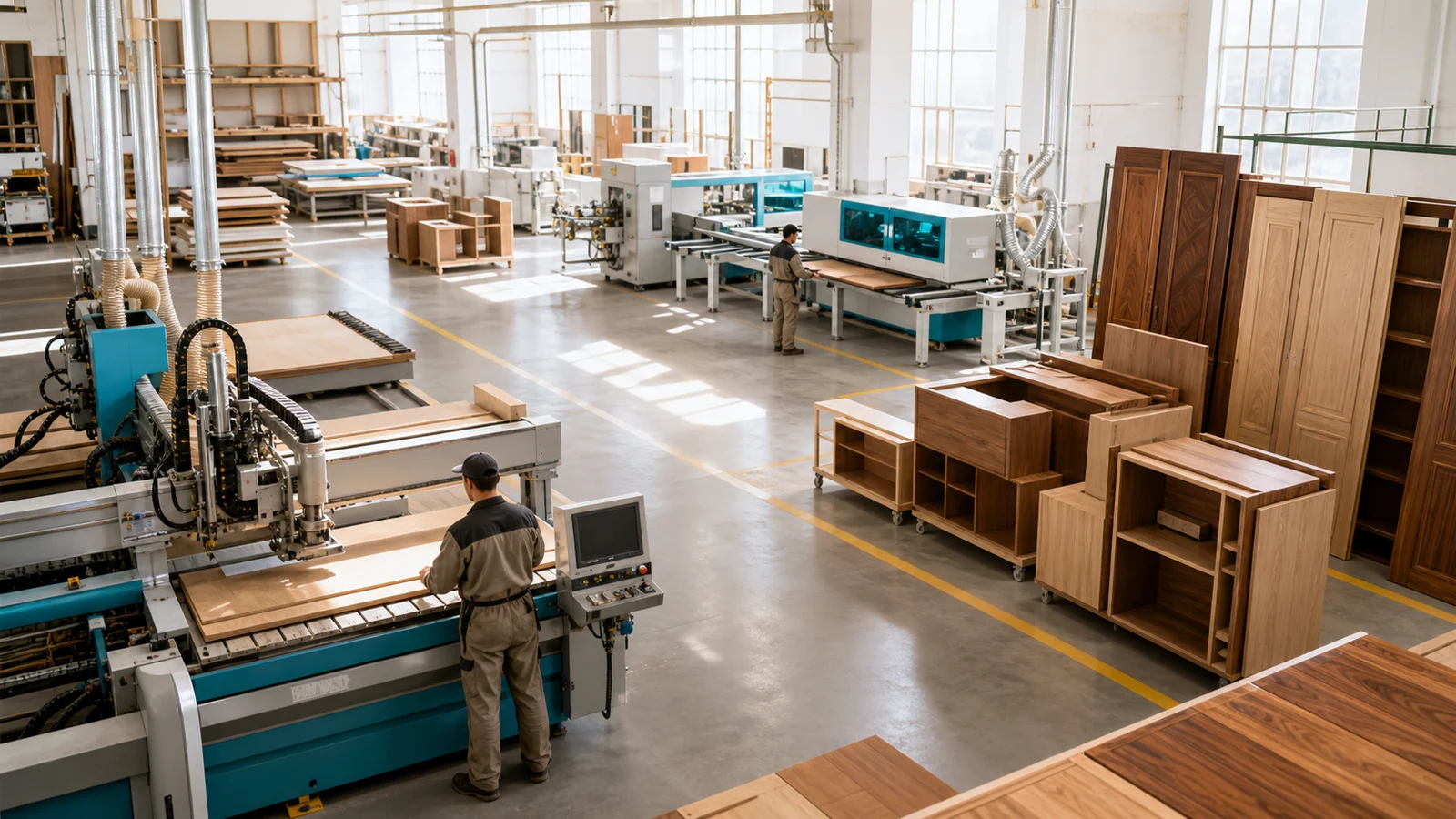
On 6 February 2024, Saint Petersburg furniture maker Atlant Wood, which sells under the Brightberry brand, announced a new production site in Vartemyagi in the Vsevolozhsk district of the Leningrad region. Investment totalled 140 million roubles. According to Vedomosti North-West, the company provided 90 million roubles of its own money for land and construction and borrowed another 50 million from a small-business credit support fund to buy equipment. The opening was planned for April.
The project matters to manufacturing in Russia as an example of regional expansion in which a public finance instrument supplements rather than replaces the owner's capital. The 1,500-square-metre production area was intended to operate alongside an existing 920-square-metre workshop in Parnas. Total manufacturing space would rise 2.6 times to 2,420 square metres, while a further 350 square metres would house an office and showroom.
Why the company is keeping its old workshop
Atlant Wood designs and makes doors, fitted cabinets and freestanding furniture for the premium segment, often using valuable timber species. Orders arrive through architects and designers rather than mass-market shopping centres. Moving the entire operation to a larger serial-production site could undermine the advantage of individual customization. The new factory was therefore intended mainly for large cabinet components and processes where manual work does not create additional customer value.
The existing Parnas workshop, already operating at full load, would remain responsible for more flexible processes. This division aligns two different production rhythms: machinery can cut and finish panels quickly and accurately, while the workshop adapts each item to a particular interior, material and design. Expansion in this model does not merely duplicate the old site. It changes the route that an order follows through the company.
The project economics in five figures
- 140 million roubles of investment. The amount covers land, construction and machinery, so the return must be assessed across the whole production system.
- 90 million roubles of internal funds. The owner retained the main financial responsibility for the expansion.
- 50 million roubles of borrowed finance. Targeted funding paid for equipment that directly increased productive capacity.
- A 2.6-fold increase in space. Manufacturing premises expanded from 920 to 2,420 square metres without abandoning the old site.
- A 200-million-rouble revenue target. After about 120 million roubles in 2023, the company aimed to grow by more than 60% by 2026.
A market opening does not remove competition
The expansion followed a sharp decline in the share of imported furniture. Vedomosti cited an industry estimate showing imported products falling from 49% of sales in 2019 to 24% in 2023. A weaker rouble and more difficult logistics made foreign bedrooms, doors and hall furniture more expensive, giving local factories room to grow.
An open niche does not guarantee orders, however. Foreign manufacturers can change routes, lower costs and return through new channels. Affluent buyers compare quality, lead time and service rather than choosing a domestic item solely because of its origin. Investment must therefore create a measurable advantage: shorter delivery, less waste, more accurate components or a broader range without sacrificing customization.
Kommersant Saint Petersburg confirmed the financing structure and planned April opening. For a smaller manufacturer, it was especially important that the loan was tied to machinery. A long-lived productive asset should not be financed entirely through a short-term credit line that must be repaid before new capacity generates stable cash flow.
Furniture production follows the local property cycle
Import substitution was not the only source of demand. Expert North-West connected furniture growth with housing completions and purchases by state-owned companies. A new apartment, hotel or public building creates sequential demand for kitchens, storage systems, doors and interior solutions. Factory utilization therefore depends on the construction cycle, designer activity and contractors completing projects on schedule.
Regional data showed rapid growth from a low base. Furniture output increased 23.2% in Saint Petersburg during 2023 and 21.4 times in the Leningrad region. Those percentages need careful interpretation. They capture the restart of individual producers and the launch of capacity, but they do not guarantee the same trajectory for every participant. A company must assess its own order book, margin and machine utilization rather than building a budget around an industry index alone.
The main business conclusion
The Atlant Wood project shows how a small or medium-sized industrial company can expand without abandoning its specialization. Automating repeatable processing of large components frees craftspeople to concentrate on work for which customers genuinely pay a customization premium. Combining internal and borrowed funds also limits leverage and links the loan to a specific production outcome.
The true test will not be the floor area of the new building or the opening date, but the ability to turn additional machinery into paid orders. That requires a steady flow of projects from architects, schedule discipline, quality control and coordinated utilization of both sites as one system. The transition from 140 million roubles invested to durable revenue growth will determine whether the expansion becomes a lasting competitive advantage.
















ADI News
Leave a comment