
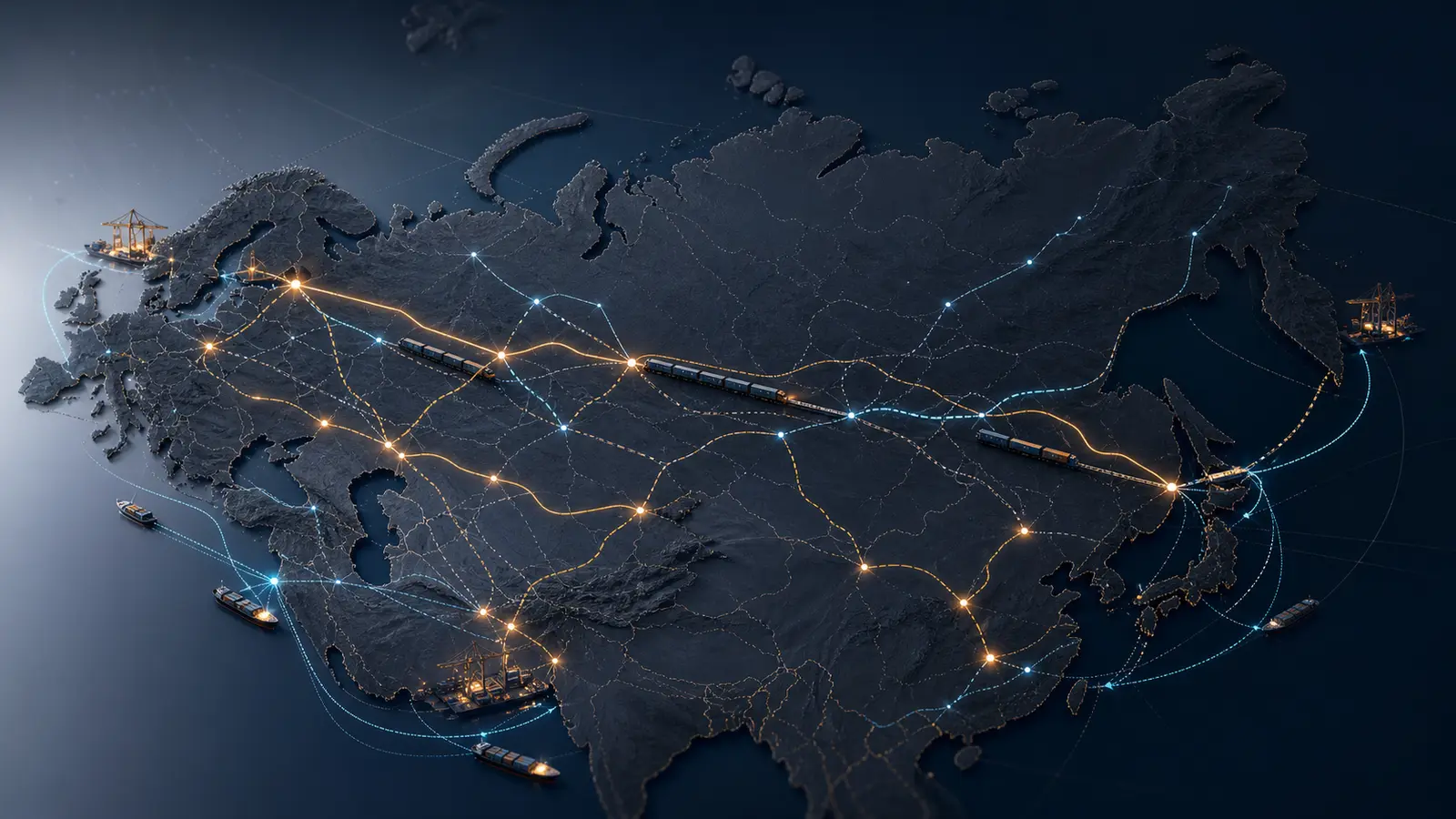
Russian cross-border logistics entered an unusual phase in spring 2025. Emergency route reconstruction was no longer a daily crisis, yet the new system had not become cheap, even or predictable. Most companies did not expect a radical change in transport geography before year-end. That calm meant consolidation of a new set of constraints, not a return to the old normal.
Interfax reported on May 28, 2025 that companies surveyed by the Bank of Russia's regional branches considered logistics a moderate influence on foreign-trade volumes. Product demand and sanctions remained stronger factors. At the same time, businesses continued to face limited capacity, congested nodes and unequal access to rail, road and maritime services.
For companies in Russia, the central management lesson is that a resilient route cannot be judged only by distance and freight rate. It is a system of ports, railways, border crossings, warehouses, documents, payments and partners. If one element has no reserve, a formally open corridor can remain commercially unreliable.
Logistics in 2025 therefore became an exercise in allocating scarce capacity. The strongest operator is not the one that finds a single short line. It is the one that can reserve space early, switch modes, see cargo throughout the journey and share risk clearly with service providers.
Stable geography does not mean an unchanged system
The survey indicated that most enterprises were not planning a major redirection of cross-border cargo before the end of 2025. At first glance, that suggests adaptation was complete. In practice, stability may have emerged because available directions had already been selected, contracts had been rebuilt and infrastructure left limited room for another maneuver.
A route gains inertia after a company finds a carrier, establishes a payment channel, agrees customs procedures and adds a time buffer. Another redesign requires testing, deposits and management attention. The absence of a plan to change is not proof that the current scheme is optimal; it may reveal the high cost of the next transition.
Executives should distinguish three states. First, a route operates regularly. Second, it can absorb a seasonal peak and a local disruption. Third, the company can transfer volume quickly to a genuine alternative. Many chains reached the first state, some reached the second, and relatively few approached the third.
This distinction changes the meaning of reliability. Several consecutive arrivals do not make a system resilient. Management needs the distribution of transit times, delay frequency, wagon and container availability, border dwell time and the cost of an emergency switch.
Transport modes moved in different directions
The Bank of Russia's May Regional Economy report described a mixed first quarter of 2025 compared with the same period of 2024. Surveyed enterprises reported deterioration in rail freight, little change in road haulage and improvement in maritime logistics.
That divergence matters more than an average. An exporter dependent on rail could face scarcity while a maritime operator gained options. Trucks retained their last-mile flexibility, but their performance depended on crossings, permits, drivers, fuel and vehicle condition.
The report said domestic rail freight volume fell 6.8% year on year in January through April 2025. A decline does not automatically create spare capacity on the route a customer needs. Trains, tracks and terminals cannot be moved instantly between regions or cargo classes, while network priorities can preserve local scarcity.
Maritime transport benefited from additional services and the ability of shipping lines to connect different ports. Port capacity nevertheless depends on approaches, depth, cranes, yards and inland evacuation. Improving one leg can merely transfer pressure to the next node.
Asia became the base while diversification continued
The Bank of Russia said Asian countries remained the main foreign-trade direction for surveyed enterprises. Companies were also expanding relationships with counterparties in the Middle East, Africa and Latin America. This creates a broad geography of demand but does not automatically produce a broad transport system.
Every new market requires its own intermediaries, documents, packaging rules and insurance. A maritime shipment depends on liner schedules and transshipment ports; rail depends on gauge changes, terminals and block-train formation; road depends on border regimes and permits. A commercial team can open a country faster than operations can learn to serve it reliably.
Diversification matters when directions are genuinely independent. Two routes that cross the same terminal or use one payment intermediary look separate on a map but share a failure point. Risk management must measure the overlap of critical dependencies rather than the number of route names.
New geography also changes the cash conversion cycle. A longer leg locks money in inventory and receivables. Even when the freight rate is acceptable, extra weeks in transit increase working-capital needs and magnify a forecasting error.
Infrastructure constraints become a business price
When capacity is scarce, the price appears beyond the carrier's invoice. A company pays through demurrage, storage, urgent handling, document corrections and safety stock. These expenses sit in separate budgets and can remain invisible to the transport buyer.
The true route cost should be measured from product readiness to cash receipt. If a cheaper option adds an unpredictable week, it may increase bank financing, penalty exposure and inventory. A more expensive service with a narrower time range can have the lower total cost.
Scarcity also reverses negotiating power. During a quiet period, shippers choose among carriers. Before a peak, carriers select cargo that offers attractive utilization and revenue. A long-term agreement, accurate forecast and disciplined tender become economic assets.
Investment in terminals and approaches has two effects: it expands physical throughput and reduces variability. The second can be more valuable because predictable timing allows customers to carry less protective inventory and promise delivery dates with greater confidence.
What managers should measure for every corridor
- median transit time and its distribution, not only the scheduled standard;
- dwell time at terminals and border crossings;
- the share of shipments requiring emergency intervention;
- total cost including storage, financing and idle time;
- available reserve capacity during the seasonal peak;
- the time and price of switching to an alternative transport mode;
- volume concentration at one operator, node or payment channel.
Rail requires queue management, not just rate negotiation
Rail is efficient over long distances and for heavy consignments, but the network operates as a shared resource. Constraints at approaches, marshalling yards and crossings create queues that one commercial contract cannot remove. A loading plan must reflect the actual availability of paths, locomotives and wagons.
Companies sometimes optimize the line-haul rate without testing the reliability of the departure station, block-train formation or inland delivery at destination. Savings on the principal leg then disappear in waiting time. Control must extend from the supplier's warehouse to the buyer's receiving point.
A shipper can divide traffic into a base volume and a flexible share. The base is committed for a longer period, giving the carrier predictable utilization. The flexible portion moves between routes according to actual conditions. This portfolio costs more than the lowest paper quotation but is more resilient than a single channel.
Better planning provides another reserve. An inaccurate forecast makes the network hold capacity that goes unused or creates sudden demand without rolling stock. Joint weekly and monthly plans can turn information discipline into effective additional throughput.
Road flexibility has a concealed ceiling
Trucks can alter direction quickly and serve locations without developed rail infrastructure. They consequently became an important adaptation tool. Yet a large vehicle fleet does not guarantee scale: traffic converges on a limited number of crossings and customs facilities.
The Bank of Russia report connected higher road-logistics costs with driver pay, vehicle maintenance and fuel. In some regions, competition from carriers based in Asia and the Commonwealth of Independent States restrained prices, but it did not remove physical limitations.
A cargo owner must look beyond the rate per kilometer. Fleet condition, insurance, driver-hour compliance, subcontracting transparency and tracking determine the probability of failure. A low-cost contractor without reserve becomes the most expensive after the first breakdown or border queue.
Road transport is particularly valuable as a bridge between trunk modes. If a terminal can receive a container from a train or vessel and dispatch it quickly by truck, the whole system becomes more flexible. Without synchronized schedules, the truck merely moves waiting time from one yard to another.
Maritime services expand choice and create new controls
The improvement in maritime logistics reported by enterprises shows the market's ability to open services and adapt port chains. A vessel can move a large consignment and connect distant markets, but schedules, transshipment and container availability generate their own volatility.
Maritime diversification requires more than comparing ports of origin. Managers must examine the transshipment hub, feeder reliability, sanctions exposure of participants, insurance and equipment-return options. One liner decision can affect the entire round trip of a container.
A port cannot be analyzed separately from land transport. Higher handling volume without rail and road evacuation creates yard congestion. Conversely, a strong inland approach is of little use if vessel calls are rare or crane capacity cannot handle the peak.
An investment project should therefore be assessed as one connected package. Berth, terminal, warehouse, customs and inland links must enter service in coordination. The weakest element will determine system output even when every other asset has a wide margin.
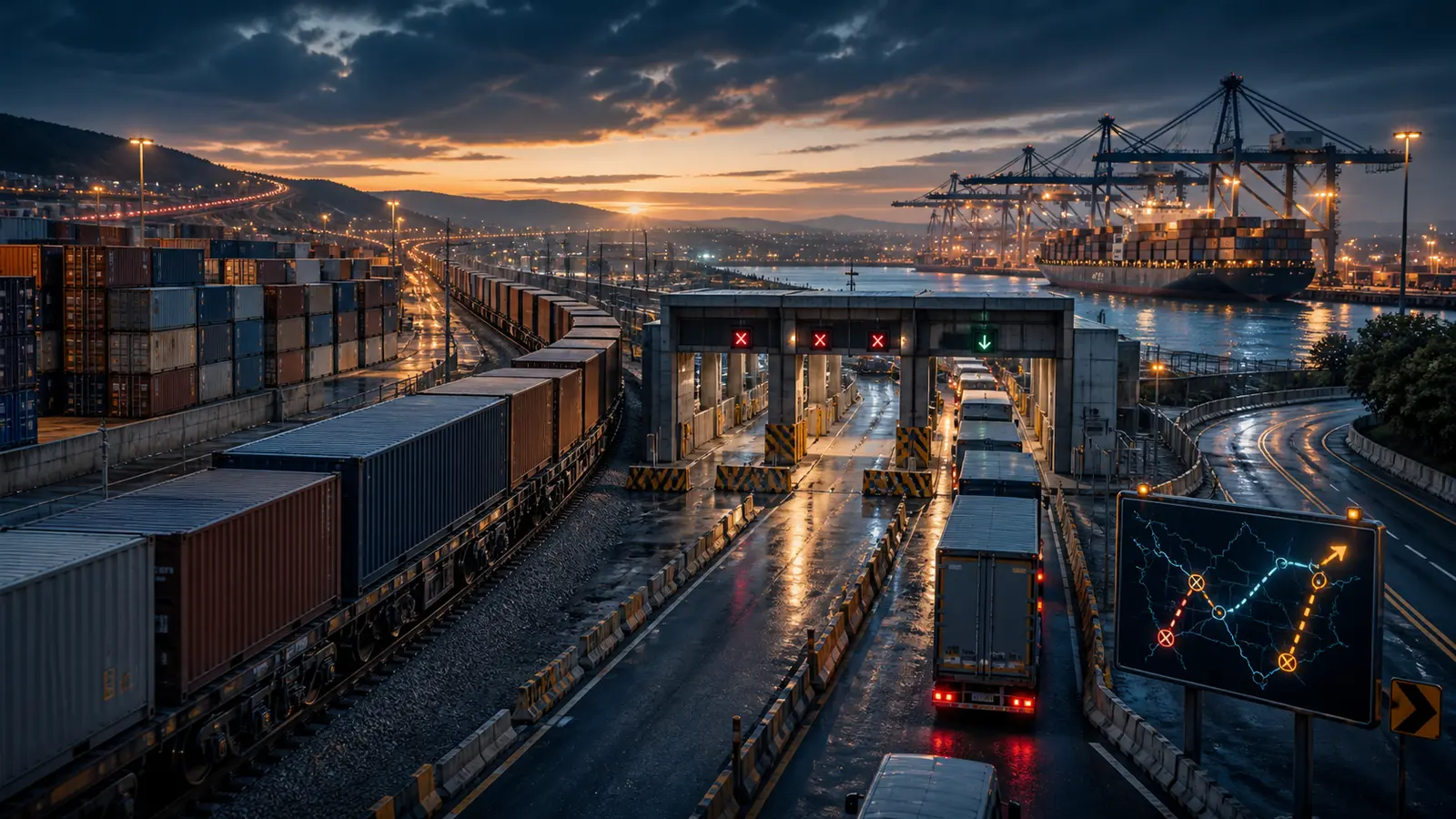
Digital visibility becomes operational capacity
Physical infrastructure takes years to build, but information can remove part of the loss sooner. When participants know the arrival time, document status, cargo type and yard availability, they allocate slots, machines and staff more precisely. Incomplete information forces everyone to create a buffer.
One shipment identifier and a consistent event history give the cargo owner more than an attractive map. They allow action: the owner can locate a deviation, identify responsibility and activate reserve before production stops or a vessel is missed.
Digitalization should not mean dependence on one closed interface. Data must be exportable, transferable to the next operator and comparable across routes. Otherwise the technology platform becomes a new bottleneck and changing the carrier destroys the measurement history.
The greatest value appears when operating events connect to finance. A delay automatically updates the expected cash date, borrowing cost, inventory need and penalty exposure. Dispatch decisions then reflect the economics of the entire transaction.
Contracts must allocate delay risk
A traditional contract specifies rate, duration and liability, but a complex chain contains several independent providers. When each accepts responsibility only for its leg, the cargo owner remains the sole integrator and pays for gaps between contracts.
End-to-end measures are more useful: time from receipt to release, completeness of tracking events, response time after a deviation and the switching procedure. A penalty does not deliver cargo. Predefined authority and accessible reserve matter more.
Force majeure should not become a universal explanation. Parties can list verifiable events, notification procedures and the duty to propose an alternative. This separates an unavoidable incident from weak planning.
A long relationship is justified when a carrier invests in capacity and quality. Exclusivity without measures creates dependence. A balanced model combines a primary partner, reserve operators and regular tests of the alternative route with small real consignments.
Inventory should reflect route variability
Safety stock is often set as a general number of days. That conceals differences: one component follows a stable route, while another crosses several congested nodes. Inventory should reflect transit-time distribution, component criticality and the speed of restoring an alternative.
Excess stock is not free resilience. It occupies space, locks capital, ages and conceals weak planning. Too little inventory transfers every delay to production. Balance requires logistics data, demand forecasts and the economic cost of stoppage in one model.
For an exporter, the equivalent buffer is time and liquidity. A longer cycle means later revenue, so advance payments, insurance and credit limits are part of route architecture. The chief financial officer and logistics director should work from the same cash-flow scenario.
Scenario analysis is more useful than one average. The base case represents normal operation, a stressed case covers a seasonal queue, and a critical case closes a node. Each needs a decision, owner, spending limit and trigger for reserve activation.
Investment should be judged by its system effect
The Bank of Russia noted that transport investment and route expansion could make logistics more efficient and create opportunities for enterprises in global markets. To realize that potential, capital must remove the constraint that limits the whole chain.
A new terminal may look impressive but create little value without an access track, customs shift or data exchange. Modernizing a modest crossing can sometimes deliver more benefit than a large asset that already has spare capacity.
Government and business need compatible measures. Public authorities evaluate freight flow, regional connectivity and export potential; cargo owners examine time, cost and variability. A durable project improves both sets rather than moving the queue elsewhere.
Phased commissioning reduces risk. Demand and process are tested on a limited volume before capacity expands. This reveals documentary and operating barriers before they are built into expensive infrastructure.
A practical corridor-management model
A company can begin by mapping flows according to revenue, margin and criticality. Each direction receives a primary and reserve route, shared nodes, financial intermediaries, minimum inventory and maximum acceptable transit time. The business must own this map rather than leaving it with one forwarder.
Next comes a small exception-control function. It does not interfere with every shipment; it receives an alert when a measure leaves its range. The team has authority to redirect cargo, use an agreed budget and inform the customer before a promise is broken.
Providers are ranked by actual reliability and data quality. A low quotation does not compensate for absent status messages, recurring delays and opaque subcontracting. Procurement should include total cost and the results of a reserve-scenario test.
Finally, executives review concentration every quarter. If a large share of margin depends on one crossing, port or operator, that exposure must be explicitly accepted or reduced. Logistics then becomes a managed portfolio rather than a collection of bookings.
The central lesson: the new normal needs reserve
Moderate expectations in spring 2025 did not mean cross-border logistics had become simple. They showed that companies had learned the available geography and moved from emergency reconstruction to daily constraint management.
Rail, road and maritime conditions developed differently. An industry average therefore cannot replace route-level analysis. A company needs to see the specific node, time distribution and switching cost rather than relying on a general transport indicator.
Infrastructure projects can expand opportunity, but coordination among all elements determines the outcome. Data, contracts, inventory and financing may improve practical resilience faster than new concrete, although they cannot replace physical capacity.
A strong chain does not promise that delays will disappear. It defines how a delay is detected, who decides, which reserve is available and how much it costs. Under that model, stable geography is not inertia; it is the outcome of a deliberately constructed network of alternatives.


ADI News
Leave a comment