
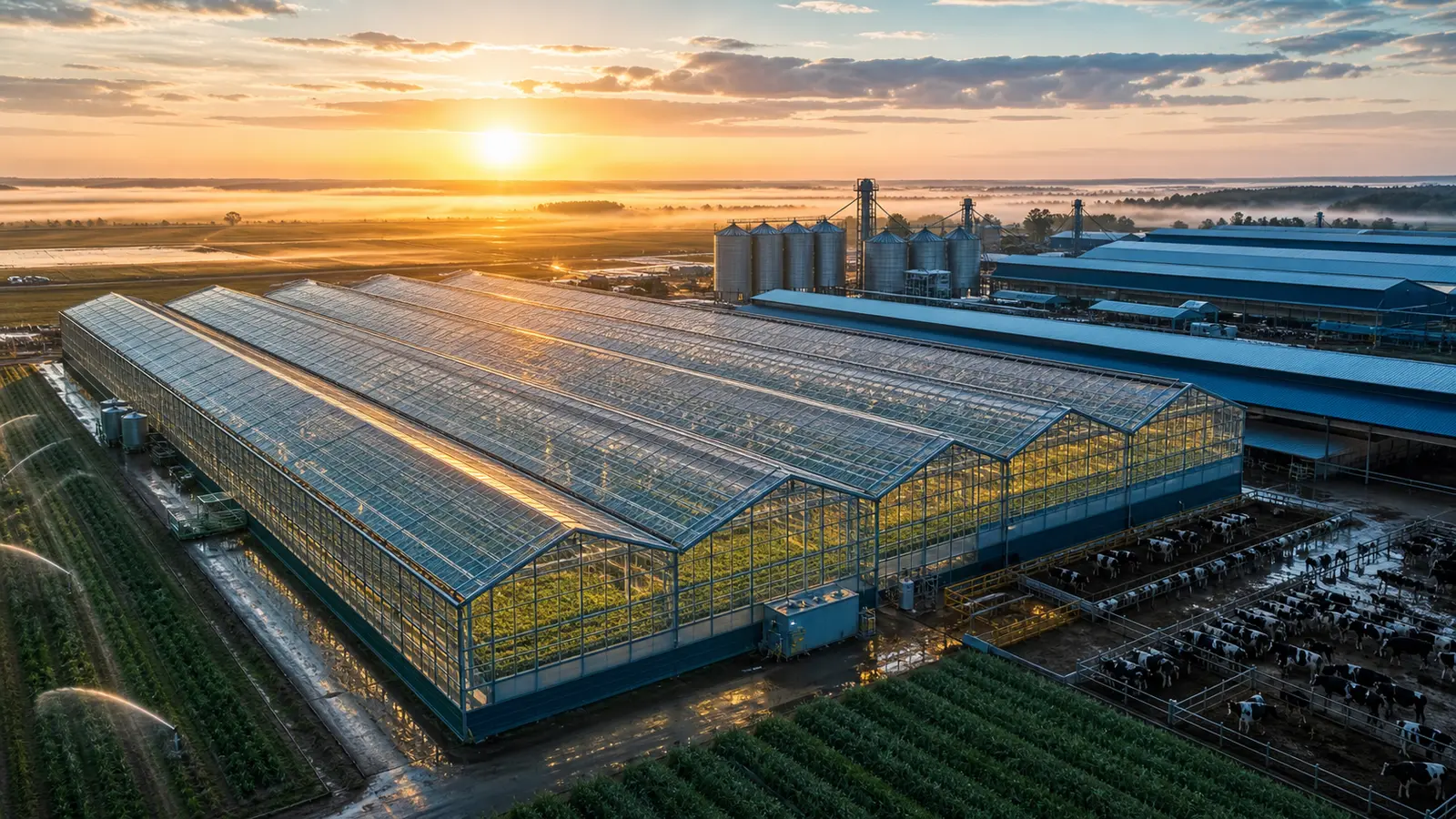
Russian agriculture entered the middle of 2025 with a paradox. Food demand remained essential, many producers had accumulated operational experience, and national policy continued to emphasize food security. Yet the number of new investment projects was falling sharply. Expensive money, rising equipment costs, labor shortages and uncertain regulation changed which projects could survive an investment committee.
Forbes Russia reported on June 26, 2025 that the number of agricultural investment projects in the first half of the year fell 32.8% from the same period of 2024. TenderPro estimated private projects at RUB245.69 billion at the end of June. This was not an absence of capital, but a narrowing gate through which mainly large, scalable and protected projects could pass.
For agricultural businesses in Russia, the central question became how to design an asset that could withstand both financial and biological volatility. A field, herd, greenhouse or processing line cannot be paused as easily as a software program. The financing schedule must respect seasons, living production systems and the long interval between construction and stable yield.
A 32.8% fall changed the meaning of the pipeline
The decline in project count was accompanied by concentration. TenderPro said 64.7% of companies investing in agricultural construction committed more than RUB1 billion. Diversification motivated 81.1% of projects, productivity 11.1%, and production expansion only 7.8%. Capital was therefore being used mainly to alter risk and business mix, not simply to add volume.
A project pipeline should be judged by probability, not announcement value. Land selection, grid connection, equipment ordering, construction and commissioning are separate gates. When 36% of projects launched during the previous year were frozen, the headline pipeline overstated future capacity. Of those paused projects, 71% had been shifted to the second half of 2025 and 29% to 2026.
Management needs a probability-weighted capital plan. Each project receives a readiness score, financing status, remaining permits and a latest useful start date. Money is reserved for the projects capable of crossing the next gate, while early concepts do not compete equally with assets already under construction.
The key rate rewrote project economics
A 21% central-bank key rate made ordinary debt difficult to reconcile with agricultural returns. Interest accumulated during construction and biological ramp-up before the asset produced full cash flow. A delay of one season could add a year to the repayment profile while input costs continued.
The correct comparison is not loan rate against expected accounting margin. It is debt service against downside cash flow after feed, seed, fertilizer, energy, labor, logistics and working capital. A project that works only under perfect yield and immediate design capacity is not financeable in an uncertain climate.
Longer equity horizons help large groups, but equity also has a required return. The project should be divided into independent productive stages where possible. A first barn, greenhouse block or processing module can create operating data and revenue before the whole complex is complete.
Scale became a form of financial protection
Large agricultural holdings could use positive cash flow from existing operations, spread specialists across several projects and negotiate with authorities. Scale also supported centralized procurement, logistics and sales. These advantages lowered the effective cost of a new asset even when its construction price was high.
Scale, however, does not automatically create resilience. A very large complex can magnify disease, energy or market concentration. It needs compartmentalized production, independent utilities, biosecurity zones and multiple sales channels. The design must prevent one failure from stopping the entire investment.
Smaller producers need a different path rather than a reduced copy of a holding company. Shared storage, machinery pools, cooperative processing and long-term customer contracts can create economic scale without transferring ownership. The governance of a shared asset must define priority, maintenance, pricing and exit before construction begins.
Weather risk redirected money toward controlled assets
The source linked investment in agricultural facilities to frequent transitions between frost and drought during 2024 and 2025. Open-field crops and orchards were directly exposed. Greenhouses, livestock buildings, storage and processing offer more control, although they introduce energy and technology dependence.
Climate adaptation must be evaluated as a portfolio. Irrigation without reliable water rights is incomplete. A greenhouse without affordable power may exchange weather risk for energy risk. Storage protects harvested value only if logistics and customer contracts can use the extended selling window.
Insurance, agronomy and engineering should share one scenario set. The company models yield, price, disease, power interruption and transport together. Correlated stress matters: drought can reduce harvest, raise feed prices and restrict water at the same time. Separate departmental models tend to underestimate this combined loss.
Regional distribution followed infrastructure and demand
The Central Federal District accounted for 29.2% of projects, the Volga district 26.2%, the Far East 12.3%, the South 9.2%, and the Northwest 8.5%. The pattern reflected more than available land. Processing capacity, roads, electricity, labor, consumer markets and regional support shape the usable return on a site.
A regional incentive cannot compensate indefinitely for weak logistics. Before accepting support, investors should calculate delivered cost to the final customer, seasonal route capacity and the availability of repair specialists. A cheap plot becomes expensive when every critical part travels across the country.
Regional diversification is valuable only when risks are genuinely different. Two projects in separate districts may still depend on one equipment supplier, one lender or one customer. A portfolio map should show common dependencies as well as geography.
Equipment and import substitution raised execution risk
Imported components, machinery, seeds and logistics were becoming more expensive. Replacing a supplier is not a one-time purchasing decision. Compatibility, productivity, maintenance, software, spare parts and warranties determine lifetime cost. A cheaper unit that causes lower yield or long downtime can be the most expensive option.
Procurement should qualify alternatives before a failure. Trial use on a limited line produces evidence without exposing the whole operation. Contracts need delivery milestones, acceptance criteria, parts availability and responsibility for integration. Technical documentation and training should arrive before commissioning, not after an emergency.
Local production can reduce currency and delivery risk, but only if volume supports quality and service. Producers, equipment makers and research institutions can share test facilities and standard interfaces. Such cooperation converts fragmented demand into a market capable of sustaining suppliers.
An agricultural investment control panel
- probability-weighted capital still required before first revenue;
- debt service coverage under yield, price and rate stress;
- construction readiness, permits and grid-connection milestones;
- cost per productive unit at partial and full utilization;
- exposure to one supplier, customer, route and source of energy;
- biological ramp-up and time to stable productivity;
- working-capital peak across the seasonal cycle;
- conditions that trigger redesign, delay or cancellation.
Labor shortages became a capacity limit
Modern farms need veterinarians, agronomists, automation technicians, machine operators and managers able to connect biology with finance. A building can be completed faster than this team can be formed. Labor therefore belongs in the feasibility study, not in a recruitment plan written near commissioning.
Automation reduces repetitive work but increases the cost of technical failure. A producer needs remote diagnostics, spare parts and employees capable of manual fallback. Technology that depends on one specialist or one distant service team creates hidden downtime risk.
Training partnerships with regional colleges can build a local pipeline. Housing, transport and predictable schedules may be as important as salary. Retention should be measured through productivity and critical-skill coverage, not only overall turnover.
Food demand did not guarantee pricing power
The source cited only 2% growth in food retail sales by physical volume in the first quarter of 2025 and limited ability to pass rising costs to consumers. Essential demand may be stable, but competition and household budgets constrain the price of each product.
An investment model must separate nominal revenue growth from volume and margin. Inflation can raise sales while real throughput falls. Producers need product-level contribution after promotions, logistics, spoilage and customer payment terms.
Long-term supply agreements can support financing, but they should allocate changes in feed, energy and packaging fairly. A fixed selling price with floating inputs transfers all macroeconomic risk to the producer. Indexation and volume corridors create a more durable relationship.
Dairy and poultry attracted capital for specific reasons
Dairy farms represented 25.9% of projects, poultry 18.8%, greenhouses 12.7%, crop facilities 11.2%, and feed production 10.6%. Dairy and poultry serve recurring consumer demand, while poultry has a relatively fast production cycle and stronger domestic substitution of inputs.
Preferential finance mattered. The source said the dairy sector began 2025 with an 8.3% concessional rate while the key rate was 21%. That difference can change whether a project has positive value. Yet subsidized funds are limited, so a viable project needs a plan for delay, refinancing or a smaller first stage.
Over the previous decade, about RUB500 billion had been invested in dairy processing and more than RUB1 trillion in raw-milk production. Future opportunity lay in replacing inefficient farms, modernizing dry and exchange-traded dairy products, and deeper processing for ingredients and exports. Each direction has a different customer and risk structure.
Regulation can consume productive capital
Some past investment was compelled by labeling, treatment facilities, recycling charges and other rules. Compliance may produce public value, but repeated or unclear changes shorten planning horizons. A facility designed under one requirement can need redesign before it earns a return.
Companies should maintain a regulatory capital register. It separates mandatory spending, productivity spending and growth spending, then shows dependencies between them. This prevents compliance from being mistaken for discretionary expansion and exposes the amount of capital unavailable for output.
Regulators can improve investment quality through transition periods, stable technical standards and digital approvals. Early consultation costs less than rebuilding a facility. Rules should specify outcomes while allowing competing engineering methods where safety permits.
Frozen projects require active preservation
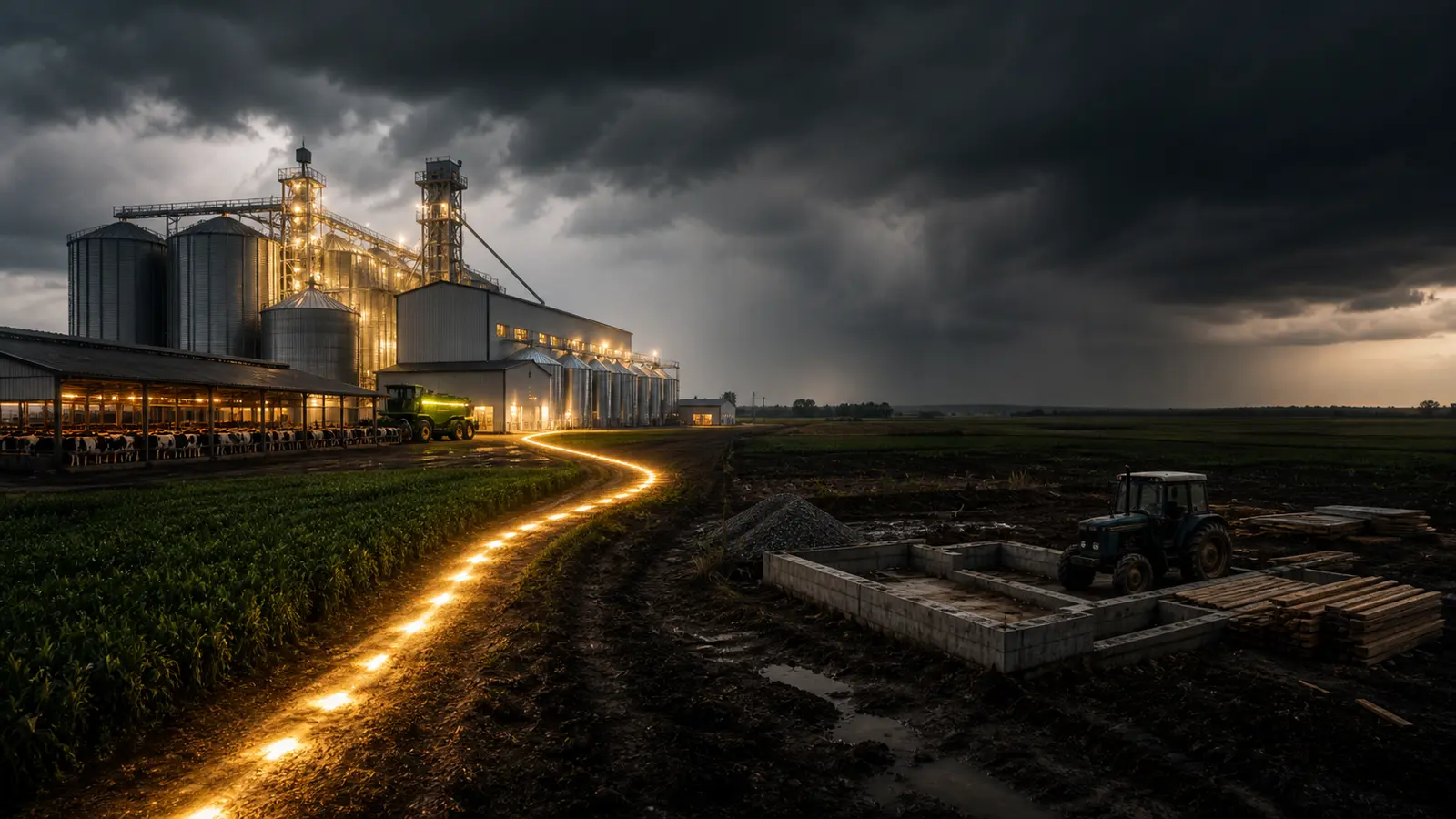
Pausing construction is not the absence of a decision. Foundations weather, equipment warranties expire, permits lapse and contractors leave. A frozen project needs a preservation budget, technical inspections and a named restart threshold.
Management should update the business case instead of defending sunk cost. Money already spent is not a reason to complete an asset whose future cash flow has deteriorated. At the same time, abandonment without securing equipment and land destroys option value.
A restart review should include current construction cost, remaining useful design, financing availability, customer demand and biological timing. If these do not support completion, sale, partnership or redesign may recover more value than another postponement.
Project finance must follow the biological clock
Agricultural assets have two commissioning curves: technical completion and biological productivity. A barn may open before a herd reaches planned output; an orchard needs years; a greenhouse staff needs several cycles to stabilize quality. Debt schedules based only on construction underestimate this ramp.
Working capital also peaks before revenue. Feed, seed, young stock, packaging and energy must be financed through the cycle. A project can be profitable over a year and still fail because cash arrives after payment dates.
Financing should align grace periods, amortization and reserves with physical production. Lenders benefit from operational milestones such as survival, yield, quality and contracted sales. These indicators provide earlier warning than a missed payment.
The shrinking number of organizations signaled consolidation
Russia had 69,700 agricultural organizations after the number fell by 119 in the first five months of 2025, compared with an increase of 171 in 2024. Some participants closed while others moved to individual entrepreneurship or self-employment. The figures suggested both economic stress and changes in legal form.
Consolidation can improve access to capital and technology, but it may reduce local competition and supplier diversity. Acquirers should value land, infrastructure, workforce and market access rather than merely accumulating hectares. Integration failure can erase the expected scale benefit.
Policy aimed at smaller producers should focus on bankable economics: shared infrastructure, transparent offtake, technical advice and simpler access to finance. Preserving a legal entity without a viable market does not preserve productive capacity.
Investment discipline is the route through expensive capital
The 2025 decline did not mean agriculture had stopped modernizing. It showed that finance was selecting more aggressively among projects. Controlled production, essential products, scale and concessional credit improved survival, while poorly staged and weakly connected assets were postponed.
A strong project begins with a customer and an operating system, not a construction budget. It specifies who buys, how the asset reaches stable yield, which risks are shared, and what management will do if rates or costs remain high. Only then does the building design become an investment plan.
The companies best positioned for the next cycle would not necessarily be those announcing the most capital. They would be those protecting liquidity, preserving viable frozen assets, building options into each stage and measuring the full biological and financial ramp. In agriculture, disciplined timing is itself a productive asset.


ADI News
Leave a comment