
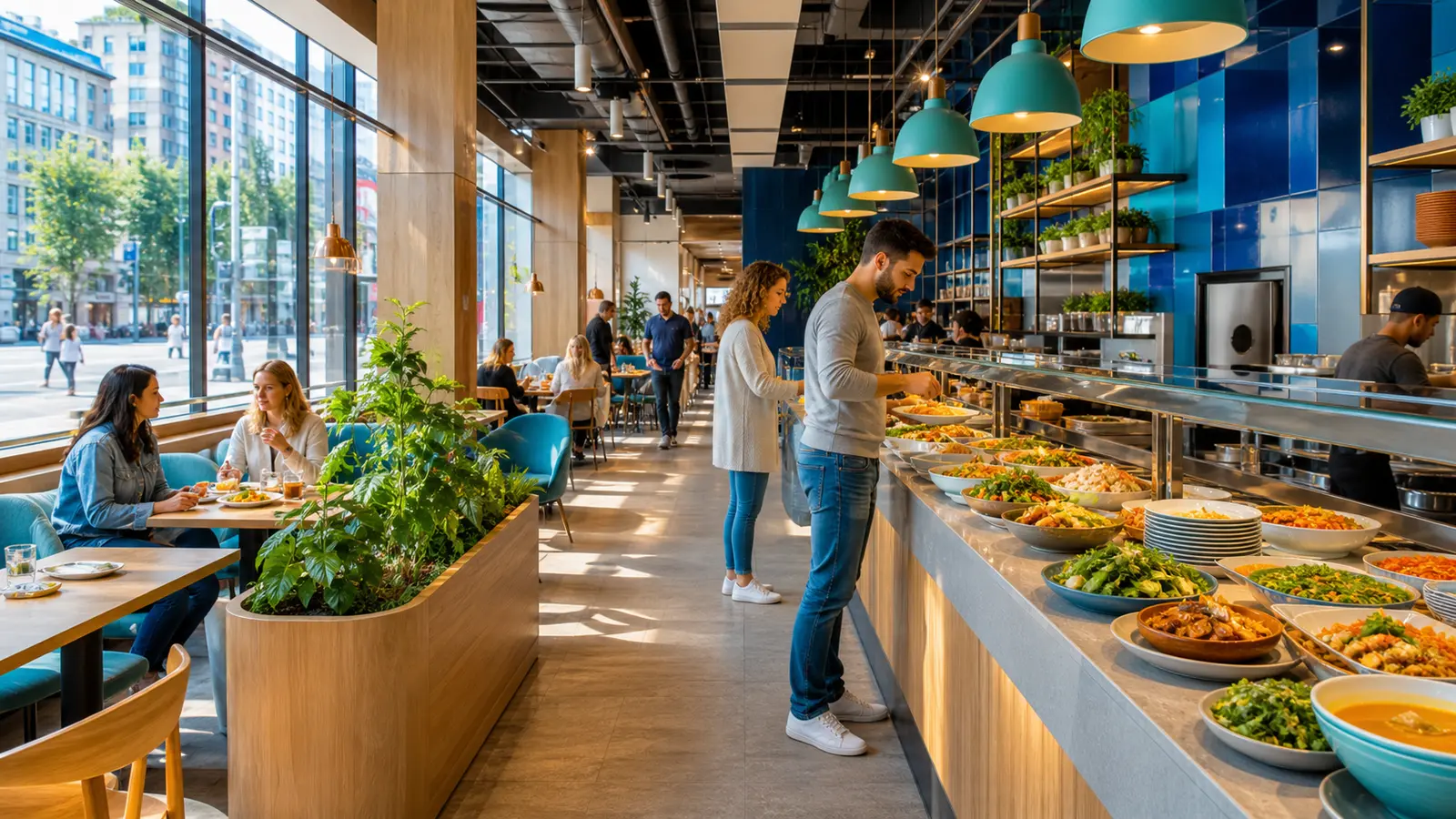
A familiar restaurant brand can survive for decades and still lose relevance one customer decision at a time. The decline rarely begins with a single disastrous choice. More often, the concept keeps doing what once worked while rents, labor costs, food inflation, delivery habits and expectations for atmosphere move around it. Traffic thins, the same large dining room becomes expensive, and a recognizable name no longer guarantees a profitable visit.
Vedomosti reported on June 25, 2026 that Moscow cafeteria chain Mu-Mu had contracted from about 40 locations at its 2022 peak to 18 operating sites, including five airport units. Reporter Linda Zhuravleva combined company counts, financial data and industry views to show how an established format can be squeezed by stronger canteens, retail ready meals, delivery and changing customer tastes.
The case is especially useful for restaurant operators in Russia, but the strategic pattern is wider. A legacy chain does not recover by painting old premises and launching a discount. It needs a controlled redesign of the customer promise, store economics, menu, channel mix, estate and operating system. The objective is not to erase history. It is to convert remembered value into a format suited to current demand.
A shrinking estate is a signal, not a complete diagnosis
Store count is the most visible measure of a chain, yet it can mislead. Closing weak units may improve cash flow, while keeping many underperforming sites can conceal deterioration. Mu-Mu's decline from roughly 40 Moscow and Moscow-region locations in 2022 to 30 in February 2025 and 18 in 2026 is therefore a starting point for analysis, not the final verdict.
The composition of the remaining estate matters. Five of the 18 listed restaurants were in airports: two at Domodedovo, two at Sheremetyevo and one at Vnukovo. Transport locations have different traffic patterns, opening hours, rent structures and customer missions from neighborhood or office-district restaurants. A chain that appears uniform at brand level may already contain several economic models.
Management should map every unit by traffic source, customer occasion, sales density, labor intensity, lease flexibility and refurbishment need. The resulting picture separates a brand problem from a site problem. If strong locations still convert traffic and retain customers, the core promise may be viable. If every format weakens, the proposition itself needs redesign.
Financial deterioration reveals the cost of delay
According to the figures cited by Vedomosti from SPARK-Interfax, revenue at Fastland, the chain's operating company, fell 44.3% year over year to RUB 2 billion in 2025. Net loss widened to RUB 208.3 million from RUB 32.1 million in 2024. Those figures describe more than fewer outlets. They suggest that the remaining system was not yet absorbing its cost base effectively.
Restaurant economics can deteriorate quickly because many expenses are committed before the first guest arrives. Rent, core staffing, utilities, equipment maintenance and central support do not fall in perfect proportion to sales. Once revenue crosses below the break-even point, a modest traffic decline can produce a much larger change in profit.
Delay compounds the problem. A weak site consumes management attention and working capital while refurbishment becomes more expensive. Suppliers may tighten terms, experienced employees leave, and customers interpret visible wear as evidence that the brand is fading. A turnaround needs an early-warning system based on contribution margin and cash generation, not only annual revenue.
The original strategic position became crowded
Mu-Mu originally occupied a distinctive space between a basic canteen and a full-service restaurant. Familiar dishes, accessible prices and a more polished environment created a clear reason to visit. The first restaurant opened in 2000, when this combination felt different from many alternatives available to Moscow customers.
Over time, the categories on both sides improved. Urban canteens upgraded interiors and food quality. Supermarkets invested in prepared meals. Delivery expanded the customer's choice without requiring travel. At the higher end, restaurants competed through distinctive menus, presentation and atmosphere. The middle was no longer protected merely by being cleaner than a canteen and cheaper than a restaurant.
This is a classic strategic compression. A concept can remain internally consistent while the market removes the gap it was designed to fill. The response cannot be a vague promise to become more modern. Management must choose a sharper job for the brand: the fastest dependable hot meal, the best-value family lunch, an airport meal with predictable quality, or another proposition that customers can recognize immediately.
Customer value has moved beyond price alone
Value-conscious customers still care about price, but they now compare a restaurant visit with several substitutes. A supermarket meal may be purchased alongside groceries. Delivery eliminates travel and waiting. A specialty cafe offers a smaller menu with a stronger identity. Home cooking competes whenever household budgets tighten.
At the same time, customers willing to pay more increasingly expect an experience: fresher presentation, a coherent interior, visible food quality, digital convenience and a reason to share the visit. An aging concept is vulnerable from both directions. It can feel too expensive for a purely functional meal and too ordinary for an occasion.
A turnaround therefore starts with occasions rather than demographic labels. Management should ask why the guest is eating now, how much time is available, who accompanies the guest, what uncertainty must be removed and which alternative would otherwise win. The same person may seek speed at lunch, comfort with family and convenience at an airport.
Large self-service formats carry a structural burden
Industry experts cited in the source noted that a serving-line cafeteria needs substantial floor area, stable traffic and strong operational control. Each requirement becomes harder when rents, wages and ingredients rise. Large premises can create variety and capacity, but empty seats turn physical scale into a visible and financial liability.
The serving line also creates production complexity. Management must forecast demand for many dishes before customers choose them. Too much preparation increases waste and damages freshness; too little creates gaps that weaken the visual promise. Labor has to cover cooking, replenishment, cleaning, payment and dining-room flow across uneven demand peaks.
Redesign should treat area as a productive asset. The chain can shorten the line, reduce duplicated stations, move high-frequency items forward, use modular equipment and create seating that works for individuals as well as groups. The goal is not maximum choice. It is maximum confidence and throughput per square meter.
Menu architecture is the center of the turnaround
A broad menu often survives because every item has an internal defender. Yet variety creates purchasing, preparation, training and waste costs that guests do not see. The first menu review should identify dishes that drive traffic, dishes that generate margin, dishes that express the brand and dishes that merely add complexity.
The answer is not necessarily a tiny menu. A cafeteria benefits from visible abundance, but that abundance can come from rotating modules and flexible ingredients rather than a permanently long list. A smaller core of dependable favorites can be surrounded by seasonal specials, regional dishes and limited tests.
Price architecture also matters. Customers need an understandable entry meal, a credible standard basket and optional upgrades. Bundles should reduce decision time without hiding value. Portion sizes, side dishes and beverages must be designed together because the economics of a guest visit depend on the full tray, not the headline price of one dish.
Prepared food and delivery changed the competitive set
Retailers no longer compete only for grocery spending. Their ready-meal counters can offer soup, salads, hot dishes and desserts in locations customers already visit. The cost of trying the offer is low, and loyalty programs connect food purchases with a broader household basket. Restaurant chains must recognize this as a direct competitor for routine meals.
Delivery changed expectations even when a chain receives few delivery orders. Customers learned to browse menus, compare prices, see preparation times and pay digitally before making a decision. A restaurant without accurate digital information may feel inconvenient before its food is evaluated.
The right response is channel design, not indiscriminate presence. Some dishes travel well; others lose texture or margin. The chain should create delivery-specific packaging, production rules and menu limits, then measure contribution after commissions, discounts, errors and refunds. Click-and-collect may offer better economics where customers pass the location anyway.
Brand memory remains an economic asset
Experts in the Vedomosti report argued that Mu-Mu still had strong recognition and a loyal audience. This matters because awareness reduces the cost of attracting trial. Customers already know the name, visual cues and broad category. A new operator would spend heavily to create that memory.
Recognition, however, can preserve negative expectations as efficiently as positive ones. If customers associate the brand with dated interiors, inconsistent food or rising prices, a campaign that merely repeats familiar symbols will reinforce the old verdict. Operational change must arrive before a major communications push.
The useful task is to identify which memories deserve protection. Familiar dishes, speed, approachability and a playful identity may remain valuable, while layout, presentation and service rituals change. The chain should make continuity visible enough to reassure loyal guests and change visible enough to earn reconsideration from lapsed ones.
Pilots turn a rebrand into an operating experiment
A nationwide or citywide redesign is tempting because consistency feels decisive. It is also dangerous. If the new menu, equipment or positioning is wrong, the company multiplies the mistake across the estate. Experts cited in the source suggested updating the concept and opening several pilot locations, which is the sounder route.
Each pilot should test a defined hypothesis. One might examine a smaller footprint; another a family proposition; another a transport-hub menu. Management must specify the expected customer, basket, throughput, labor hours, waste level and repeat rate before opening. Otherwise every result can be explained after the fact.
The control group is equally important. Comparing a renewed site only with its own weak past exaggerates success when the whole market is recovering. A pilot should be compared with similar unchanged units and local competitors. Qualitative interviews explain behavior, while transaction and operating data establish whether the economics can scale.
Franchising cannot repair weak unit economics
In 2019, Mu-Mu said it intended to expand to 84 cafes, partly through franchising. The target was not achieved. The program began shortly before the coronavirus pandemic, while delivery-oriented concepts were better positioned during restrictions. Timing amplified the challenge, but timing was not the only issue.
The source reported an upfront franchise fee of RUB 2.5 million, which an industry specialist considered too high for the market and restrictive for potential partners. A fee is sustainable only when the franchisee receives proven demand, documented operations, purchasing advantages, training and a credible payback period.
Franchising transfers capital requirements but does not transfer away strategic responsibility. A partner operating a large, labor-intensive format under weak traffic will damage both its own finances and the brand. The chain should resume franchise sales only after pilot stores prove a repeatable model under realistic rent, wage and food-cost assumptions.
Operational control must become visible in the design
Operational excellence is often treated as back-office discipline, yet guests experience it directly. A clean serving line, full trays, accurate labels, short queues and consistent temperature communicate competence. Empty stations, confused movement and delayed replenishment communicate risk before the customer tastes anything.
A renewed format should be designed around observable standards. Production batches can be smaller and more frequent. Digital kitchen screens can connect sales pace with preparation. Checklists should focus on outcomesavailability, freshness, queue time and cleanlinessrather than paperwork completed after the fact.
Managers need a limited dashboard that can trigger action during the shift. Sales by interval, labor deployment, waste, unavailable items, service time and guest complaints are more useful than a large monthly report. The central team should compare patterns across stores without removing local accountability.

The estate needs segmentation, not one closure rule
A shrinking chain may be tempted to rank stores by current profit and close the bottom group. That approach ignores strategic role and recoverability. Some weak locations have poor leases and no future; others are strong markets trapped in an outdated format; airport units may have high sales but unique costs and constraints.
Management can divide the estate into four portfolios: protect, renew, relocate and exit. Protected sites need maintenance and incremental improvement. Renewal sites justify pilot investment. Relocation candidates have customer demand but structurally unsuitable premises. Exit sites consume cash without a credible path to target returns.
Decisions should include closure costs, lease obligations, equipment reuse, employee transfer and effects on nearby units. A clean exit can fund the turnaround, while a rushed closure may destroy useful teams and customer access. Estate strategy must be coordinated with the new format rather than completed before it exists.
Unit economics should govern every design choice
A beautiful pilot can fail when rolled out because it relies on exceptional traffic or extra labor. The financial model should begin with transactions per day, average basket and gross margin, then subtract ingredients, marketplace commissions, labor, occupancy, utilities, maintenance, local marketing and allocated support.
Each design decision changes this model. A smaller menu may lower waste and training cost. A compact site may reduce rent but constrain peak throughput. Premium ingredients may support price while increasing exposure to volatility. Digital ordering may save cashier time but require integration and customer assistance.
The chain needs target ranges rather than one optimistic forecast. Base, downside and high-volume cases reveal which variables threaten cash. No pilot should be declared successful because sales are strong if it depends on permanent discounts, unusually favorable rent or managers performing work that ordinary staffing cannot sustain.
People determine whether the renewed concept is repeatable
Restaurant turnarounds can overinvest in architecture and underinvest in roles. Employees must learn new preparation routines, service language, digital tools and quality standards while continuing to serve guests. If the new system is harder to operate, inconsistency will appear as soon as the launch team leaves.
Training should use observable tasks and certification, not presentation attendance. A cook demonstrates batch standards; a service employee handles peak flow; a manager responds to waste and queue signals. The pilot must record learning time and identify procedures that require redesign rather than blaming employees for complexity.
Retention is an economic metric. Experienced teams understand local demand and recover from surprises faster. The turnaround budget should include fair scheduling, manager development and communication about closures or role changes. Uncertainty handled badly can cause the best employees to leave precisely when the company needs them.
Customer research must include people who stopped visiting
Loyal guests explain what the brand should preserve, but they cannot fully explain decline. The most valuable interviews may be with former customers and people who considered the chain but chose a supermarket, delivery service, cafe or another restaurant. Their alternatives reveal the real competitive set.
Research should combine observed behavior with stated opinion. Customers may say they want more choice while repeatedly buying a small group of dishes. They may complain about price when the deeper issue is uncertainty about quality or an environment that no longer fits the occasion.
A practical feedback system connects exit interviews, digital reviews, menu conversion, repeat visits and complaint categories. The organization looks for patterns, tests a change and measures behavior again. Research becomes a learning loop rather than a report used to justify a decision already made.
Governance protects the turnaround from compromise
Legacy organizations accumulate stakeholders around products, sites and traditions. Without clear governance, every proposed removal returns as an exception. The menu stays broad, the floor plan stays large and the marketing message promises everything. The result is an expensive redesign with the same strategic ambiguity.
One accountable leader should own the customer proposition and unit economics across food, operations, property, technology and marketing. Functional leaders provide expertise, but trade-offs need a single forum and a fixed evidence standard. Pilot changes should be logged with the hypothesis, date, cost and result.
Capital is released in stages. The next investment follows evidence that the previous stage improved customer behavior and economics. This protects the company from both paralysis and enthusiasm. A turnaround is urgent, but urgency is not permission to scale an unproven model.
A practical restaurant-chain renewal sequence
- Map every store by customer occasion, traffic source, contribution margin and lease flexibility.
- Define one sharp value proposition for each viable format rather than one vague promise for the whole estate.
- Simplify menu architecture around traffic drivers, margin contributors and recognizable brand signatures.
- Build two or three pilots with explicit hypotheses, control stores and downside financial cases.
- Measure sales density, basket, labor, waste, queue time, availability, repeat visits and guest sentiment.
- Train ordinary operating teams and remove processes that work only with launch specialists present.
- Classify sites to protect, renew, relocate or exit, then release capital in evidence-based stages.
- Restart franchising only when partners can reproduce the model with credible returns and support.
What recovery would look like
Success is not automatically a return to 40 locations, much less the once-stated ambition of 84. A smaller chain can be healthier if every format has a purpose, stores generate cash, customers return and the operating system can support selective expansion. Size should be an outcome of repeatability.
Leading indicators include higher sales per square meter, lower waste, stable food availability, faster service and more frequent repeat visits without excessive discounting. Employee retention and franchisee interest become useful only after unit economics improve. Brand awareness should translate into trial, and trial into a second visit.
The most important change is organizational confidence grounded in evidence. Teams know which customer they serve, which dishes define the offer, how each store earns its space and what result justifies the next investment. That clarity allows a legacy brand to use its memory without being trapped by it.
A legacy brand can change without becoming unrecognizable
The Mu-Mu story illustrates how quickly a once-distinctive middle position can lose protection. Store contraction, falling revenue and widening losses are serious, yet recognition, loyal customers and familiar food still provide raw material for recovery. The strategic question is whether management can redesign the system before memory turns entirely into nostalgia.
Renovation alone will not answer that question. The business must choose occasions, simplify complexity, test formats, segment locations, rebuild unit economics and make operational quality visible. Marketing follows proof. Franchising follows repeatability. Expansion follows cash-generating demand.
For mature restaurant chains, renewal is not a choice between preserving history and chasing fashion. It is the disciplined work of identifying what customers still value, removing the cost and habits that obscure it, and expressing the result in a format people want to visit now. That is how a familiar name becomes a current business again.






ADI News
Leave a comment