
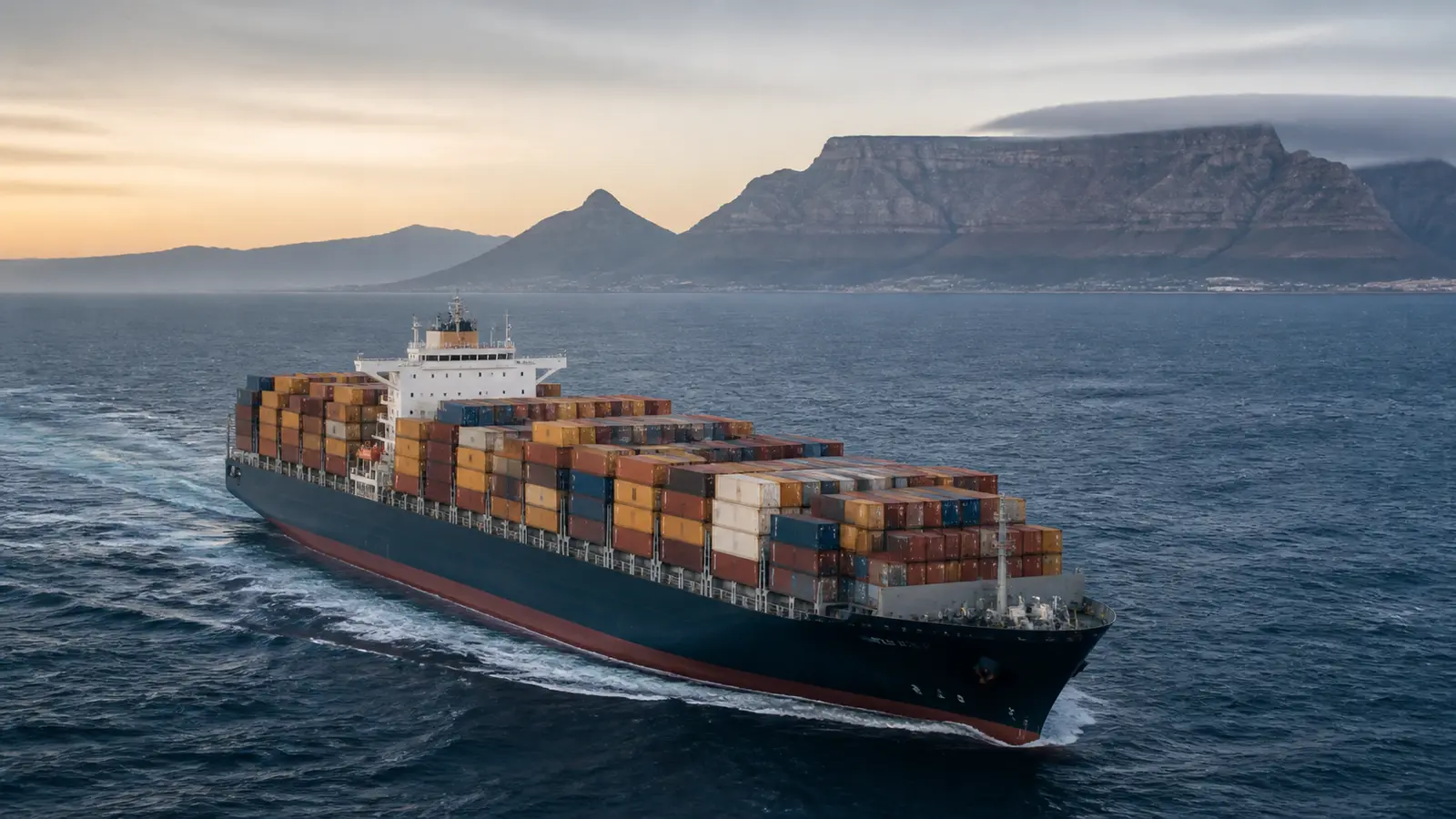
A maritime detour became a balance-sheet event
A container ship does not need to sink for a shipping crisis to damage a business. It only needs to arrive late enough and cost enough to turn a profitable order into a loss. That was the lesson confronting exporters in early 2024 as carriers avoided the Red Sea and the Suez Canal. Vessels sailing between Asia and Europe were redirected around the Cape of Good Hope, extending voyages, consuming more fuel and keeping ships and containers away from their next scheduled loads.
The effect was especially severe for small manufacturers and trading companies in China. Their business model often combined large volumes, narrow margins and payment after delivery. A delay therefore affected more than freight expense. It postponed cash receipts, lengthened the period during which inventory had to be financed and forced negotiations over who would absorb an unexpected bill. A route disruption became a working-capital shock.
A Reuters report published on January 19, 2024 by Samuel Shen, Casey Hall and Ellen Zhang documented that pressure through exporters, manufacturers and logistics managers. Their reporting provides a useful starting point for a broader business question: how should companies redesign trade operations when the shortest route can no longer be treated as a dependable constant?
The freight bill exposed the fragility of thin margins
Han Changming, founder of Fuzhou Han Changming International Trade Co Ltd, exported Chinese-made cars to Africa and imported off-road vehicles from Europe. He told Reuters that the price of sending a container to Europe had climbed from about $3,000 in December to roughly $7,000. Insurance premiums were also rising. Europe and Africa represented 40% of his business, so the increase was not a minor cost on a peripheral lane. It threatened the economics of the company.
The arithmetic explains why a freight shock can overwhelm an exporter even when customer demand remains intact. Suppose a container carries products expected to produce a gross contribution of $8,000 after ordinary logistics. An additional $4,000 of freight consumes half that contribution before insurance, storage, financing or penalties are considered. If the seller accepted a fixed delivered price months earlier, there may be no contractual mechanism for passing the increase to the buyer.
Large corporations may hedge freight, negotiate annual capacity or spread loads among several carriers. A small exporter often buys closer to the spot market and has less leverage with both customers and suppliers. Its apparent efficiency in normal times—limited inventory, rapid turnover and low overhead—can become a weakness when one external charge doubles. Resilience begins with recognising that margin is not simply a percentage on a sales report. It is a buffer against time, volatility and contractual rigidity.
Two extra weeks reduced capacity without removing a single ship
The Red Sea connects the Indian Ocean to the Suez Canal and provides the shortest maritime path between much of Asia and Europe. Attacks launched from Yemen led many carriers to avoid that corridor. Sailing around southern Africa could add about two weeks to a schedule. The detour did not destroy physical capacity, but it made each round trip longer. A ship that returned later could not collect its next load on the original date.
This is why freight markets can tighten rapidly even when fleet size is unchanged. Capacity is a function of vessels multiplied by the number of voyages they can complete. Longer cycles reduce annual turns. Empty containers also return more slowly, equipment becomes concentrated in the wrong ports and schedules lose the spare time needed to recover from weather or terminal congestion. A disruption on one corridor spreads through a network of linked departures.
Reuters reported early signs of container shortages around Ningbo-Zhoushan, one of the world's busiest ports by cargo tonnage. The operational problem was compounded by the approaching Lunar New Year, when factory closures and worker travel normally create a rush to ship finished goods. Companies were not responding to a single late vessel. They were competing for scarce space and equipment at the same moment that a predictable seasonal peak was compressing the calendar.
Time entered the cash-conversion cycle
Transport discussions often treat lead time as a customer-service measure: an order arrives in six weeks rather than four. For an exporter, those two weeks can also be financing time. Materials have already been purchased, workers have been paid and goods have left the factory, but the invoice may remain unpaid until arrival, inspection or acceptance. Every additional day increases the amount of capital trapped between expenditure and receipt.
Marco Castelli, founder of IC Trade, described factories that were paid only when goods reached their destination. The mechanism creates a chain reaction. The exporter waits for the buyer, the component supplier waits for the exporter and employees depend on both. Banks may extend credit, but facilities have limits and interest charges reduce the remaining margin. A shipment that is commercially successful can still create a liquidity crisis if cash moves more slowly than obligations.
Managers should therefore model route risk through the cash-conversion cycle, not only through a logistics budget. The relevant exposure includes inventory in transit, customer payment terms, supplier due dates, available credit, currency movements and the concentration of departures in a few weeks. A finance team that receives vessel data late cannot act early. Operational milestones need to flow into rolling cash forecasts so that a delayed estimated arrival date immediately changes the expected receipt date and funding requirement.
Small suppliers carried the hidden systemic risk
Mike Sagan, the Shenzhen-based vice president for supply chains and operations at KidKraft, observed that European customers were stopping shipments and that suppliers were urgently concerned about money. His warning focused on the snowball effect among smaller companies. These firms could be the last to receive payment while remaining essential to a larger manufacturer's ability to deliver.
Supply-chain maps frequently stop at the direct supplier. That creates false reassurance. A major vendor may look financially strong while depending on a specialised coating company, mould maker or valve producer with only a few customers and limited cash. If the smaller firm cannot finance materials during a delay, the direct supplier's contractual strength does not keep production moving. The weakest liquidity position can determine the performance of the whole chain.
Yang Bingben's experience illustrates the problem at order level. His company in Wenzhou prepared materials for 75 industrial valves, but a customer reduced the order to 15 after freight costs increased. Processed material could not simply be returned. Revenue fell while committed cost remained, and employment decisions came into question. The episode shows why cancellation terms, material commitments and freight thresholds belong in commercial governance. A purchase order is not fully protected if a logistics shock permits the customer to remove most of the volume after production has begun.
Just-in-time efficiency acquired a route-risk premium
Just-in-time systems are often blamed whenever logistics fail, but the principle is not inherently fragile. Coordinating production with demand can reduce waste, storage and obsolescence. Fragility arises when a company treats one route, one port, one carrier or one replenishment interval as certain. The Red Sea disruption revealed that inventory policy and network design cannot be separated.
Products require different responses. A low-value, bulky item may not justify air freight or a large safety stock. A critical component that can stop an assembly line may warrant both. Fashion goods lose value when a season passes, while industrial parts can remain useful but tie up cash. Managers need segmentation rather than a universal instruction to hold more inventory. The purpose of a buffer is to protect a defined service or production outcome at an acceptable cost.
A practical route-resilience checklist
- Identify products whose contribution margin cannot absorb a defined freight-rate increase.
- Measure inventory and receivables by route, not only by business unit or customer.
- Set trigger points for switching carrier, port, mode or delivery promise.
- Reserve scarce premium transport for items that protect the greatest operational value.
- Test whether contracts allocate surcharges, delays and cancellation risk explicitly.
- Monitor second-tier suppliers whose liquidity could interrupt a critical product.
This discipline converts resilience from a vague preference into a set of choices made before the market is under maximum pressure.
Diversification was a strategic option, not a quick escape
The Reuters report described companies considering alternative production locations. BDI Furniture was relying more on factories in Turkey and Vietnam. Castelli noted that some production might move to India, which was about a week closer to Europe. Those alternatives reflected a wider interest in near-shoring and “China-plus-one” sourcing.
Moving a purchase order is much easier than moving a capable supply network. A new location must reproduce tooling, quality, labour skills, component availability, regulatory compliance and management attention. Unit price can look attractive while total landed cost rises because yields are lower, suppliers are farther apart or production requires more supervision. A hurried shift may exchange visible shipping risk for less visible execution risk.
The strongest diversification plan begins with products and capabilities, not countries. A company can identify which items have transferable processes, which depend on a local cluster and which carry enough margin to support dual sourcing. It can qualify a second supplier before volume is urgently needed and place a small recurring share of orders there to keep the relationship operational. Geography then becomes one dimension of a portfolio rather than a symbolic decision to leave or stay.
Contracts determine where volatility lands
When freight rises unexpectedly, every participant asks who should pay. The answer depends partly on delivery terms, pricing clauses and bargaining power. A supplier quoting a delivered price may control the carrier but also retain the freight risk. A buyer arranging transport gains visibility but must secure capacity. Neither structure eliminates volatility; each locates the responsibility differently.
Commercial teams should avoid treating logistics language as boilerplate. Agreements can define which index or event activates a surcharge, how often the price is reviewed, what evidence supports an adjustment and whether a prolonged route closure permits a new delivery date. They can distinguish ordinary delay from a fundamental route change. They can also specify responsibility for materials already committed when a customer reduces an order.
Good clauses do not replace relationships. In a systemic disruption, rigid enforcement may bankrupt a supplier that the buyer needs after the crisis. Han Changming was asking suppliers and customers to share additional costs. That negotiation is easier when both sides can see the original freight assumption, the new carrier quotation and the effect on the order. Transparency turns a general complaint into a commercial decision: absorb, share, delay, redesign or cancel with a known consequence.
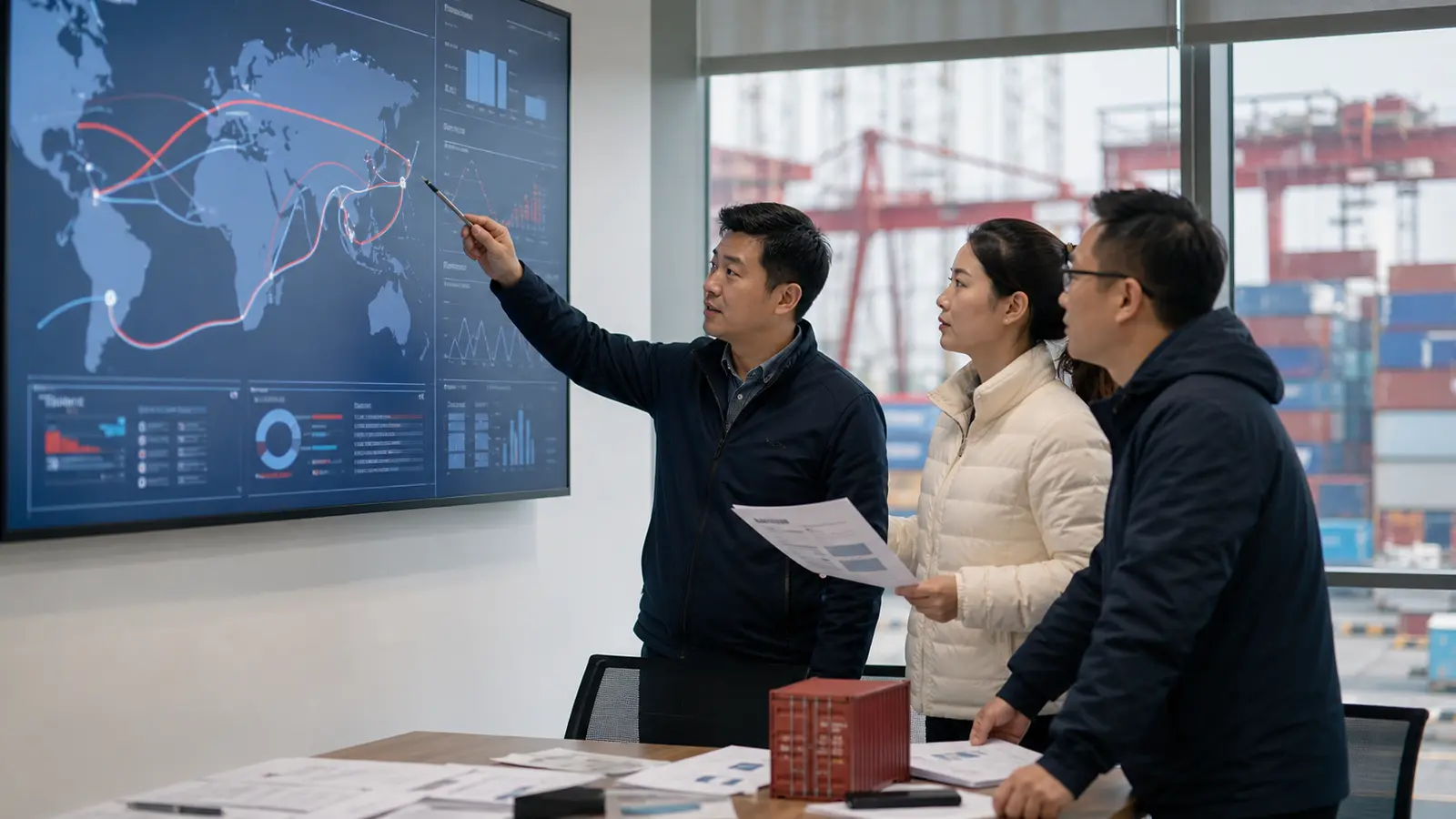
A control tower needs financial signals as well as vessel positions
Many logistics dashboards can show where a vessel is located. Fewer show which business decision should change because the vessel moved. A useful control tower connects estimated arrival, container availability and carrier notices with product margin, stock cover, customer priority and expected cash receipt. It does not merely create a more attractive map.
The design should support exceptions. Teams do not need to discuss every container every morning. They need a ranked view of shipments that cross a threshold: an assembly line will stop, a promotion date will be missed, a credit facility will be exceeded or a customer contract will incur a penalty. Each alert should identify an owner and a limited set of actions. Otherwise the dashboard increases awareness without increasing control.
Data quality matters because estimated arrivals can change repeatedly during disruption. The system should preserve the history of revisions, show the source of each estimate and distinguish carrier data from an internal assumption. Finance can then model a range rather than one precise date. Sales can communicate a realistic window. Procurement can decide whether expediting one component protects enough value to justify the premium.
Scenario planning must quantify decisions, not invent predictions
No management team in January 2024 could know exactly how long the Red Sea disruption would last. That uncertainty did not prevent preparation. Scenario planning is useful when it links plausible conditions to actions, rather than pretending to forecast a single outcome. A company might model a short disruption with elevated rates, a six-month diversion and a prolonged period in which the alternative route becomes normal.
For each case, the team can calculate freight per unit, additional days in transit, peak borrowing, inventory required to protect service and customers whose orders become unprofitable. It can also estimate the time needed to qualify another port or supplier. The purpose is to expose thresholds. If a lane exceeds a certain rate for four weeks, a surcharge discussion begins. If stock cover falls below a defined level, scarce space is allocated to high-contribution products.
- Establish the normal route, rate, transit time and cash timing as a baseline.
- Apply a range of detour days, freight rates, insurance costs and demand responses.
- Calculate profit and liquidity effects at product and customer level.
- Assign an action, owner and latest decision date to each threshold.
- Review assumptions as carrier schedules and customer behaviour change.
This approach does not make uncertainty disappear. It makes the organisation less likely to discover its response only after cash or inventory has run out.
Customers need choices before they need apologies
A delayed shipment is partly a communication problem. Customers may accept a later arrival if they learn early and can alter their own plan. They are less tolerant when a promised date passes without explanation. Exporters should translate shipping uncertainty into a small number of commercial options: wait for the economical route, pay for priority space, split the order or substitute an available product.
Different customers value continuity differently. A retailer serving a seasonal promotion may pay to protect a launch date. A distributor replenishing standard inventory may prefer a lower price and a longer window. A manufacturer facing a line stoppage may need a small emergency quantity by air while the balance remains at sea. Segmenting these needs prevents the loudest customer from consuming every premium option.
Companies serving buyers in the United States and Europe also need consistent messages across sales offices. A central scenario, updated from verified logistics data, allows account managers to explain the same cause and range while negotiating a response suited to each contract. Credibility becomes an operational asset: honest uncertainty communicated early can preserve a relationship even when the original schedule cannot be preserved.
The board should measure resilience as an economic return
Resilience spending is sometimes presented as insurance that only adds cost in normal conditions. That view makes buffers easy to remove during an efficiency programme. A better calculation compares the continuing cost of an option with the expected loss it can prevent. Dual sourcing, reserved capacity, safety stock and additional credit each protect a different part of the business and should be evaluated against that exposure.
Metrics should include more than on-time delivery. Leaders can track margin lost to emergency freight, days of cash tied up by route, revenue protected by alternative supply, time required to activate a second source and the financial health of critical small suppliers. They can also measure forecast accuracy during disruption and how early customers were notified. These indicators reveal whether the organisation is learning or merely paying repeated premiums.
The board's role is to set risk appetite and resolve trade-offs that functions cannot settle alone. Operations may favour inventory, finance may favour cash conservation and sales may favour uninterrupted availability. The decision needs a shared economic model. A resilient network is not one in which nothing goes wrong. It is one in which an interruption does not force uncontrolled choices that destroy more value than the original event.
The Red Sea lesson is about the architecture of trade
The exporters interviewed by Reuters showed how quickly a distant maritime threat could reach an order book, a payroll and a factory floor. Han Changming faced a freight increase that erased thin margins. Yang Bingben held processed material after most of an order disappeared. Logistics managers worried that small suppliers would run out of cash. None of those outcomes can be understood by watching freight rates alone.
The two-week detour exposed connections that efficient trade had allowed companies to ignore. Vessel time determined container availability. Container availability influenced freight. Freight changed customer demand and order economics. Arrival dates controlled payment, and payment controlled the ability of suppliers to operate. The route was not a line on a map; it was part of the financing and contractual architecture of the business.
The practical response is not to abandon global trade or duplicate every supplier. It is to make dependencies visible and create options where failure would be most expensive. Companies can segment products, connect logistics with cash forecasts, strengthen contract triggers, qualify alternative capacity and communicate choices early. When the shortest route becomes unavailable, these preparations cannot remove the extra miles. They can prevent those miles from deciding whether an otherwise viable exporter survives.


















ADI News
Leave a comment