
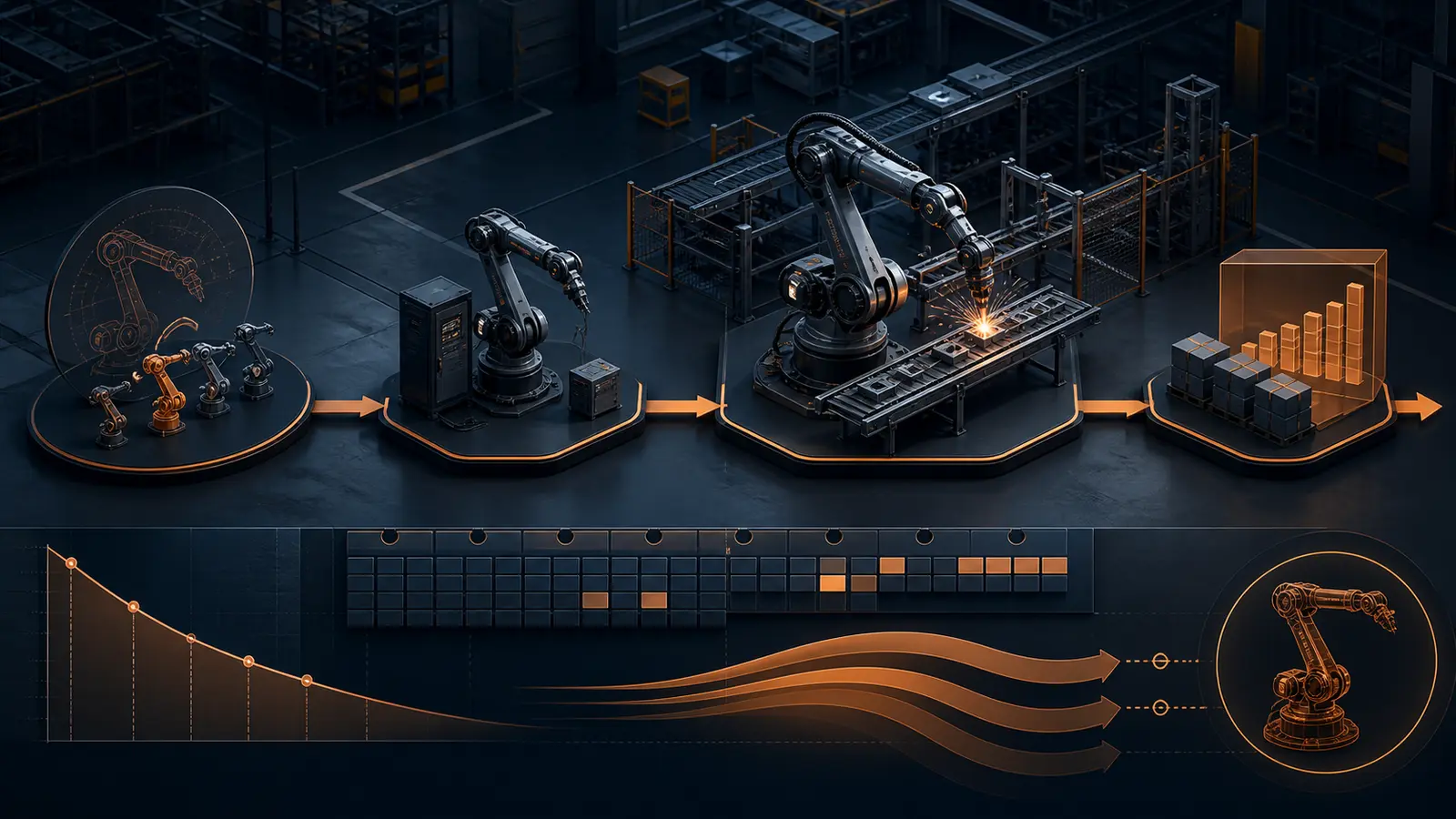
An industrial robot is rarely purchased for the machine itself. A manufacturer wants repeatable quality, predictable output, a safer operation and the ability to move people from strenuous handling into process supervision. Yet a major capital decision stands between that technical need and a productive cell. Vedomosti reported on May 26, 2025 that a leasing program had been launched for serially produced Russian robot manipulators with different payload capacities.
The partners were Zavod Robotov and Sberbank Leasing. Their offer was intended to simplify automation for enterprises that find a conventional investment loan difficult or unattractive. Andrey Gartung, founder of the robot manufacturer and chief executive of the Chelyabinsk Forge-and-Press Plant, connected domestic robotics with productivity, competitiveness and production safety.
Program details published by CNews explained the financial structure: the financing limit for robot purchases was 400 million rubles, the term could reach seven years, collateral was not required, the transaction could be completed online and the initial payment started at zero. The product range included six-axis RusRobot manipulators with payloads of 60 and 120 kilograms.
For industry in Russia, leasing matters as more than a less restrictive source of money. It changes the sequence of the decision: a company can compare scheduled payments with the automation benefit instead of removing the full equipment price from working capital on delivery. An accessible structure does not make every robot profitable. Economic value still depends on selecting the right operation, integrating it and operating it with discipline.
Leasing converts a capital barrier into an operating schedule
With a direct purchase, a company first spends a large amount and then may spend months designing the cell, installing guarding, adjusting tooling and bringing the equipment to planned productivity. Cash outflow precedes the benefit. Leasing distributes payments over time and can bring them closer to the period in which the robot is already producing acceptable parts.
That timing is especially important to a midsized manufacturer where one automation project competes with raw-material inventory, maintenance, warehouse expansion and working capital. Preserved liquidity has economic value. It may help the company survive a seasonal peak, buy material on favorable terms or fulfill a new contract while the robot cell is still moving through its learning curve.
A monthly lease payment is not the full price of automation. Integration, grippers, guarding, sensors, programming, training, foundation preparation, electrical work, consumables and maintenance must be added. A budget that counts only the leased object makes the project look artificially inexpensive and produces a funding shortage at the most delicate launch stage.
The correct financial model is built as a calendar. It displays the advance, installation, commissioning, training period, output ramp, lease payments, relevant tax effects and residual value. Management can see the maximum cash requirement and the month in which accumulated operating benefits cover the costs. Leasing then becomes a management instrument rather than a promotional promise.
Questions to answer before applying for finance
- Will the part, routing and production volume remain stable over the agreement?
- Can current labor, defects, downtime and injury exposure be measured?
- Is integration included in the financing, and who guarantees final performance?
- Does the plant have people able to operate the cell and perform first-line diagnosis?
- What happens to payment capacity if launch is delayed or customer demand declines?
These answers are needed before choosing a brand or payload. If the operation is unstable, drawings change constantly and volume is unknown, automation will preserve the disorder. The process must first be standardized and only then equipped with a machine that repeats it.
Start with the constraint, not the catalogue
A supplier presents speed, reach, repeatability and payload. The factory must identify its line constraint. If a welding station limits output and creates a queue of semi-finished parts, a robot may increase throughput. If the true constraint is painting, quality inspection or incoming material, faster welding merely increases work in progress.
Candidate operations should be observed across shifts. Engineers record actual cycle time, changeovers, interruptions, manual rework and defect causes. An average hides instability. A robot sized around the best shift will not meet the plan when real blanks vary in geometry and feeding is frequently delayed.
The clearest first project has a repeatable part, sufficient volume, a hazardous or demanding task and a measurable quality criterion. It does not need to create the largest saving across the entire plant. Its role is to develop integration competence and prove that the organization can maintain an automated process.
After the pilot, the portfolio can expand through common modules. Standard controllers, safety interfaces, program templates and spare parts reduce the cost of the next cell. Unrelated one-off purchases instead create a collection of incompatible machines that require separate specialists, training and inventories.
Payload is only the beginning of the specification
The reported 60- and 120-kilogram models indicate a useful task range, but nominal payload alone does not establish suitability. Engineers must add the mass of the part, gripper, cables and auxiliary tooling, then account for the center of gravity and movement dynamics. Operation at the limit can reduce speed and service life, so the design needs an engineering margin.
The second parameter is the working envelope. The manipulator must reach every point without entering problematic configurations or colliding with guarding, fixtures and nearby equipment. A three-dimensional model tests trajectories, but final validation requires representative physical parts and tooling.
Position repeatability does not guarantee process quality. Welding depends on edge preparation, gap, wire feeding and power-source stability. Material handling depends on gripper stiffness, part detection and conveyor accuracy. A robot repeats the instructed motion; it does not automatically correct weak technical discipline around it.
The specification should include cycle time, allowable defects, target availability, changeover format, safety requirements and the procedure after a fault. Acceptance must test those indicators over a representative batch rather than admiring an unloaded demonstration movement.
The integrator influences the outcome as much as the manufacturer
A serial manipulator is the core, but an operating cell contains dozens of components. The integrator designs the gripper, positioner, feeding system, guards, interlocks, fume extraction, machine vision and connection with production management. A mistake in inexpensive tooling can stop an expensive robot.
Responsibility must be unified and testable. If the supplier guarantees only the arm, the tooling firm only the gripper, and the factory connects the signals itself, disagreement is inevitable when the required cycle is missed. A lead integrator or an explicit interface matrix removes that gray area.
The contract needs intermediate tests. The parties first approve a digital layout, then operation at the integrator's site, followed by installation and production acceptance. Every stage defines the data supplied by the customer, the criteria for proceeding and the method for correcting a nonconformity.
The leasing structure must reflect this chain. If only the standard robot is financed while integration is paid separately and earlier, much of the capital barrier remains. If every component is included without testing price and performance, overpayment risk rises. Budget boundaries should match accountable outcomes.
Payback comes from flow, not one eliminated wage
The simplest calculation compares a lease payment with the wages of operators supposedly removed. It is incomplete and can lead to a poor workforce policy. Automation often moves people into part preparation, quality control, maintenance and additional shifts rather than eliminating them. Value comes from more output, fewer defects, stable quality and reduced exposure to hazardous tasks.
A financial model should calculate contribution from each additional acceptable unit. If the robot produces more but the market cannot absorb the quantity, a production gain becomes warehouse inventory. The base case therefore depends on confirmed orders, while an optimistic growth scenario is evaluated separately.
A defect has two costs: lost material and occupied machine time. A repeatable process can reduce both. During commissioning, however, defects may rise because of an incorrect program, unstable tooling or unfamiliar part preparation. A launch reserve prevents that temporary learning cost from breaking cash flow.
Safety also has an economic dimension, although it must not be reduced to money alone. Removing a person from a welding arc, heavy part or repetitive movement reduces injury and fatigue exposure. New machine-motion risks appear at the same time, making guarding, interlocks and training mandatory rather than optional accessories.
A seven-year term requires scenarios, not one forecast
A long agreement lowers the monthly burden but increases the period in which orders, technology and service prices may change. A part can be redesigned, a customer may reduce its program, and a production line may switch products. The robot therefore needs enough flexibility for retooling and secondary use.
The base scenario uses realistic volume and availability. A downside case assumes delayed integration, lower orders and higher costs. A stress case asks whether the company can continue paying during a temporary halt. The upside case identifies where another shift, tool or upstream capacity would be required.
The decision should not rest on payback period alone. Two projects may both show a three-year recovery while carrying very different risks: one has a multiyear contract and a conventional task, the other depends on one customer and a new part. The second deserves a higher required return.
Exit options should be defined in advance: moving the robot to another operation, replacing the gripper, transferring it to another site, purchasing early or returning it under an agreed process. Flexibility has a financial value that should be compared with the lower payment of a more restrictive contract.
Localization matters through lifecycle availability
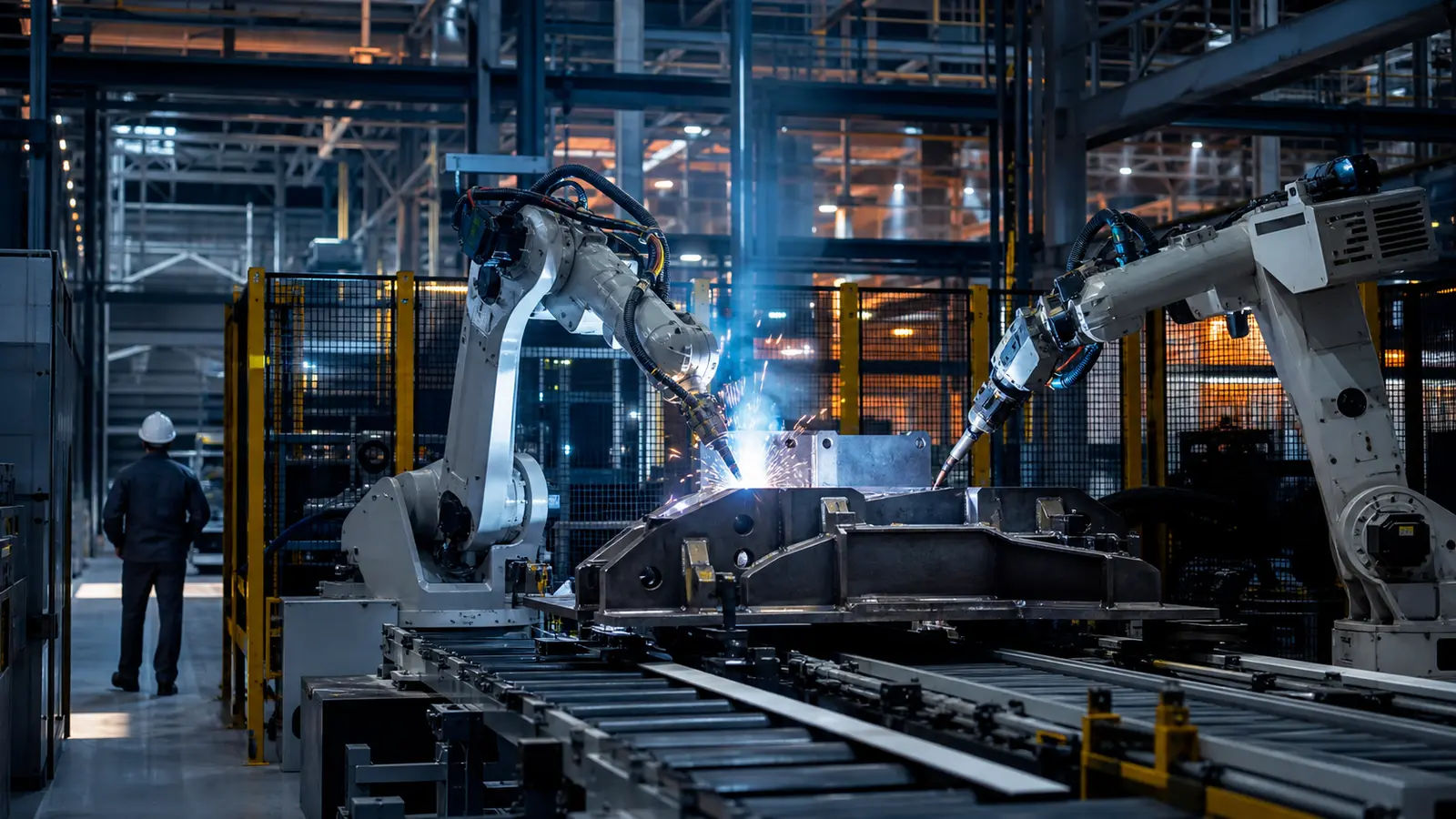
The source also cited Industry and Trade Minister Anton Alikhanov, who said preferential localization conditions for robotics were to apply only through the end of 2025. Domestic-product status can be important for access to support measures, but its operating value is broader than a formal registry entry.
A plant needs available spare parts, software updates, documentation, training and engineering support. If a critical drive or controller takes months to arrive, expected productivity disappears into downtime. Local service capacity can matter more to an operator than a component percentage calculated for a report.
Rights to programs and backups require review. Who may change the code after the warranty? In what format is the project stored? Can a controller be restored after failure? Is there a list of compatible substitutions? These questions protect the investment over the full financing horizon.
A domestic ecosystem grows through repeatable demand, but the customer should not relax quality acceptance. Supporting a manufacturer and demanding performance are compatible positions. Clear availability, service-response and durability targets create better feedback than purchasing solely for origin.
People move from handling parts to controlling the process
Robotization changes the composition of work. An operator performs fewer hazardous repetitive motions and spends more time preparing jobs, checking fixtures, responding to deviations and supervising quality. A technician develops a new diagnostic role covering sensors, trajectories and communications among devices.
Training should begin before delivery. The internal team participates in design, learns operating modes, writes instructions and observes testing at the integrator. At launch, employees then understand the cell's logic rather than receiving only a set of buttons. Knowledge remains at the plant after external specialists leave.
Resistance often comes from uncertainty. When workers hear only that productivity will rise, they may interpret the project as a threat. Management should define future roles, skills, training and compensation in advance. A credible workforce plan reduces hidden resistance and encourages practical feedback from experienced operators.
Performance measures also change. Constant visible motion is not the operator's objective when the assignment is stable automatic running. Cell availability, speed of cause removal, batch quality, preventive work and improvements become the relevant indicators. The correct metric reinforces the new process.
Commissioning begins the learning curve
Acceptance proves that a cell can perform the specified cycle, not that it will remain stable for months. Real batches vary, shifts behave differently and consumables wear. The opening weeks need enhanced engineering support and rapid data collection.
Every stop should be coded by cause: waiting for a part, tooling, program, safety, quality, maintenance or an external process. A total downtime figure does not indicate an action. Classification identifies the process owner who must remove a recurring loss.
Critical spare inventory is based on failure likelihood and delivery time. An expensive rare unit need not sit at every site if the manufacturer guarantees an exchange pool. An inexpensive sensor with a long lead time should probably be nearby. The decision reflects the expected cost of downtime risk.
After three and six months, the company compares actual results with the investment model. If the cycle is slower, it separates a temporary learning curve from a permanent constraint. If output rises but the saving disappoints, it examines defects, maintenance, energy and missing demand. This review turns one pilot into knowledge for the next project.
A management dashboard for the leased asset
Executives need a short set of connected measures. Finance without production discovers causes too late, while a technical team without financial data can keep improving a cell that no longer generates sufficient value.
- Project readiness along the critical integration path.
- Actual cycle time and acceptable-output percentage.
- Technical availability and causes of unplanned stops.
- Incremental contribution and savings against the baseline.
- Lease and service payments by date.
- Number of trained operators and technicians.
- Remaining payback time under the updated forecast.
The indicators must be considered together. High availability without customer orders is not success, nor is higher output with excessive defects. The dashboard should lead to a decision: remove a constraint, modify tooling, update software, transfer an operation or revise the commercial plan.
The central lesson: finance the system, not a metal arm
A program with a 400-million-ruble limit, a term of up to seven years, no minimum advance and no collateral lowers a meaningful barrier. It makes a serial industrial robot more accessible to companies that do not want to freeze capital or navigate a complex conventional credit process. That is a real expansion of choice.
Leasing moves the payment schedule; it does not transfer responsibility for the technology. The plant must still select a stable operation, verify payload and trajectories, procure integration, prepare people, ensure safety and measure results. A missing link can turn convenient financing into years of payments for underused equipment.
The best first project is not necessarily the largest. It is repeatable enough to demonstrate a result, important enough to receive management attention and flexible enough to survive an order change. Its standards and competence then reduce the risk of the next cell.
The investment decision is therefore wider than the manipulator. A company finances a production system: part flow, tooling, software, safety, service and employee knowledge. When the cash schedule follows the ramp-up of that entire system, leasing accelerates productivity instead of merely postponing a problem.
















ADI News
Leave a comment