
When a company has no private ultimate owner
Most corporate-governance debates begin with a familiar cast: founders, families, institutional investors, private-equity funds or the state. An enterprise foundation changes the starting point. A self-governing foundation holds a controlling interest in an operating company, follows a legally binding purpose and usually directs part of the economic return toward philanthropy. No individual can sell the foundation, inherit it or take its assets home.
In a Financial Times article published on March 31, 2024, editor Roula Khalaf argued that a non-profit motive need not be bad for business. The item referenced Steen Thomsen, whose research has examined foundation ownership and firm performance. The proposition challenges the assumption that a company needs a tradable ultimate owner to remain disciplined, innovative and competitive.
The model is especially visible in Denmark, where enterprise foundations sit within a developed legal and capital-market system. Their significance is not that charitable intentions automatically improve management. It is that ownership can be designed as a permanent institution with explicit purpose, stable voting control and professional governance. Those features can support long investment horizons, but they can also conceal weak accountability if boards become insulated.
Control, cash flow and purpose are separated
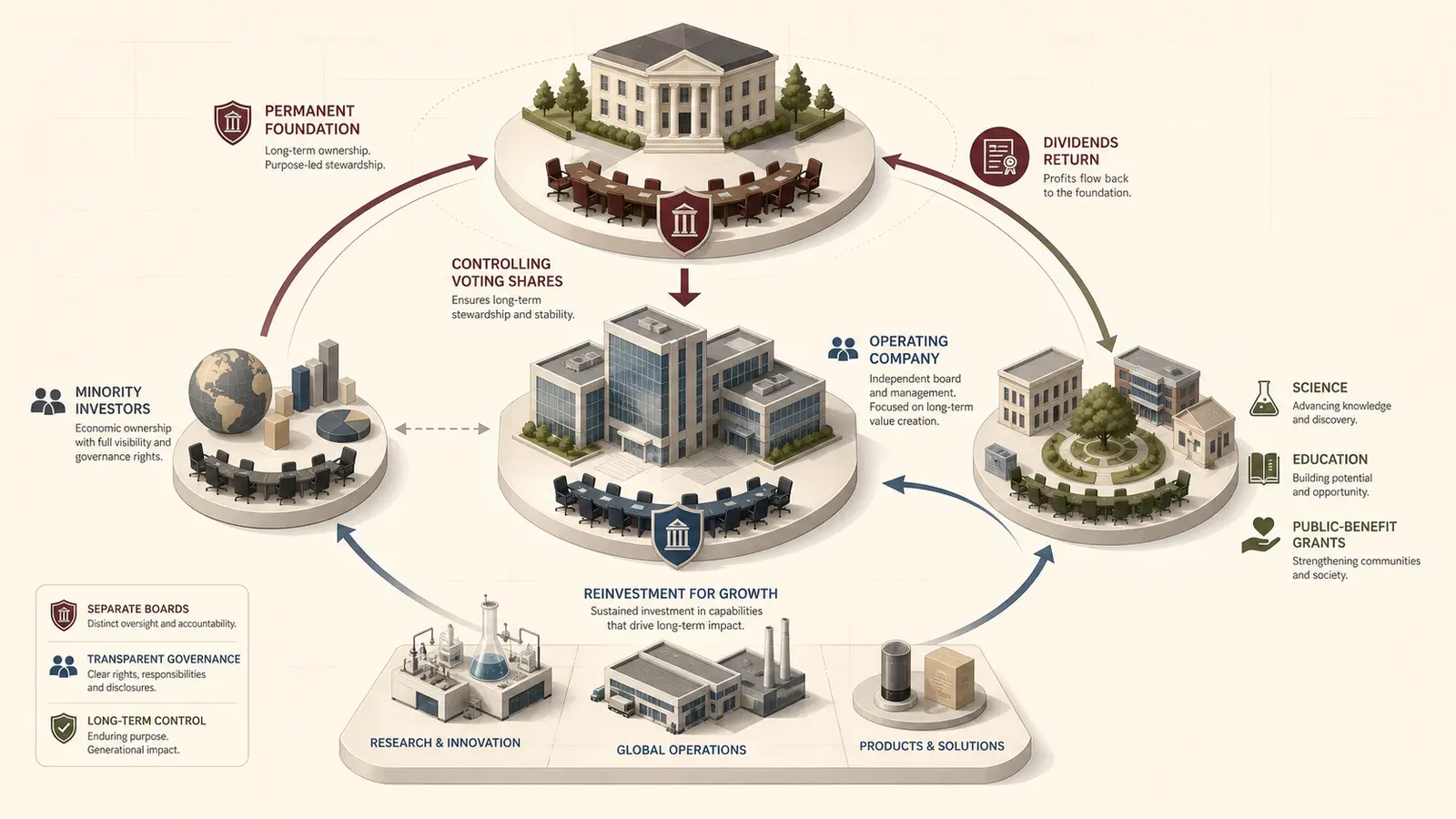
A conventional controlling shareholder usually combines voting influence, economic ownership and the ability to sell. An enterprise foundation separates these rights. It may control a majority of votes while owning a smaller percentage of the economic capital. Public shareholders receive dividends and market liquidity, while the foundation protects the controlling block under its charter.
The operating company remains a commercial business. It hires executives, competes for customers, raises capital and earns profits. The foundation does not replace management. Its principal role is to appoint or influence the company board, approve major ownership matters and preserve the purpose attached to control. Dividends received by the foundation can finance grants, reserves and stewardship costs.
This architecture creates two linked institutions with different duties. The company board owes duties to the company and all shareholders. The foundation board must protect the charter, manage foundation assets and oversee the controlling investment. Confusing the two boards risks turning long-term ownership into informal intervention. Clear boundaries make permanence compatible with professional management.
Permanent ownership changes the corporate clock
A listed company with dispersed investors may still invest for decades, but managers know that disappointing quarterly results can trigger pressure, leadership change or a takeover. A foundation-controlled company faces a different clock. The controlling block is not routinely for sale, and the owner can evaluate strategy across a longer period than a typical fund mandate.
That patience can support research, manufacturing capacity, brand building and employee development whose returns arrive slowly. It can also protect a company during a temporary downturn, when selling assets or cutting productive investment might improve near-term earnings but damage long-term capability. Stable control reduces the risk that a good project is abandoned merely because the market cycle is inconvenient.
Patience is not the absence of financial discipline. Capital that stays forever can be wasted forever. A capable foundation owner still needs return thresholds, portfolio choices and evidence that retained earnings outperform alternative uses. The advantage is the freedom to choose the correct horizon, not permission to ignore performance.
Novo Nordisk shows how voting power can outlast a founder
The Novo Nordisk Foundation owns Novo Holdings, which in turn holds the controlling position in Novo Nordisk and a portfolio of other life-science investments. The structure allows the commercial group to operate with professional boards while placing ultimate voting control inside a permanent foundation. The founder's intent becomes institutional rather than hereditary.
According to the foundation's official governance description, Novo Holdings held about 28.1% of Novo Nordisk's share capital and 77.1% of its votes at the end of 2024. The gap between capital and votes is essential: the foundation preserves control without owning every economic share, leaving room for public-market investment and liquidity.
The arrangement also concentrates responsibility. A controlling owner with more than three quarters of votes cannot plausibly claim to be a passive observer. It must ensure capable boards, orderly succession and oversight of strategic risk. The charitable purpose may justify permanence, but it does not excuse weak decisions at the company or foundation level.
Carlsberg demonstrates that a charter can evolve
The Carlsberg Foundation combines scientific philanthropy with long-term ownership of Carlsberg. Its history shows that permanence does not require a frozen capital structure. Charter amendments have adjusted the economic stake needed to preserve voting control, allowing the listed company to raise equity and participate in major transactions without forcing the foundation to contribute proportionally every time.
The foundation's ownership policy published on May 1, 2024 explains that its charter requires at least 51% of the votes. It also emphasises engaged ownership, respect for non-controlling shareholders and the separate responsibilities of the company's executive committee and supervisory board.
This balance matters. A rigid rule requiring a fixed share of capital could limit acquisitions or new investment. A voting threshold preserves influence while allowing financial flexibility. Governance design must distinguish what is essential to purpose from what can adapt as the company grows.
Philanthropy can strengthen the owner's time horizon
A foundation normally depends on investment income to finance grants. That creates a reason to protect the operating company's productive capacity rather than extract maximum cash immediately. A durable dividend stream can support research, education, culture or other public benefits across generations. The charitable program and commercial asset become economically connected.
The connection can reinforce reputation. Employees and communities may understand that part of corporate success supports an enduring public purpose. This can aid recruitment, stakeholder trust and willingness to invest in capabilities whose benefit extends beyond a single reporting period. Purpose becomes credible when it is embedded in ownership rather than added as a marketing campaign.
Yet philanthropy can also create pressure for distributions. A foundation with ambitious grant commitments may demand dividends when the company needs reinvestment. Boards must therefore coordinate financial planning without confusing their duties. Grant budgets should reflect sustainable income, reserves and business cycles rather than treating the operating company as an unlimited cash machine.
The absence of a takeover threat is both strength and risk
A permanent controlling block can protect management from opportunistic bids and short-lived market fashions. It can preserve research programs, industrial know-how and local capabilities that a financial buyer might divide. This stability is valuable when the competitive advantage depends on cumulative learning.
The same protection weakens one external discipline. If control cannot change hands, an underperforming board may remain in place despite dissatisfaction among public investors. Market price can signal concern but cannot readily transfer control. The foundation must replace the missing takeover mechanism with stronger internal evaluation and willingness to change leadership.
That means board renewal is central, not ceremonial. Directors need relevant commercial skills, independence of judgment and explicit terms. Performance reviews should examine strategy, capital allocation, risk and succession. A foundation that treats board seats as honours rather than demanding jobs converts patient ownership into complacent ownership.
Minority shareholders need more than a liquid exit
Public investors knowingly buy into a controlled company, but the controller still owes them fair treatment. Different voting rights can be legitimate when clearly disclosed, yet they increase the importance of related-party controls, independent directors and transparent capital decisions. The foundation's purpose cannot override the company's obligations to all shareholders.
Minority investors need confidence that dividends, acquisitions, executive pay and financing are decided for commercial reasons. Transactions involving foundation affiliates require robust review. Information should reach all investors at the same time, and the company should explain how its long-term plan creates economic value rather than asking outsiders to trust noble intentions.
Liquidity is not a complete safeguard. Selling after value has been transferred or governance has deteriorated merely crystallises a loss. Effective protection operates before harm: independent committees, audit quality, voting procedures, disclosure and access to legal remedies. Patient control earns a lower cost of capital only when outside investors believe the rules are reliable.
Board design must prevent circular accountability
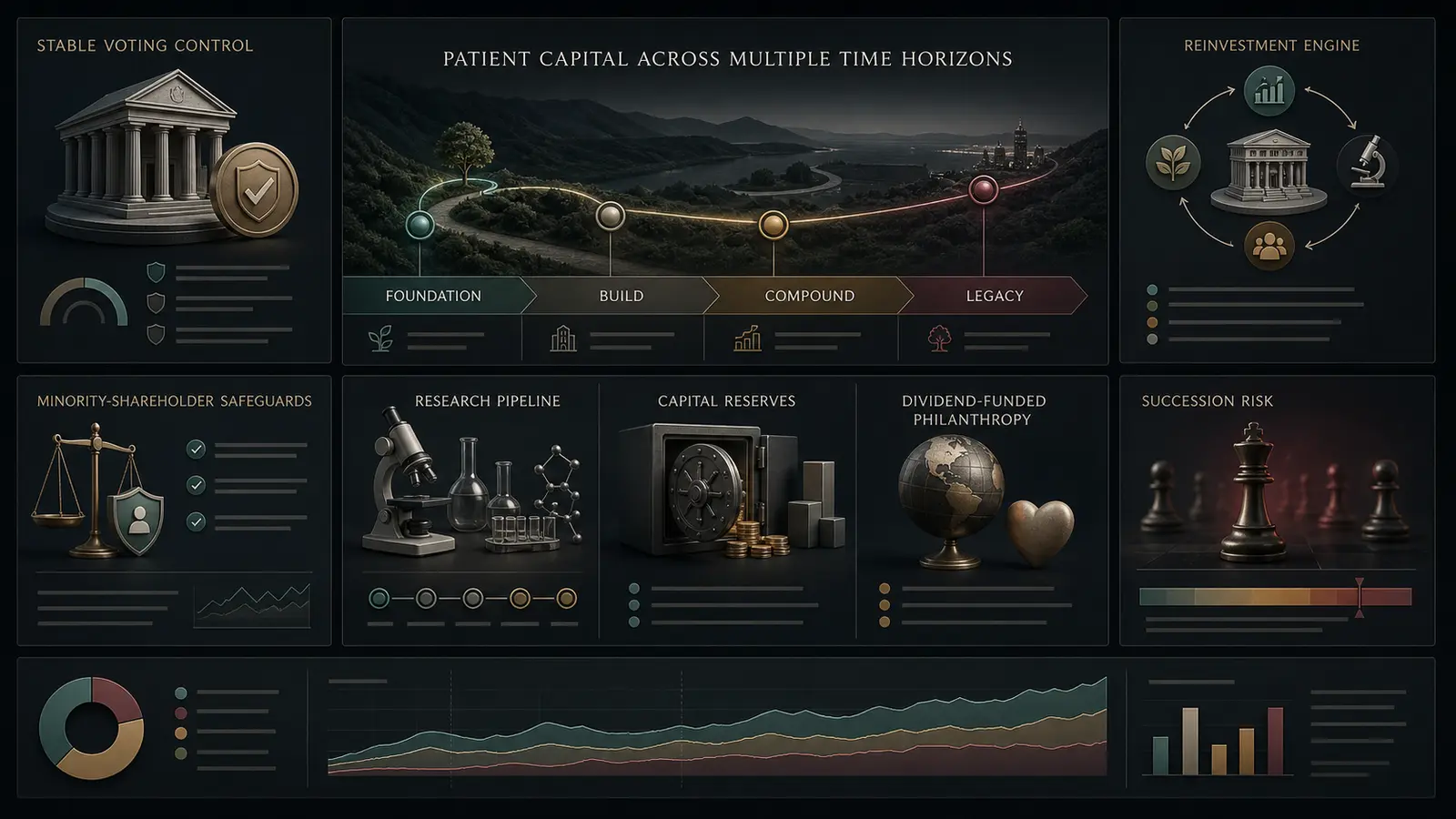
Foundation ownership can produce overlapping directors, informal influence and unclear reporting lines. Some overlap may transmit knowledge, but too much creates circular oversight: the same people influence the company, evaluate its performance and decide how foundation income is used. No board can independently challenge itself.
A sound design maps reserved matters and conflicts. The foundation selects company directors through a documented process; the company board controls operations and executive appointments; independent committees review audit, remuneration and related transactions. The foundation board evaluates the ownership strategy and its own performance. Each body records why important decisions serve its legal duties.
Competence also needs renewal. A foundation created around science or culture may have appointment traditions that do not automatically produce expertise in global business, digital risk or capital markets. The charter can preserve mission while nomination processes add the skills required by the operating asset. Tradition should shape purpose, not narrow the talent pool.
Succession is institutional but not automatic
Family businesses face generational succession; foundations replace it with board succession. This removes disputes among heirs and prevents fragmentation of the controlling stake. It does not eliminate leadership risk. A self-perpetuating board can become homogeneous, closed to challenge or overly dependent on a long-serving chair.
Succession planning should cover both institutions. The company needs executive and director pipelines. The foundation needs a transparent method for finding trustees with stewardship, investment and mission expertise. Emergency plans should address sudden vacancies, incapacity and conflicts. Term limits or staged rotation can preserve continuity without freezing membership.
The owner should also prepare for strategic discontinuity. A permanent charter may confront a business that changes beyond recognition, a technology that becomes obsolete or a capital requirement the foundation cannot support. Governance must define how to interpret purpose, amend structures lawfully or reduce exposure without abandoning fiduciary responsibility.
Capital allocation still decides whether patience creates value
Long-term control is often praised for encouraging reinvestment, but retained capital needs destinations. Management should compare research, capacity, acquisitions, debt reduction and dividends using consistent assumptions. A project does not become attractive merely because its payoff is distant. Its strategic option value, technical milestones and downside must be explicit.
Foundation owners can support countercyclical investment when public markets are fearful. They can also become emotionally attached to legacy assets. Independent analysis is therefore important for acquisitions and divestments. The owner should be willing to sell a subsidiary or close a program when evidence changes, even while preserving control of the core company.
A useful capital framework separates maintenance from growth, and committed projects from options. It tracks returns over the horizon appropriate to each investment. It also compares actual results with the original case. Patience should allow learning and adaptation, not endless extensions of a failed promise.
Purpose must be translated into operating choices
A broad instruction to serve society can support almost any decision after the fact. Effective purpose is more specific. It identifies what the foundation preserves, which public benefits it funds, how commercial success supports those benefits and which constraints apply to ownership. It also states what management remains free to decide.
The company then translates purpose into strategy without turning every action into philanthropy. Product quality, research, safety, environmental performance and workforce capability may align with the owner's horizon while remaining commercially necessary. Grant-making stays at the foundation unless a business investment has its own economic and stakeholder rationale.
Measurement protects against purpose washing. The foundation can report dividends received, grants awarded, reserves, ownership costs and board activity. The company reports commercial, operational and sustainability outcomes under normal market standards. Readers can then see both the connection and the boundary.
Seven tests for a credible enterprise foundation
The legal label alone says little about governance quality. Investors, employees and policymakers should examine how the structure works in practice. Seven tests reveal whether permanent ownership is supporting a strong business or merely protecting insiders:
A practical governance checklist
- Is the foundation's purpose specific enough to guide ownership decisions?
- Are the foundation board and company board distinct, skilled and accountable?
- Can directors and executives be replaced when performance deteriorates?
- Are minority shareholders protected through disclosure and independent review?
- Does capital allocation compare long-term projects with realistic alternatives?
- Are grants based on sustainable income rather than pressure for excessive dividends?
- Can the structure adapt to capital needs without quietly abandoning its purpose?
A strong answer to one question cannot compensate for failure elsewhere. Noble grants do not cure unfair treatment of investors. High profits do not justify a closed board. Permanent ownership is a system, and its elements reinforce or weaken one another.
What conventional companies can learn
Most companies will never be foundation controlled, yet the model offers transferable lessons. A stable statement of purpose can clarify investment horizons. Reserved matters can distinguish ownership from operations. Board succession can be treated as strategic infrastructure. Dividend policy can balance reinvestment with stakeholder commitments.
Institutional investors can also behave more like patient owners without becoming permanent. Longer mandates, concentrated engagement and evaluation across full investment cycles reduce pressure for cosmetic quarterly action. Family owners can use charters and independent boards to separate legacy from day-to-day intervention.
The lesson is not that one ownership form is universally superior. It is that governance architecture changes behaviour. A company should choose mechanisms that match the time required to build advantage while preserving accountability strong enough to correct mistakes.
A patient owner needs impatient standards
The enterprise-foundation model shows how commercial competition, permanent control and public purpose can coexist. Stable voting power can protect research, brands and capability through market cycles. Dividends can finance lasting philanthropy. Professional management and public investors can participate even when ultimate control is not tradable.
None of those outcomes is automatic. Protection from takeover increases the burden on boards. Dual voting power increases the duty to minority shareholders. Philanthropic purpose increases the need to disclose how money and influence move. Permanence raises the stakes of succession because a governance weakness can persist for decades.
The best summary is a productive paradox: patient capital requires impatient standards. The owner can wait for a sound strategy to mature, but it should not wait to confront weak performance, conflicts or stale leadership. When that discipline exists, a non-profit ultimate owner can be not merely compatible with business success, but one deliberate way to sustain it.








ADI News
Leave a comment