
Electric trucks have a financing problem as well as a technology problem
Battery-electric trucks can remove tailpipe emissions from freight routes, but buying a cleaner vehicle is only the first step. Operators also need depot chargers, grid connections, route planning, trained technicians and enough dependable work to recover a higher initial investment. A shipper may want low-emission transport while having no electric truck available on the precise lane, date or depot that serves its cargo. That mismatch leaves demand on one side and usable equipment on the other.
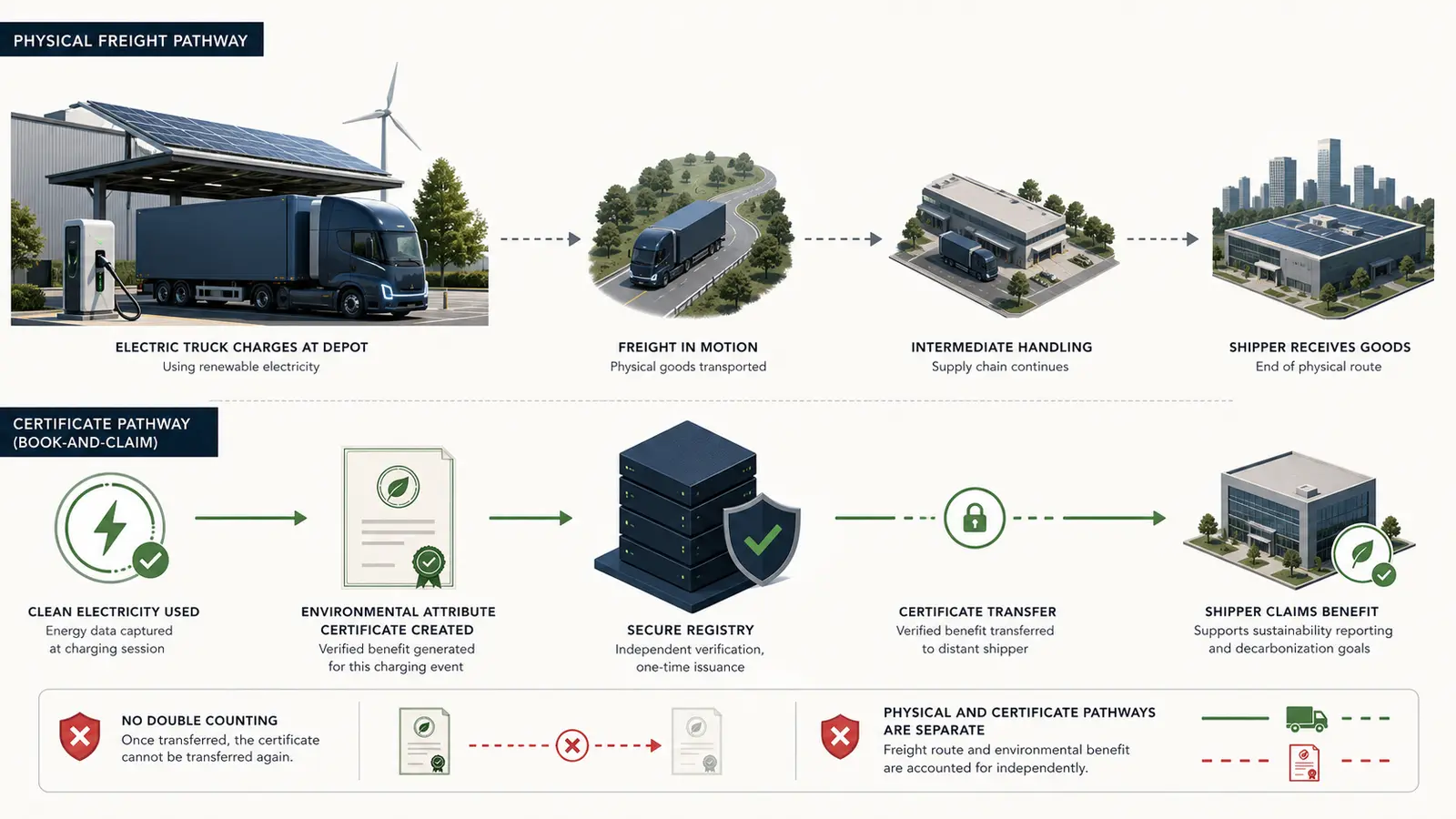
Christine Wiederkehr-Luther, global head of sustainability at Kuehne+Nagel, described a market-based response in an Economist Impact article published on July 18, 2024. The method is called book and claim. A verified environmental benefit created by an electric movement is recorded separately from the physical shipment, then assigned to a paying customer that helps fund the cleaner service.
The idea matters because freight decarbonisation is constrained by timing and geography. A carrier cannot instantly replace every diesel vehicle, and a customer cannot always redesign a supply chain around the few zero-emission lanes available today. Book and claim attempts to aggregate willingness to pay across the network. If designed well, it can turn scattered customer demand into a bankable revenue signal for new vehicles and charging capacity. If designed badly, it can become little more than an attractive certificate.
What is actually being booked and claimed?
The physical product is freight movement: pallets, parcels or industrial inputs travel from origin to destination. The environmental attribute is the measured emissions difference between an eligible lower-emission movement and an agreed baseline. Under book and claim, those two things do not have to reach the same buyer through the same route. The carrier books the verified attribute in a registry, and an eligible customer later claims it against a defined transport footprint.
This separation resembles renewable-energy certificates, but road freight introduces its own variables. Vehicle class, payload, distance, charging electricity, weather, empty running and operational efficiency all affect emissions. A credible certificate therefore cannot be based merely on the purchase of an electric truck. It must represent actual eligible transport activity, supported by energy and operational data and calculated through a disclosed methodology.
The word claim is equally important. A certificate does not erase physical emissions everywhere, and it should not imply that a specific shipment rode on an electric truck when it did not. The buyer is financing and receiving an allocated environmental attribute within the transport value chain. Marketing, inventory accounting and target reporting must describe that limited proposition accurately.
Why lane-by-lane matching slows investment
Electric freight capacity is scarce and unevenly distributed. Early fleets naturally cluster around depots with suitable power, predictable routes, supportive regulation and enough daily mileage to justify the asset. Customer demand is broader. A multinational buyer may have thousands of shipments across regions, contractors and vehicle types, only a fraction of which can be electrified immediately.
Requiring each buyer to use an electric vehicle on its own exact route can strand both demand and supply. A carrier may have a suitable truck in one operating region but no customer there willing to pay a premium. Elsewhere, an ambitious shipper may be ready to pay but lack charging infrastructure or an available vehicle. The market fails to clear even though the combined willingness to invest is real.
Book and claim broadens the matching area. Funding from a customer can support eligible electric operations elsewhere within a defined system boundary. This does not eliminate geography; the rules must specify which modes, regions, time periods and value chains can be connected. It does, however, allow investment to begin where conditions are practical, creating operating experience and scale before every lane is ready.
The commercial engine is a forward demand signal
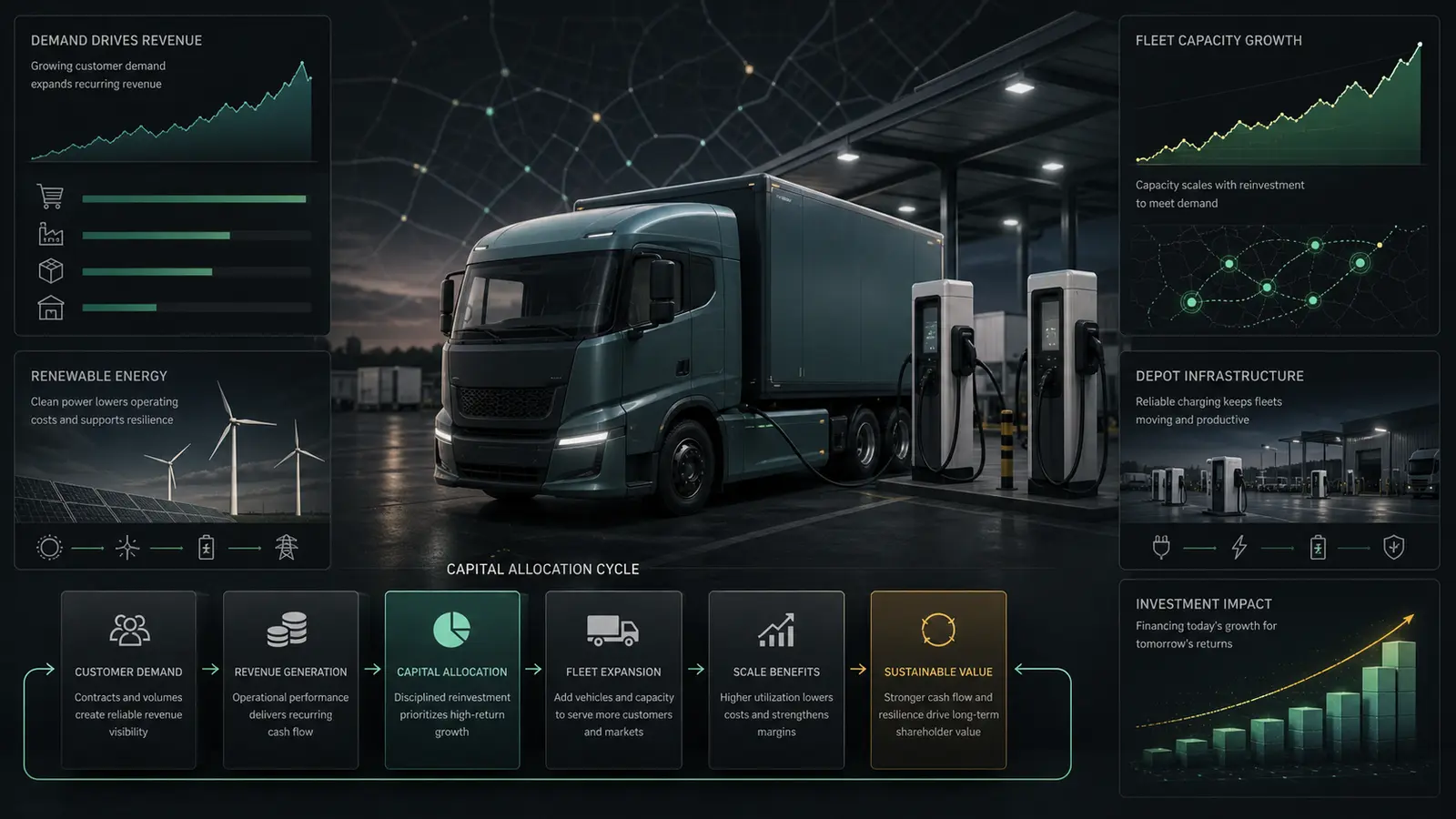
A fleet operator deciding between diesel and battery-electric equipment compares total cost, operational risk and expected utilisation. The electric option may have lower energy and maintenance expenses but higher purchase price, charging cost and uncertainty. A certificate contract can add predictable revenue tied to verified low-emission activity. That income changes the investment case without relying only on grants or future fuel savings.
Kuehne+Nagel announced in January 2024 that its electric-vehicle book-and-claim offer initially used company-owned battery-electric trucks. Keeping the first assets under direct control made operational and energy data easier to govern. The company is headquartered in Switzerland, but the commercial principle is global: verified customer commitments can help justify fleet assets before perfect route matching exists.
Longer contracts are especially valuable. A one-off purchase may reward activity that would have happened anyway, while a multi-year offtake agreement can support a vehicle order, grid upgrade or charger lease. The strongest model connects certificate revenue to a documented expansion plan and shows which investment hurdle that revenue helps overcome.
Additionality separates investment from relabelling
The hardest question is whether the buyer caused or accelerated a real change. If a carrier would operate the same electric truck at the same intensity without certificate revenue, selling the attribute may redistribute credit rather than add capacity. That outcome can still allocate an existing benefit, but it should not be presented as financing a new transition.
Additionality can be tested in several ways. A program may require assets commissioned after a cut-off date, show that revenue closes a documented cost gap, reserve certificates against incremental utilisation, or link contracted demand to a fleet expansion decision. No single screen is perfect. The evidence should be proportional to the claim and available for independent review.
Managers should avoid promising a counterfactual that cannot be proven. A useful formulation is narrower: customer demand contributed revenue to an eligible pool of verified electric transport activity. Stronger statements about causing a specific truck purchase require stronger evidence, including investment approvals, contract timing and financial assumptions.
Measurement begins with physical operations
A robust system starts at the charger and vehicle, not at the marketing department. It needs distance, vehicle type, energy consumed, load or freight work, charging source and the baseline against which savings are calculated. Data should cover empty kilometres and losses where the methodology requires them. Selective measurement can exaggerate performance by ignoring inconvenient parts of the journey.
Electricity is central. A truck with no tailpipe exhaust can still be associated with power-sector emissions. Programs must state whether they use grid-average factors, time-specific factors, contracted renewable electricity or another method. Each choice changes the result. Transparent assumptions allow buyers to compare certificates rather than treating every electric kilometre as identical.
The baseline also matters. Comparing an electric truck with an unusually inefficient diesel vehicle inflates the claimed reduction. Comparing it with a realistic vehicle serving the same freight task is more credible. Methodologies should document vehicle class, fuel efficiency, payload and regional conditions, then update assumptions as fleets improve.
A registry must make double counting difficult
The same environmental attribute can appear in several corporate reports unless ownership is explicit. A carrier, logistics intermediary, shipper and consignee may all want to describe the benefit. The charging electricity may also carry a separate renewable attribute. Without clear rules, one physical action can generate overlapping claims that exceed the underlying reduction.
A registry should create a unique record, identify the eligible activity, show transfers and retire the certificate after final use. Retirement is not administrative decoration; it closes the asset so it cannot be sold again. Audit trails should connect the retired unit back to source data without exposing commercially sensitive shipment details unnecessarily.
Governance needs controls for errors and reversals. Duplicate uploads, faulty meters, corrected electricity factors or ineligible activity must be handled through documented cancellation and replacement procedures. Buyers need confidence that a later correction will be visible rather than quietly edited out of a report.
Book and claim is not conventional offsetting
An offset typically represents a reduction or removal outside the buyer's own value chain. A freight book-and-claim certificate is intended to allocate a benefit created within the transport system that serves corporate supply chains. That proximity is why advocates often call it insetting. The distinction is meaningful, but terminology alone does not guarantee integrity.
A buyer should still reduce transport demand, improve loading, redesign routes and procure direct zero-emission service wherever feasible. Certificates are most defensible for residual lanes where direct matching is temporarily unavailable. If book and claim becomes a permanent substitute for operational change, it can weaken the pressure to build charging infrastructure where the buyer actually ships goods.
The hierarchy is therefore practical. Avoid unnecessary movement first. Improve logistics efficiency second. Contract direct cleaner transport where possible. Use a governed market-based instrument for the remaining mismatch, while setting a timetable for direct coverage to grow. Reporting should show all four layers separately.
Standards determine whether corporate buyers can use the result
Companies often purchase lower-emission logistics because they have value-chain targets. Yet a voluntary instrument becomes far less useful if major accounting or target-setting frameworks do not recognise the claim. In 2024 the Science Based Targets initiative was considering how environmental attribute certificates might interact with scope-three targets, while clarifying that its existing standards had not automatically changed.
The uncertainty affects contracts. A buyer may value the operational benefit but hesitate to sign a long agreement if the certificate cannot be counted in a target report. A carrier may need that commitment to order vehicles. Clear guardrails can unlock demand, while permissive rules without quality thresholds could flood the market with weak units and damage trust.
The Book and Claim Community, co-chaired by Smart Freight Centre and RMI, published principles and best practices for heavy transport in June 2024. Its focus on reporting, certification, registries and capacity building reflects the real challenge: the certificate must work as an auditable system, not merely as a product label.
The pricing question should be visible
Certificate prices can reflect the cost gap between technologies, scarcity of eligible activity, verification expense and buyer demand. A very low price may signal that revenue is too small to change investment. A very high price may attract supply, but it can also encourage creative baselines and speculative intermediation. Transparent price formation matters even when individual contracts remain confidential.
Buyers should ask how much of the payment reaches fleet operations and infrastructure. Registry, audit, sales and program administration are necessary, but excessive intermediation reduces the transition effect. A program can report the share allocated to vehicles, chargers, renewable power and operating support without revealing every commercial term.
Carriers should avoid treating certificate income as guaranteed margin. Standards may change, buyers may prefer direct transport, and electric technology costs may converge with diesel. Investment models should test lower certificate prices and shorter contract durations. The objective is to use early market revenue to cross the adoption gap, not to create permanent dependence on premiums.
Operational reality still decides where trucks work
No accounting framework changes vehicle range, charging time, payload, driver schedules or grid capacity. A fleet must select routes that fit actual equipment and protect service reliability. Depot charging may work well for return-to-base operations, while long-haul networks require public or shared infrastructure and careful energy planning.
Utilisation is decisive because capital-intensive vehicles earn returns only while doing productive work. Charging at the wrong time can reduce daily mileage or expose the operator to peak electricity prices. Smart scheduling can align charging with dwell periods, cleaner electricity and lower tariffs, but it requires reliable data and coordination with dispatch.
Maintenance capability must scale too. Technicians need high-voltage training, spare parts and safe procedures. Recovery plans must cover breakdowns without defaulting every disruption to diesel. Early book-and-claim revenue is most valuable when it helps build this complete operating system rather than funding isolated vehicle purchases.
A buyer's due-diligence checklist
Procurement teams should evaluate the instrument with the same discipline used for other strategic suppliers. Sustainability language cannot substitute for a clear contract, measurement method and liability allocation. At minimum, the buyer should understand the following:
Questions that reveal certificate quality
- Which vehicles, journeys, energy sources and dates are eligible?
- What baseline converts physical activity into a reduction?
- Who owns the attribute before transfer, and who retires it?
- How are electricity emissions and renewable-energy claims treated?
- What evidence supports additionality or accelerated investment?
- Which independent party verifies source data and calculations?
- Can the registry prevent duplicate issuance and disclose corrections?
- What claim language may the buyer use in inventories and marketing?
- How much revenue supports vehicles, chargers and operations?
- When will direct electric service replace indirect matching on key lanes?
A procurement decision should also include an exit path. If standards reject the intended accounting treatment, the contract might redirect value toward verified operational reporting, convert future volume to direct service or allow termination. Designing that flexibility early is cheaper than arguing after a reporting rule changes.
Management metrics should follow both climate and business value
A program needs more than tonnes of reported emissions. It should track electric kilometres, freight work, energy use, vehicle utilisation, charger availability and incremental assets supported. Financial measures include certificate revenue, capital deployed, operating cost, contract duration and the amount of customer demand waiting for supply.
Quality metrics are equally important: percentage independently verified, age of source activity, correction rate, retirement time and concentration among vehicles or customers. A portfolio that depends on one depot or buyer may be fragile even if its current volume is large. Diversity should be measured rather than assumed.
Finally, management should report progress toward direct matching. The strongest evidence that book and claim is a bridge is a rising share of customers receiving electric service on their actual lanes. If indirect claims grow indefinitely while direct coverage is flat, leaders should reconsider whether the mechanism is accelerating transition or merely monetising scarcity.
What success would look like by the next investment cycle
A successful first cycle produces several observable results. Customer contracts become long enough to influence fleet planning. Operators order additional vehicles and chargers. Verified activity grows without weakening baselines. Registry records are retired once, corrections remain visible, and public claims use precise language. Buyers continue to improve logistics rather than relying exclusively on certificates.
Scale should also reduce the premium. More vehicle supply, better charging utilisation and operational learning can narrow the cost gap. Certificate revenue may then shift from supporting basic adoption toward difficult routes, smaller carriers or infrastructure bottlenecks. A declining subsidy need is a sign of market development, not program failure.
Book and claim cannot electrify road freight by itself. Manufacturers must supply vehicles, utilities must connect power, governments must provide coherent rules, carriers must operate reliably and customers must pay for cleaner service. Its contribution is coordination: it gives distributed demand a way to reach investable projects before the physical network is complete.
The strategic conclusion: finance the bridge, then shorten it
The 2024 debate was not about choosing certificates instead of electric trucks. It was about finding a credible bridge between current network constraints and the scale of investment required. Market-based accounting can help when direct service is unavailable, provided every unit begins with measured physical activity, passes through a controlled registry and ends with one limited, transparent claim.
For carriers, the opportunity is to convert customer ambition into longer-term demand and productive assets. For shippers, the opportunity is to support real transport decarbonisation without pretending every shipment is already electric. For standards bodies, the task is to recognise useful innovation while excluding double counting, weak baselines and claims detached from investment.
The bridge should become shorter over time. More lanes should gain direct electric service, more depots should connect to clean power, and certificate rules should become more consistent. When a program can show that progression, book and claim is not an accounting shortcut. It is an early-stage financing mechanism helping a fragmented freight market build the physical system it says it wants.




















ADI News
Leave a comment