
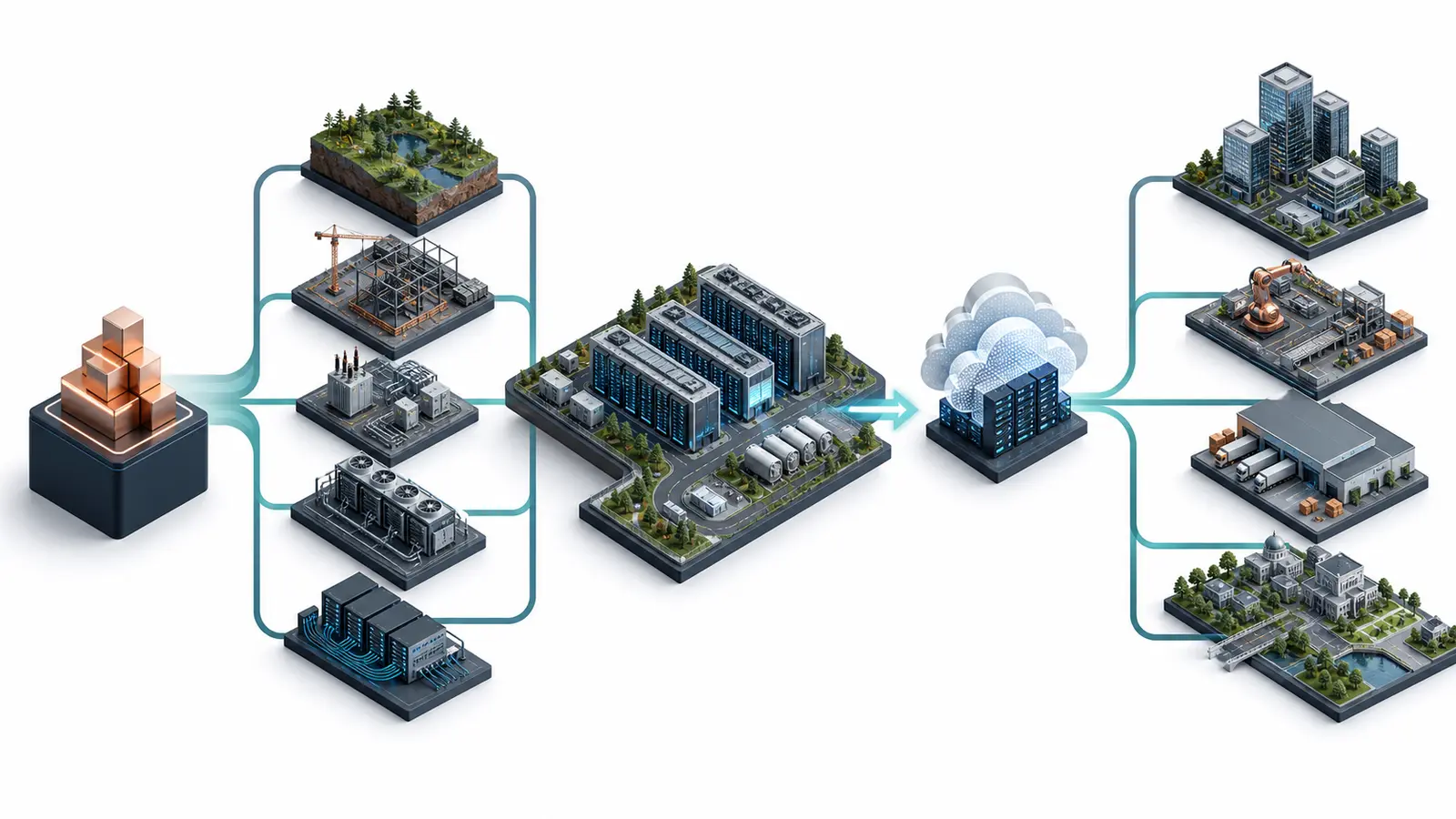
Cloud demand becomes concrete, steel and electricity
Cloud computing sounds weightless because customers buy processing and storage through software. The service is physical underneath. A provider must secure land, connect to high-capacity electricity, install cooling, purchase servers and networking equipment, and operate the campus for years before capital earns an adequate return. Artificial intelligence makes each constraint more visible because its workloads demand dense compute and rapid access to large datasets.
Kimberley Kao reported in The Wall Street Journal edition of Sept. 12, 2024 that Amazon Web Services planned to invest £8 billion, about $10.5 billion at the time, through 2028 to build and operate data centres. The commitment followed a surge in demand for cloud and artificial-intelligence computing and added to a worldwide expansion of technology infrastructure.
The strategic question is not simply whether more computing will be needed. It is how a long-lived, location-specific asset can remain useful while chips, models, energy prices and customer behavior change rapidly. A successful campus combines financial discipline with engineering flexibility. It must create capacity early enough to capture demand without building so far ahead that expensive equipment sits idle.
£8 billion is a portfolio, not one construction project
A multi-year investment announcement usually includes several categories. Land and buildings form the visible shell. Electrical substations, backup systems, cooling plants, fibre connections, security and water infrastructure make that shell operable. Servers and accelerators deliver the product, while maintenance, software, technicians and replacement cycles keep it commercially available.
These components do not share the same useful life. A building may serve for decades. Electrical equipment can be upgraded but requires long planning and grid coordination. Compute hardware may become economically obsolete in a few years. Treating all spending as one project hides the different risks and replacement schedules.
Management therefore needs a capital portfolio. Each campus phase should have a demand trigger, power requirement, construction budget and expected customer ramp. Long-life civil works can create options for later modules, while fast-depreciating hardware should be installed closer to contracted or strongly evidenced use. This staging reduces the cost of forecasting error.
Growth figures explain the urgency, not the return
The Journal reported that the cloud unit's second-quarter net sales rose about 19% from a year earlier to $26.28 billion. It was also described as Amazon's most profitable unit. At the group level, purchases of property and equipment reached $17.62 billion in the quarter, more than 50% above the prior-year period and the highest quarterly level since 2021.
These numbers explain why management was willing to accelerate infrastructure. They do not prove that every additional data centre will earn the same margin. Revenue growth can coexist with falling utilization, pricing pressure or higher energy costs. A campus may take years to reach efficient occupancy, and the newest artificial-intelligence hardware carries a high initial price.
Return analysis should connect a specific block of capacity with contracted demand, expected on-demand usage, pricing, electricity, depreciation and network cost. Aggregate cloud growth is useful context, but investment approval requires local economics. The more capital a provider commits, the more important this bridge becomes.
Power availability is becoming a strategic asset
A data centre cannot choose electricity after construction. Grid capacity, connection timing, reliability and price shape the location before ground is broken. A nominally attractive site can lose its advantage if a connection is delayed or if transmission constraints make expansion impossible. Backup generation protects continuity but cannot replace a dependable grid for normal operation.
Artificial-intelligence systems increase power density. More computation can be placed in each rack, but the building must distribute electricity and remove heat safely. Retrofitting an older facility may require new switchgear, cooling and structural changes. A campus designed for modular expansion can adapt more economically than one optimized for yesterday's density.
Power strategy also affects reputation and regulation. Customers want evidence about the emissions associated with their digital services. Communities care about local grid pressure. Providers may combine renewable contracts, storage and efficiency measures, but claims should distinguish annual matching from reliable supply at every hour. Physical limitations cannot be solved by accounting language alone.
Cooling and water turn compute into a local question
Every calculation ultimately becomes heat. Cooling technology must maintain equipment within operating limits through seasonal weather and changing rack density. Air systems, liquid loops and evaporative methods have different capital, energy and water profiles. The best choice depends on climate, equipment design and local resources.
Water can become a source of conflict if a facility competes with households, agriculture or industry. Even a technically efficient design may face opposition when disclosure is weak. Operators should publish consistent measures, explain peak conditions and show how reuse or closed-loop systems reduce withdrawals.
Cooling is also a resilience issue. Extreme heat can raise electricity demand at the same time a campus needs more cooling. Maintenance must occur without interrupting customer services. Redundant systems provide protection but add capital and can lower efficiency when poorly operated. Engineering value comes from balancing continuity with lifetime resource cost.
Networks define the real geography of the cloud
Customers experience cloud capacity through latency, throughput and availability. A building full of servers is not useful if data cannot reach users and other facilities quickly. Fibre routes, carrier diversity and connections to exchange points determine which workloads a campus can support.
Network design also creates regional effects. A major cloud campus can justify new fibre, attract software and service partners, and give local organizations lower-latency access to advanced computing. Those benefits are not automatic. They depend on commercial access, competitive connectivity and customers with the skills to use the capacity.
Concentrating connections through one route creates hidden fragility. Construction damage, equipment failure or a supplier dispute can interrupt services across supposedly independent systems. Resilience requires physical route diversity, not merely different contracts using the same trench.
Regional economic impact requires careful interpretation
The official Amazon Web Services announcement estimated that the investment would contribute £14 billion to gross domestic product through 2028 and support an average of more than 14,000 full-time-equivalent jobs each year at local businesses. It described roles across construction, maintenance, engineering and telecommunications.
Economic-impact estimates measure direct, supplier and induced activity under assumptions about spending and multipliers. They are not the same as 14,000 permanent employees inside data centres. Construction employment peaks during development, while operating campuses use smaller teams with specialized skills. Supplier purchases can support many more roles outside the site.
A credible regional scorecard should separate temporary construction work, continuing operations, local procurement, wages, training and tax contributions. It should also identify displacement: workers or grid capacity used by the project may be unavailable elsewhere. Gross activity is useful, but net additional value is the stronger policy question.
Skills determine whether local value persists
Data-centre operations require electrical and mechanical technicians, network specialists, security, logistics and facility management. Construction requires another set of trades. A region can host the physical asset while importing much of the skilled work if training does not develop alongside investment.
Employers, colleges and contractors need a shared demand forecast. Apprenticeships should connect classroom learning with actual equipment and safety practice. Transferable credentials reduce the risk for workers who train for one operator, while a wider supplier base creates career paths beyond a single campus.
Skills planning should begin before opening. Hiring everyone at once can raise costs and pull scarce technicians from utilities or other critical infrastructure. Staged recruitment, supplier development and conversion programs for adjacent trades can expand the pool rather than simply redistribute it.

Capacity is valuable only when customers use it
A provider can report installed power, server count or available accelerator capacity, but financial return depends on utilization and price. Low utilization leaves depreciation and energy infrastructure spread over fewer billable workloads. Very high utilization can damage service quality and leave no room for customer peaks.
Demand forecasting is difficult because artificial-intelligence adoption combines structural growth with experimentation. A customer may reserve substantial capacity during model development and later optimize the workload. New chips can perform the same work with less energy, changing the value of older equipment. Competing providers can also reduce price.
A disciplined capacity dashboard
- Contracted, reserved and on-demand use by campus and hardware generation.
- Power capacity connected, commissioned and awaiting grid delivery.
- Revenue and contribution margin per unit of active compute.
- Energy and cooling cost under normal and peak conditions.
- Construction commitments compared with demand triggers.
- Hardware age, expected replacement and resale or alternative use.
- Service reliability, latency and available headroom for customer peaks.
This dashboard connects engineering and finance. It prevents a construction milestone from being mistaken for a commercial result and helps management delay, accelerate or repurpose a phase as evidence changes.
Artificial-intelligence infrastructure carries technology risk
Demand may grow while the winning architecture changes. Accelerators improve, models become more efficient and customers shift between training and inference. A fixed facility must support equipment generations that were not known when planning began. Flexible electrical distribution, cooling and network design can preserve options.
Technology risk also affects purchasing. Buying equipment early can secure supply but begins economic depreciation before revenue arrives. Waiting protects capital but may lose customers when demand accelerates. Framework agreements, phased delivery and diverse hardware support can reduce the binary choice.
Software matters as much as hardware. Scheduling, virtualization and workload optimization determine how effectively physical capacity is shared. Better utilization can create saleable compute without constructing another building. Capital discipline therefore includes investment in the control layer, not only visible assets.
Large campuses intensify concentration questions
Cloud platforms benefit from scale. A large operator can spread security, software development and network investment across many customers. It can purchase equipment efficiently and provide services that smaller organizations could not build alone. These economies support innovation but also increase dependence on a few providers.
Customers need portability, tested recovery and visibility into where critical data and workloads run. A nominal multi-cloud policy has little value if applications cannot move or teams have never exercised the plan. Regulators and public buyers should focus on practical switching and resilience rather than counting contracts.
Communities also negotiate with an operator that may have greater information and bargaining power. Transparent planning rules for grid connections, water, tax incentives and restoration obligations help compare projects consistently. Special treatment can attract investment, but hidden concessions make it difficult to assess public value.
Capital staging protects both growth and resilience
A five-year commitment should be governed through gates rather than treated as an instruction to spend on schedule. Early phases can secure land, power and network options. Later phases should depend on construction performance, customer demand, equipment economics and community conditions.
Four decision gates
- Site readiness: planning permission, grid timing, water, fibre and community commitments are verified.
- Module approval: demand evidence supports the building and long-life infrastructure.
- Equipment release: customer ramp justifies installing fast-depreciating compute and network hardware.
- Operating review: utilization, reliability and regional commitments support the next expansion.
Gates do not eliminate urgency. They clarify which risks management accepts and which evidence can change the decision. A provider can move quickly on scarce land or grid options while remaining cautious about hardware. This separation is essential when demand grows faster than infrastructure can be delivered.
Infrastructure policy must measure durable additional capacity
Rachel Reeves described the commitment as evidence that the United Kingdom was a place to do business. Tanuja Randery of Amazon Web Services connected the investment with cloud adoption, artificial intelligence, productivity and competitiveness. Andy Jassy had reoriented the wider company toward artificial-intelligence innovation and infrastructure.
For government, the opportunity is broader than one corporate announcement. Reliable power, efficient planning, digital networks and technical skills can support several industries. Policies designed only for one campus risk creating isolated capacity; policies that improve shared infrastructure can lower the cost of subsequent investment.
Public evaluation should return to durable additional capacity. Did the project add grid and fibre that others can use? Did suppliers gain capabilities? Did training create portable careers? Did compute access help organizations become more productive? These questions distinguish an impressive construction budget from a lasting economic platform.
The £8 billion plan showed how cloud competition was becoming industrial policy by another name. Servers and software remain central, but the decisive constraints increasingly sit in land, electricity, cooling, networks and people. The provider that coordinates those systems can convert demand into reliable service. The region that governs them well can convert one data-centre investment into a wider base for growth.




















ADI News
Leave a comment