
Alphabet X is changing the business model behind the moonshot
For years, the idea of a corporate moonshot was closely associated with patience. A large technology company could assemble scientists, designers and engineers, give them access to unusually capable laboratories, and allow them to work on problems that ordinary product teams could not justify against a quarterly plan. X, the research organization created inside Google and later placed within Alphabet, became the best-known expression of that model. Its teams explored autonomous transport, delivery aircraft, internet connectivity, industrial robotics, health technology and climate systems. The promise was not that every experiment would survive. The promise was that a disciplined factory could turn a very small number of radical ideas into businesses with global relevance.
By 2024, however, the route from experiment to commercial company was becoming more important than the romance of invention itself. Bloomberg Businessweek reported in May 2024 that Alphabet was ending an era of relatively unconstrained invention at X and moving more projects toward independent startups. That shift did not mean the moonshot factory had abandoned difficult science. It meant that promising teams increasingly had to demonstrate who would fund the next stage, who would buy the product, and why the project belonged outside the corporate parent. The strategic question changed from whether a technology could work to whether an organization could carry it into a real market.
Why the old corporate innovation bargain became harder to defend
Corporate research has always lived with a structural tension. The parent company wants access to discoveries that may define the future, but the operating business must allocate capital among products with measurable demand. A laboratory can celebrate learning from failure; a public company must also explain the cost of that learning. The tension becomes sharper when interest rates rise, investors reward efficiency, and artificial intelligence creates an immediate contest for computing infrastructure and technical talent. Every dollar assigned to an uncertain hardware or climate project is a dollar that cannot be assigned to a core platform with visible users and revenue.
Alphabet can afford long research cycles, but affordability is not the same as strategic fit. Some X projects are close to Google’s computing strengths. Others address aquaculture, energy storage, mobility or industrial systems that require manufacturing partners, specialized sales teams, regulatory expertise and patient project finance. Those businesses may benefit from Alphabet’s engineering culture while still being awkward additions to a digital advertising and cloud portfolio. Independence offers a way to preserve the technology without forcing the parent to become the permanent operator of every market it helps create.
This is the commercial logic beneath the change. A spinout can raise capital from investors who understand its sector, recruit directors with relevant operating experience, and form partnerships that might be difficult under the strategic boundaries of a large parent. At the same time, external capital supplies an honest price signal. If a project cannot persuade informed investors or customers to support its next phase, more years inside a protected laboratory may not solve the underlying problem.
Skip shows what graduation looks like in practice
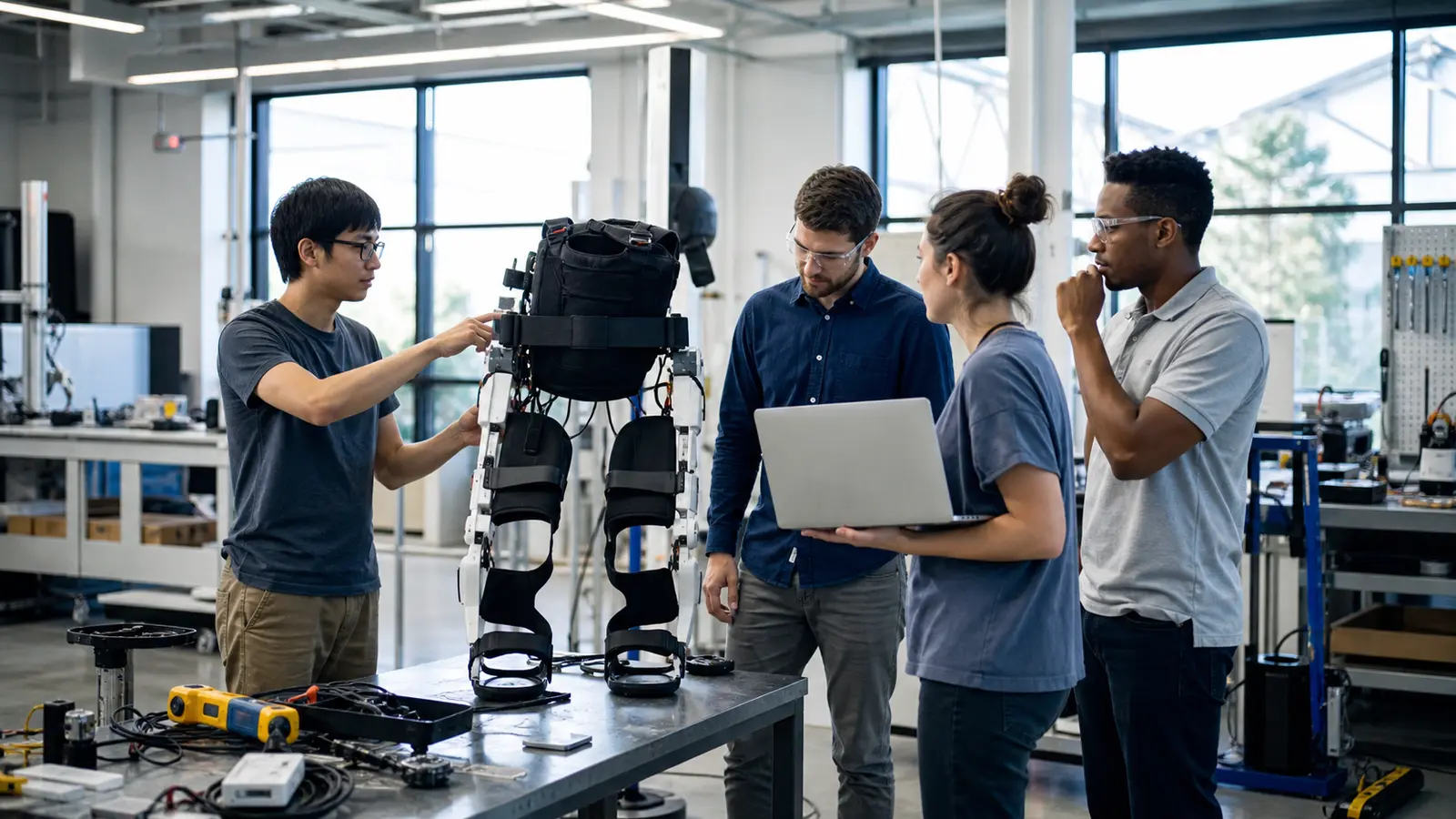
The Businessweek report opened with Kathryn Zealand, whose team developed a wearable system intended to support human movement. Zealand joined X in 2018 after work in consulting, physics and entrepreneurship. The prototype described in the report combined a belt, sensors, actuators and mechanical assistance around the legs. It illustrated both the strength and the difficulty of the moonshot model: the work demanded knowledge from robotics, biomechanics, machine learning, product design and user research, yet the final product needed to feel less like laboratory equipment and more like clothing.
The project became Skip, an independent company in 2023. X says the team built dozens of prototypes and tested its concepts with hundreds of people before graduation. In 2024, Skip introduced MO/GO powered pants with outdoor equipment company Arc’teryx. The product was described as an e-bike for walking, designed to reduce exertion and joint discomfort during activities such as hiking and climbing stairs. Those details matter because they reveal a transition from a broad social problem to a specific commercial proposition. Improved mobility is the mission; a wearable product, an identified user and a distribution partnership form the business.
Skip also demonstrates why independence can be productive rather than punitive. A specialized company can focus its brand, product roadmap and fundraising on mobility. It can decide whether its first customers should be outdoor enthusiasts, older consumers, rehabilitation providers or another segment without competing for attention inside a vast technology group. Alphabet loses some control, but the technology gains a management team whose entire mandate is to find product-market fit.

The spinout model changes how technical risk is financed
Inside a corporate laboratory, technical uncertainty and commercial uncertainty are often financed together. The parent pays while a team discovers whether the science works and whether a market exists. A spinout separates those stages more clearly. X can absorb the earliest period, when a concept may require specialized facilities and repeated failure. Once core technical risks have been reduced, outside investors can evaluate the remaining questions: manufacturing cost, customer acquisition, regulation, service obligations and scale.
That handoff creates discipline, but it can also expose a funding gap. Deep-technology companies frequently need more capital and more time than software startups. A prototype may perform well in controlled tests yet still require certification, supply agreements, tooling and field support. Venture investors may want rapid growth, while infrastructure or industrial customers move through long procurement cycles. A successful graduation system therefore needs more than a legal separation. It needs investors whose time horizon matches the technology and a staged plan that connects each round of capital to evidence.
What investors need to see after a project leaves the laboratory
- A clearly defined customer problem that is costly or urgent enough to support adoption.
- Technical results that can be reproduced outside the original research environment.
- A realistic account of manufacturing, certification, deployment and support costs.
- Commercial partners that contribute market access rather than publicity alone.
- Milestones that reduce a named risk before the company needs its next financing round.
These requirements do not eliminate scientific ambition. They make the capital structure match the stage of development. The corporate parent funds exploration; the independent company raises money to prove a repeatable business. When the boundary is explicit, both sides can judge progress against the correct objective.
Independence gives projects a sharper strategic identity
A moonshot can begin with an enormous mission, but a company cannot sell an enormous mission by itself. It needs an offer, a buyer and an accountable delivery system. Independence forces choices that a research group can postpone. A team must decide which application comes first, which capabilities remain proprietary, what it will manufacture, what partners will supply, and how much service customers will require. Those choices may narrow the initial vision, yet the narrower business can be the mechanism that eventually expands the technology’s impact.
The effect is visible across former X projects. Industrial robotics company Intrinsic became a separate Alphabet business after developing software intended to make robots easier to use. Tidal, focused on underwater artificial intelligence for aquaculture, later graduated as an independent company backed by outside capital. Other projects have followed different routes: some entered Google, some became Alphabet businesses, some licensed technology, and some were stopped. The factory is therefore not a single pipeline toward one type of exit. It is a portfolio system that searches for the organizational home most appropriate to each technology.
For founders and employees, that transition can be demanding. A scientist who succeeded by removing technical uncertainty may have to build a sales process, manage cash, recruit a board and explain progress to new investors. Compensation, culture and risk tolerance change. The strongest spinouts acknowledge that a new corporate identity is not created by changing the name on an employment contract. It emerges when authority, incentives and operating routines are redesigned around the market the company intends to serve.
The parent company gains options but gives up control
From Alphabet’s perspective, independent financing creates strategic options. The parent may retain an economic interest while reducing the amount of capital and management attention required for scale-up. It can maintain commercial relationships, license intellectual property, provide technical services or participate in later funding without carrying every operating decision. A successful spinout can validate the original research and produce financial value; an unsuccessful one can fail without disrupting the core company.
The trade-off is control. An outside board may change strategy, accept a buyer or prioritize a market that does not align with Alphabet’s preferences. New investors will expect governance rights and a credible path to returns. The spinout may also need freedom to work with companies that compete with parts of Alphabet. If the parent retains too much influence, outside capital can become cosmetic. If it retains too little, useful intellectual property or strategic learning may drift away.
Well-designed spinouts address those tensions before separation. Agreements specify ownership of patents, access to data, use of shared facilities, employee transfers and the terms of future collaboration. Governance should distinguish matters that protect the parent’s legitimate interests from ordinary operating decisions that belong to the new company. Ambiguity may feel cooperative at launch, but it becomes expensive when the business encounters its first financing, partnership or acquisition proposal.
A laboratory still matters even when projects leave sooner
The shift toward spinouts could be misread as evidence that centralized research no longer works. The opposite conclusion is more useful. A laboratory like X can provide assets that an early startup rarely assembles: machine shops, specialist engineers, rapid prototyping, safety expertise and colleagues accustomed to testing unfamiliar ideas. It can move people between projects and stop weak concepts before they consume a full company’s resources. That environment is particularly valuable when progress depends on combining hardware, software and scientific research.
X describes its method as investigating hundreds of ideas and allowing only a few to develop into moonshot businesses. The purpose of the factory is not to protect every team. It is to find the hardest assumption, test it early and treat evidence as more important than attachment. Graduation should follow the same principle. A project leaves not because it has completed every risk, but because the remaining risks are better handled by a market-facing organization.
The distinction matters for corporate innovation leaders elsewhere. Copying the visible creativity of a moonshot lab without creating rules for termination and transfer produces an expensive exhibition. A useful laboratory needs an entry thesis, a method for testing, and several credible exits. Those exits may include integration into the core, licensing, a joint venture, an independent company or closure. Spinouts are one instrument in that system, not a substitute for the system itself.
The 2024 environment rewarded a more selective approach
The timing of the Businessweek report reflected a wider change in technology finance. Companies that had expanded aggressively during years of inexpensive capital were reducing headcount, consolidating products and asking research groups to connect spending with strategic outcomes. Generative AI simultaneously created a new investment race. Computing capacity, chips and experienced researchers became priorities with visible demand, making unrelated long-horizon programs harder to defend inside the same budget.
For Alphabet, the pressure was not simply to cut costs. It was to concentrate resources where ownership created an advantage. Google could integrate AI research into search, cloud services, productivity tools and advertising systems. A company developing powered clothing or aquaculture monitoring had fewer direct connections to those distribution channels. Externalizing such projects could preserve their potential while allowing Alphabet to focus internal capital on businesses where its data, infrastructure and customer relationships had immediate relevance.
This pattern extends beyond technology. Pharmaceutical groups create venture-backed companies around experimental assets; industrial corporations place climate technologies into joint ventures; banks separate software units that can sell to competitors. The common question is whether a project will grow faster with access to the parent’s balance sheet or with freedom to build its own ecosystem. The answer changes as the technology matures.
Regional ecosystems become part of the commercialization strategy
Spinouts also move innovation into a wider network. X operates in the United States, and the concentration of technical talent and venture capital around California gives its graduates an immediate financing community. Yet many moonshot markets are inherently international. Climate systems depend on local infrastructure; health products face national regulation; industrial technologies must fit regional supply chains. An independent company can bring investors and strategic partners from those markets into its ownership and governance.
That flexibility can improve market knowledge. A corporate research team may validate a technology with expert partners, but a standalone business must learn how purchasing decisions are actually made. It needs local installation capacity, service response, insurance, financing and compliance. These are not secondary details added after invention. They determine whether the customer receives an economically complete product.
The regional model also reduces dependence on a single corporate sponsor. A spinout that serves multiple geographies and works with several industrial partners can develop evidence that travels beyond its original network. The price is greater organizational complexity. Management must decide which markets justify local presence and which should be served through partners. Expansion should follow repeatable demand, not the symbolic value of appearing global.
What other companies can learn from Alphabet X
Most corporations do not need a moonshot factory on the scale of X, but they face the same design problem. Innovation projects move through different economic stages. Early work needs permission to explore and disprove assumptions. Later work needs customers, operating accountability and capital that is priced against a defined opportunity. Using one governance model for every stage either suffocates experiments too early or protects mature projects for too long.
A practical corporate system can borrow five lessons from the transition:
- Define the strategic problem before selecting technology, so the project is not sustained by novelty alone.
- Test the most dangerous assumption first, whether it concerns physics, user behavior, regulation or unit economics.
- Choose graduation criteria before success creates political pressure to keep a project inside.
- Match the next owner and source of capital to the market, rather than assuming the parent is always the best home.
- Preserve learning through clear intellectual-property, data and talent agreements even when the project becomes independent.
These rules make innovation more durable because they separate protection from permanence. A new idea may need shelter while evidence is scarce. It does not need to remain sheltered after its central challenge becomes commercialization.
The biggest risk is losing patience at the wrong moment
A more commercial model carries a danger of its own. Outside investors can demand timelines that do not fit complex science, and a parent focused on efficiency may push projects out before technical foundations are strong enough. A spinout created mainly to remove cost from corporate accounts begins with a weak bargaining position. It may accept unsuitable capital, pursue an easy but limited application, or cut research that is essential to long-term advantage.
The quality of the graduation decision therefore matters more than the number of companies produced. Leaders should ask whether the technology has crossed a meaningful threshold, whether key people want to make the transition, and whether the new company has enough capital to reach its next proof point. They should also identify which resources must remain available during a transitional period. Laboratory access, engineering support or procurement assistance can be more valuable than a large but undirected cash transfer.
Patience and accountability are not opposites. The objective is patient capital tied to the correct evidence. A medical device may need clinical milestones; an energy system may need a field demonstration; an industrial platform may need reliable operation at a customer site. Forcing every project into a software-style growth curve would repeat the same governance mistake in a different form.
Moonshots are becoming companies sooner
The 2024 shift at Alphabet X marked an evolution in corporate innovation rather than a simple retreat. The laboratory remained responsible for finding unusual ideas and reducing foundational technical risk. What changed was the presumption that Alphabet should finance and control the entire journey. Projects with credible technology but limited fit with Google’s core operations increasingly needed an independent balance sheet, sector-specific partners and leaders focused on commercialization.
Skip provides a clear illustration. Years of work inside X produced knowledge, prototypes and a team. Independence converted that foundation into a focused mobility company with a product and a commercial partner. The path will not guarantee success, and the economics of powered clothing still have to be demonstrated through real customers. But the organization is now designed around answering that question.
For business leaders, the broader lesson is that ambitious research requires an equally ambitious exit architecture. It is not enough to fund invention or celebrate failure. Companies must decide how a promising experiment becomes an accountable enterprise, where its next capital comes from, and which owner can build the market around it. Alphabet’s moonshot factory is becoming less of a permanent home and more of a launch system. That may look like restraint compared with the earlier era, but it could give more inventions a realistic chance to survive outside the laboratory.




















ADI News
Leave a comment